Keiser clinical hours, program by program
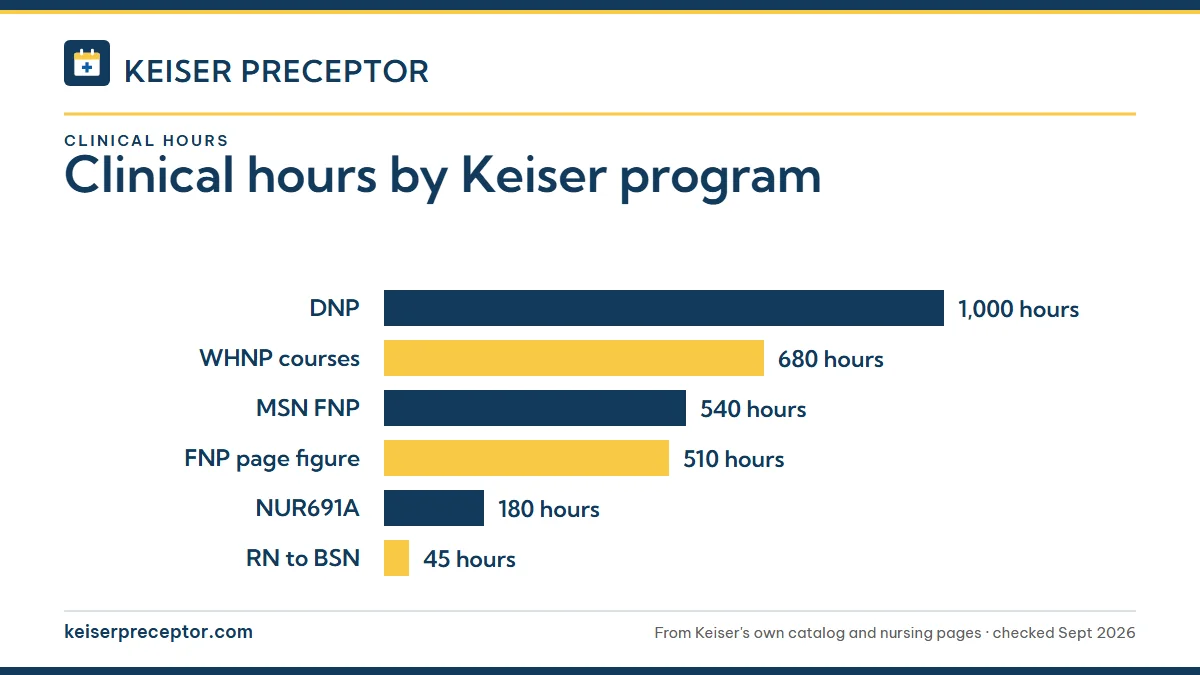
Keiser's 2026-27 Graduate Catalog sets the FNP at 540 precepted hours, the WHNP at 710 and the DNP at 1,000, yet Keiser's program pages and nursing manuals print other totals for the same programs. The planner shows each clinical course; the sections below name the document behind every figure and who settles it for your start term.
Get your placement plan
Tell us your Keiser program and where you live. A placement advisor replies with the preceptor and site options that fit your Keiser course.
Pick your Keiser program
Your clinical courses and hours, who can precept you, where, and when to start looking. From Keiser's own catalog and nursing pages.
- Who precepts
- A master's-prepared FNP preferred; a limited number of other NPs; MDs and DOs; a year of experience and an active license
- Where
- Primary care settings where you live and hold a license: clinics, health departments, urgent and retail care
- Start looking
- About three months before each 8-week practicum term
- Who precepts
- Women's health and OB-GYN clinicians approved by Keiser
- Where
- Keiser assists in South Florida; elsewhere you select the site
- Start looking
- Preceptor and site approval and clearance before you can register
- Who precepts
- A preceptor or employer mentor approved by Keiser, plus a faculty mentor
- Where
- An organizational setting, then a community setting, for your DNP project
- Start looking
- NUR801A can follow NUR700; the Flagship residency comes before ADP902
- Who precepts
- A preceptor you secure, in a setting the University Department Chair approves
- Where
- A community nursing setting you choose
- Start looking
- Before the 4-week term that carries NUR4636
Start with the catalog, then confirm
When Keiser's documents disagree about hours, the Graduate Catalog 2026-2027, effective August 31, 2026, is the one that governs. It outranks the program web pages, the 2023 Graduate Nursing Program Policy and Procedure Manual and the older Graduate Nursing Programs Clinical Manual, each of which still circulates with hour totals of its own. The number a classmate quotes you depends on which of those documents they happened to read.
The planner above uses catalog course hours for the FNP, WHNP and DNP, plus the single RN to BSN clinical course. Treat those as your planning baseline. Before each practicum, course faculty or the Clinical Coordinator can confirm the figure that applies to your start term, and it is worth keeping their answer in writing alongside your plan for clinical course completion.
FNP: 540, 510 or 630, depending on the document
Keiser's Family Nurse Practitioner program has three published totals, and the planner shows only the catalog's. This is where each comes from.
| Keiser source | Total | What makes it different |
|---|---|---|
| Graduate Catalog 2026-2027, degree requirements | 540 | A minimum of 540 precepted, direct care hours; the course descriptions put NUR691A at 180, misprinted as "180 credit hours" |
| FNP program page and the 2023 Policy and Procedure Manual | 510 | The same first four practicums, with NUR691A at 150 hours instead of 180 |
| The same program page, answering hours by age group | 630 implied | 120 each for pediatrics, women, young and middle adults, and older adults, plus 150 integrated |
| Graduate Nursing Programs Clinical Manual (2017) | 630 in its text, 600 in its table | Hours by population, with up to 60 in a specialty area if the MSN FNP Department Chair approves |
Between the two current documents, the whole gap sits in one course, the final Integration Practicum. The 630 figure belongs to an older population-based layout that no longer matches the catalog's five-course sequence. Plan to 540 and a later confirmation of 510 leaves you with hours to spare; plan to 510 and a confirmation of 540 leaves you 30 short in your final term.
Build your FNP plan on the catalog's 540 unless course faculty or the Clinical Coordinator confirm a different total for your start term.
WHNP: a 710-hour requirement over 680 hours of courses
The Women's Health NP conflict sits inside the catalog itself. Its degree requirements tell students to "Complete the 710 minimum required number of precepted clinical hours", while the four WHNP clinical courses listed in the same catalog total 680, and the 2023 Policy and Procedure Manual also gives 680.
Nothing public explains the remaining 30 hours. WHNP students already need preceptor and site approval, and clearance from the Clinical Coordinator, before they can register for each clinical pair, so that clearance request is the natural moment to ask which total your cohort is held to. With 260 hours in the last clinical alone, a 30-hour surprise late in the program is worth avoiding. The WHNP clinical courses guide covers each course's setting and hours.
DNP: one requirement, two ways of reaching 1,000
Every Keiser source agrees the post-master's DNP needs at least 1,000 clinical practice hours. They part ways on where those hours come from.
- Graduate Catalog 2026-2027: requires a minimum of 1,000, but the practice courses it lists add up to 510:
NUR801AandNUR802Aat 120 each, andADP902taken three times at 90. - DNP Student Handbook (2022) and the 2023 Policy and Procedure Manual: reach 1,000 as 60 project hours, 480 across four clinical practice courses (
NUR801AthroughNUR804A, 120 each) and 460 across four core courses at 115 each. - DNP program page: shows Clinical Practice I to IV and DNP Project I to IV in place of three rounds of
ADP902.
How the current catalog credits the hours beyond its listed 510 is not public. The Nursing Chair approves your project topic and mentor, which makes that approval the right time to ask how your 1,000 will be counted. The DNP clinical practice courses guide explains the mentor and setting behind each course.
RN to BSN, the MSN and the campus programs
Outside the NP and doctoral tracks the picture is simpler. The RN to BSN has one precepted clinical course, NUR4636 Community Nursing I, at 45 hours in a setting you choose and the University Department Chair approves. The Undergraduate Catalog also describes a 45-hour NUR4817 Nursing Roles Practicum that is missing from the current RN to BSN outline, and a placeholder course, NUR9999 Community Nursing II, whose hours are not published.
The MSN (Nursing) generalist program has no practicum course at all. For the Accelerated, FastTrack and Traditional BSN and the ASN, clinicals run through the program, with the ASN's Nursing Roles Practicum chosen together with faculty and an RN preceptor, and the catalog does not print hour totals course by course, so your campus clinical faculty are the source for those numbers.
What a total leaves out
A total tells you how many hours to reach, not which hours qualify. Keiser counts direct care of real patients under an approved preceptor, limits telehealth to a quarter of direct patient care hours and wants encounters documented within a week; what counts as a clinical hour takes each rule in turn. Every hour then has to appear in your Typhon case log.
Totals also hide the weekly load. A 120-hour practicum inside one 8-week term means roughly 15 to 16 hours a week at the site before any online coursework. Some states add a floor of their own: Kansas checks for at least 750 role clinical hours for students admitted after March 1, 2025, above every FNP figure Keiser prints. The Kansas guide explains that rule.
Why Keiser students plan their hours with us
We plan every practicum against the catalog figure, so the preceptor we find has enough clinic days to deliver a full course of hours inside the 8-week term. For the FNP we match the population each course is built around, adults and older adults first, then children, then women's health, then the integration term, so your age-group totals fill the way faculty expect.
The packet the Clinical Coordinator reviews is ready about three months before the term: the preceptor's CV or resume, license and certification details, the site contact for the affiliation agreement, and your clinical days and dates. Keiser's faculty and Program Director approve every arrangement, and what we send them is complete on the first pass. Tell us your program and start term and the planning starts there.
Questions Keiser students ask
Do the hours I work as an RN count toward Keiser's FNP clinical hours?
No. Keiser's clinical hours are unpaid student hours, and its clinical manual says students may not be paid for work they perform as nursing students. A rotation at your employer is possible only in a different department, under someone other than your immediate supervisor, and outside your normal working hours. The workplace rules guide has the details.
Does Keiser's MSN (Nursing) program require clinical hours?
The generalist MSN has no practicum or precepted clinical course. Its catalog entry lists supplemental course hours instead, which may include agency visits, conferences, volunteer work and preceptor training, along with one required residency over an intensive weekend. The capstone is set in your own practice setting, so this program involves no preceptor search.
How many clinical hours is Keiser's nurse anesthesia (DNAP) program?
The 2026-27 Graduate Catalog gives the Doctor of Nurse Anesthesia Practice (Entry-into-Practice) 15 credits of clinical practicum across five courses but publishes no hour total. Clinicals run through the program's affiliates in Tampa Bay, Orlando, Miami, Fort Lauderdale, Naples and Jacksonville, and the program states it cannot promise a specific site. The Naples campus program answers hour questions.
What should I show my preceptor about the hours a Keiser course needs?
Keiser gives each preceptor a Preceptor/Mentor Agreement along with the course objectives and evaluation criteria. For the hour count itself, point to your practicum's course description in the 2026-27 Graduate Catalog, and if your syllabus shows a different number, ask course faculty which one your preceptor should plan around before the first clinical day.
Related pages
Last checked 2026-09-25
We check these pages against Keiser's catalogs, graduate nursing manuals, licensure disclosures and program pages. Your course, the Clinical Coordinator and the 2026-27 Graduate Catalog have the final word.
Keiser asks you to find your own preceptor. Let us run that search.
Tell us your Keiser program, your next practicum and where you live. We find preceptors who fit the course and prepare the CV, license and site details your Preceptor/Mentor Information Form needs, about three months ahead.
- Preceptors matched to the course: adult and older-adult primary care for
NUR602AandNUR603A, pediatrics forNUR604A, women's health forNUR605A - CV, license, certification and site contact ready for Keiser's review and the affiliation agreement
- Across Florida, from Miami to Jacksonville, and in the other states where you are licensed
Start your placement plan
Your program, city and next practicum term is all we need to begin.