Keiser's MSN FNP: the program and its five practicums
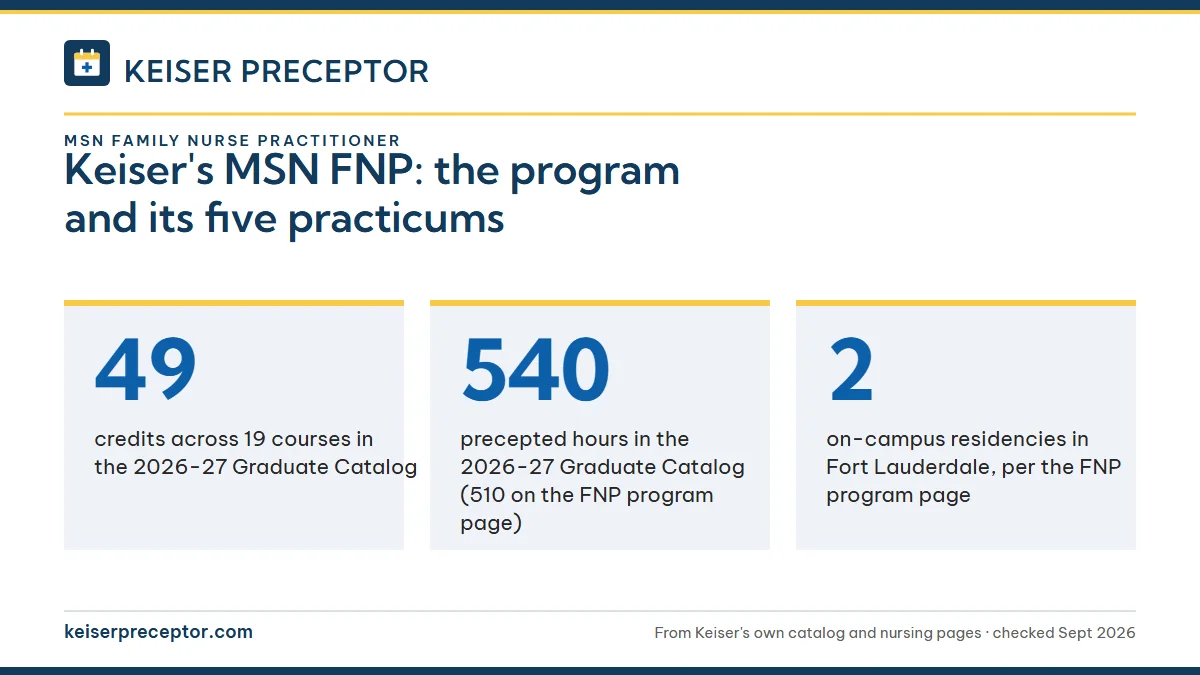
Keiser's MSN Family Nurse Practitioner is a 49-credit online program in 8-week terms, with five precepted practicums and two on-campus residencies in Fort Lauderdale. The 2026-27 Graduate Catalog sets 540 clinical hours, while the program page still says 510. Every preceptor and site is yours to find, and Keiser approves each one before your hours begin.
Get your placement plan
Tell us your Keiser program and where you live. A placement advisor replies with the preceptor and site options that fit your Keiser course.
The FNP program at a glance
Keiser's catalog and its FNP program page agree on the program's shape, 49 credits over 19 courses, and differ on most of the numbers attached to it. Where they split, the table gives both, and the 2026-27 Graduate Catalog is the document that governs your degree requirements.
The Graduate School runs the FNP online, and each Florida campus entry in the catalog marks it online only. The in-person parts are the two residencies and the practicums themselves, which happen face to face at sites you line up near home.
| Item | Graduate Catalog 2026-27 | FNP program page |
|---|---|---|
| Credits and courses | 49 credits, 19 courses | 49 credits and 19 courses in the header; the course list shows 20 lines |
| Length | About 28 months | Typically 21 to 24 months |
| Term length | 8-week courses | 8-week terms; part time means one course per 8 weeks |
| Precepted clinical hours | 540 minimum | 510 minimum |
| On-campus time | Two residencies, each an intensive weekend | Two residencies in Fort Lauderdale |
| Time limit | Degree completed within five years | Five years recommended |
How the course sequence leads to your first practicum
The first half of the FNP is all coursework. NUR501 opens the program, and the core covers theory, health policy, behavioral health and research alongside the three advanced courses Keiser treats as the gate to clinicals: NUR650 pathophysiology, NUR661 pharmacology and NUR671 health assessment, where the first residency sits.
The catalog lists NUR501, NUR502, NUR640, NUR650, NUR661 and NUR671 as prerequisites for NUR602A. Since NUR650 requires NUR501, NUR661 requires NUR650 and NUR671 requires NUR661, our reading of that chain puts the first practicum around term five of the 8-week calendar, even taking two courses per term. Keiser publishes no start month, so treat that as a planning estimate, and see the first clinical course guide for the full timing.
After that, each practicum runs in the same term as its didactic partner course. A theory and clinical pair has to be finished, with final grades posted, before you enroll in the next pair, and NUR698, the certification review, sits at the end of the outline.
Five practicums, in the order Keiser runs them
The practicums move from adult primary care to children, then women, then an integrated final course. Each lists the earlier pairs as prerequisites, so they run one after another, one per 8-week term; the program page counts 40 weeks of clinical time if you take them back to back. Settings, pairing and preceptor fit for each course are in the FNP practicum course guide.
| Practicum | Focus | Catalog hours | Program page hours |
|---|---|---|---|
NUR602A | Primary care of the family I: adults and older adults | 120 | 120 |
NUR603A | Primary care of the family II | 120 | 120 |
NUR604A | Children and adolescents | 60 | 60 |
NUR605A | Women | 60 | 60 |
NUR691A | FNP Integration Practicum, final term | 180 | 150 |
The two 60-hour courses carry half the hours of the adult pair but every approval step, and each needs a preceptor whose panel fits the population. A pediatric or women's health search deserves the same three-month lead as the adult ones.
Clinical hours: three Keiser totals
Keiser's official documents give three different FNP totals. The 2026-27 Graduate Catalog sets the floor at 540 precepted hours of direct care, built from the course lines above. The program page and Keiser's 2023 graduate policy manual say 510, because they give NUR691A 150 hours rather than 180. Keiser's older Graduate Nursing Programs Clinical Manual says 630.
Of the three, the catalog is binding, and your course faculty or the Clinical Coordinator can confirm what your own syllabus requires. For planning, work from 540 and raise the NUR691A question early, since that final course is where the 30-hour gap sits. The clinical hours guide has the planner and the rules on what counts.
Two habits keep a term on track. The program page budgets roughly 15-16 hours of clinical time weekly for a 120-hour course and recommends spreading them across all 8 weeks instead of stacking them late. Telehealth counts only up to a 25% share of direct care, and every hour and case goes into Typhon.
Preceptors: your search, Keiser's approval
The FNP is the Keiser program where the whole search belongs to the student. When the program page answers who assigns preceptors, its answer is that students identify their own, and it cautions that how long that takes depends on your location. The 2023 policy manual says the same about every FNP clinical site.
Keiser's role starts once you have a name. The site signs an affiliation agreement with the university, and the college approves the preceptor before clinical experiences start. A master's-prepared FNP is the preferred preceptor; a limited number of adult, pediatric, psychiatric or women's health NPs may also serve, and MDs and DOs are acceptable. The preceptor requirements guide covers license and experience rules.
Keiser's guidance is to begin planning a clinical course roughly three months out from its start date. With five practicums in a row, the next search is usually underway while the current practicum is still running.
Keiser requires the affiliation agreement and preceptor approval before any clinical hours begin, so a preceptor who says yes is the start of the paperwork, not the end of it.
Two residencies in Fort Lauderdale
Both FNP residencies are in person in Fort Lauderdale. The first comes with the advanced health assessment course and runs three days, Friday through Sunday. The second falls inside the final Integration Practicum and runs Saturday and Sunday. The catalog calls each one an intensive weekend of teaching on campus.
There is a one-time residency fee, and travel and lodging are yours to arrange and pay for. Because the second residency lands in the same term as NUR691A, block that weekend out when you and your final preceptor set the clinical calendar. The first residency comes before any practicum, so it shapes your coursework term rather than a preceptor's schedule. The residency guide explains what happens on campus and how to plan practicum hours around both visits.
Admission and progression rules that touch clinicals
A handful of catalog rules decide whether and when you can start practicums, and a few more decide whether you stay in the program once they begin.
- An active unrestricted Florida RN license and, if your clinicals will be in another state, that state's license as well.
- For applicants outside Florida, written verification that the home state allows clinical rotations there and NP licensure after graduation.
- A year of recent clinical practice and a clear Level 2 background check at application, with a drug screen or further checks if a site calls for them.
- An A or B in
NUR650,NUR661,NUR671, every practicum and its didactic partner, andNUR698. - Under the policy manual, two grades below B in those courses means academic dismissal; the degree allows no more than one C and needs a 3.0 CGPA.
- Registration for the national board exam before your last course, and the degree finished within five years.
Keiser's two published state lists disagree about where out-of-state FNP students can train, and the out-of-state FNP guide sets them side by side.
Why Keiser FNP students choose us
We are built around the FNP's rhythm: five practicums, a new preceptor for each, every one approved before its term. Your placement advisor starts about three months ahead and matches the preceptor to the course population, adult primary care for NUR602A and NUR603A, a pediatric practice for NUR604A, a women's health setting for NUR605A, close to where you live.
Your advisor gathers the pieces Keiser's Preceptor/Mentor Information Form calls for, from the preceptor's CV and license details to the agreement contact at the site and a plan of your clinical dates, so the Clinical Coordinator reviews one tidy package. Approval stays with Keiser's faculty and Program Director, and our job is sending them a file with nothing missing. If a preceptor drops partway through the program, we find the replacement. Read how it works, or use the form below to share your details.
Questions Keiser students ask
How long does Keiser's online FNP program take?
Keiser gives two answers. The 2026-27 Graduate Catalog says about 28 months, and the program page says 21 to 24 months. Part-time study at one course per 8 weeks takes longer, and the degree has to be finished within five years. The practicum sequence alone spans 40 weeks without a gap, so any term lost to a late preceptor extends your finish date.
Can I do my Keiser FNP practicum where I work?
Yes, within limits. Keiser wants the rotation in another department than the one you normally work in, precepted by someone other than your direct supervisor, and scheduled outside your usual shifts; your own unit is off the table. If your employer hosts the rotation, ask about the liability-insurance waiver that Keiser's older clinical manual allows for employer sites.
Can a PA be my preceptor in Keiser's FNP?
Physician assistants are not on Keiser's FNP preceptor list, which names nurse practitioners, MDs and DOs. A master's-prepared FNP is the preferred choice, and a limited number of other NPs are allowed. If a PA-led practice is your strongest local option, raise it with the Clinical Coordinator before you commit, because approval rests with Keiser.
Are Keiser FNP clinical hours paid?
No. The program page says clinical hours carry no compensation, and Keiser's older clinical manual adds that nursing students cannot receive pay for the work they do as students. Preceptors take part as volunteers under the site's affiliation agreement. If you hold a job, build your work schedule around unpaid clinical weeks of about fifteen or sixteen hours during the 120-hour practicums.
What is NUR698 in the Keiser FNP?
The catalog lists NUR698 as the Family Nurse Practitioner Certification Review, while the program page calls it FNP Capstone (FNP Certification). It needs an A or B like the clinical courses, and the catalog asks you to register for the national board exam before your last course, so exam planning and the review run together at the end.
Related pages
Last checked 2026-09-25
We check these pages against Keiser's catalogs, graduate nursing manuals, licensure disclosures and program pages. Your course, the Clinical Coordinator and the 2026-27 Graduate Catalog have the final word.
Keiser asks you to find your own preceptor. Let us run that search.
Tell us your Keiser program, your next practicum and where you live. We find preceptors who fit the course and prepare the CV, license and site details your Preceptor/Mentor Information Form needs, about three months ahead.
- Preceptors matched to the course: adult and older-adult primary care for
NUR602AandNUR603A, pediatrics forNUR604A, women's health forNUR605A - CV, license, certification and site contact ready for Keiser's review and the affiliation agreement
- Across Florida, from Miami to Jacksonville, and in the other states where you are licensed
Start your placement plan
Your program, city and next practicum term is all we need to begin.