The five Keiser FNP practicums, in the order you take them
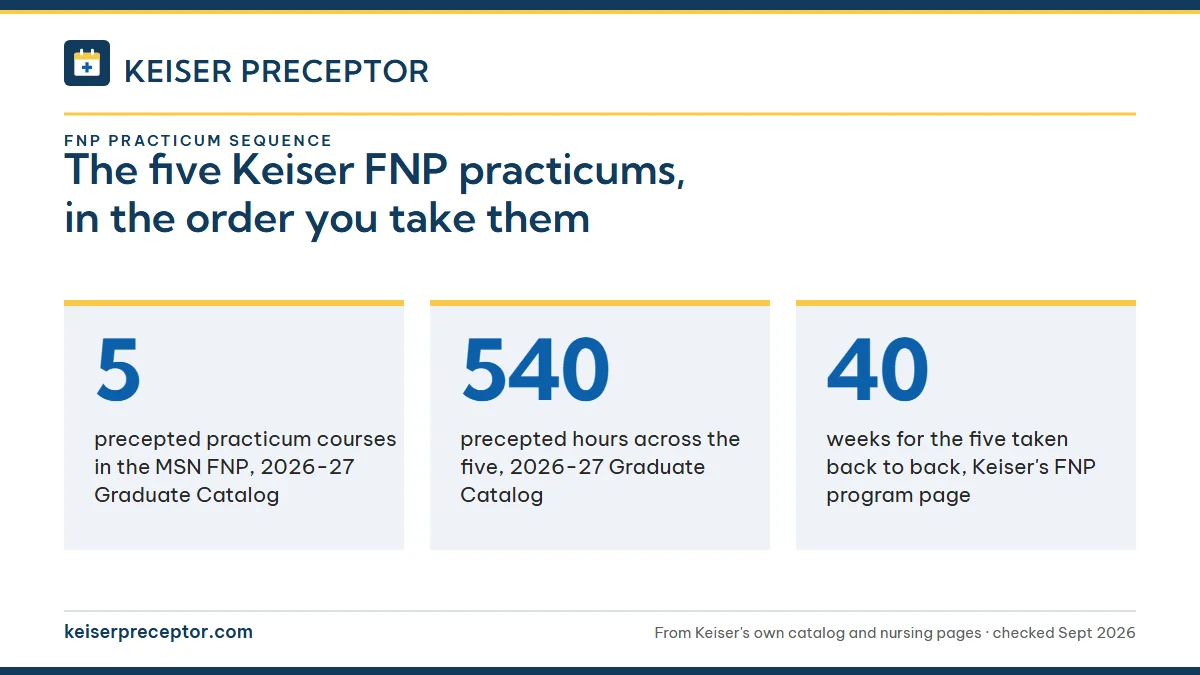
Keiser's MSN FNP saves its precepted clinical work for five practicums, each one an 8-week term taken beside a didactic course: NUR602A, NUR603A, NUR604A, NUR605A and, last, NUR691A. The 2026-27 Graduate Catalog gives them 540 hours between them, and every one needs an approved preceptor arrangement before its first hour counts.
Get your placement plan
Tell us your Keiser program and where you live. A placement advisor replies with the preceptor and site options that fit your Keiser course.
The five practicums side by side
Each row below is one 8-week term of clinical work. The practicum carries the hours; its didactic partner, taken in the same term as a co-requisite, carries the theory for that population. Credits and catalog hours come from the 2026-27 Graduate Catalog, and the last column shows the figures printed on Keiser's FNP program page.
| Order | Practicum | Taken with | Patients | Credits | Catalog hours | FNP page hours |
|---|---|---|---|---|---|---|
| 1 | NUR602A Primary Health Care of the Family I Practicum | NUR602 | Adults and older adults | 2 | 120 | 120 |
| 2 | NUR603A Primary Health Care of the Family II Practicum | NUR603 | Adults, second term | 2 | 120 | 120 |
| 3 | NUR604A Primary Health Care of the Family III Practicum | NUR604 | Children and adolescents | 1 | 60 | 60 |
| 4 | NUR605A Primary Health Care of the Family IV Practicum | NUR605 | Women | 1 | 60 | 60 |
| 5 | NUR691A Family Nurse Practitioner Integration Practicum | NUR691 | The whole family, integrated | 3 | 180 | 150 |
| Total | Five practicums | 9 | 540 | 510 |
Only the last row disagrees. The catalog prints NUR691A as "180 credit hours", plainly meaning clock hours for a 3-credit course, while the program page and the 2023 policy manual give it 150. Keiser's older clinical manual works from 630 hours in all. The clinical hours guide lays every total beside its source; for your own plan the 2026-27 catalog governs, and course faculty confirm.
Why the order is fixed
The catalog lists each practicum with the earlier pairs as prerequisites, so the five run in one direction only: adult, adult, pediatric, women's health, integration. Keiser's FNP page adds that the theory course and the clinical course must both be finished, with final grades submitted, before you enroll in the next pair.
Grades tighten the chain. Keiser requires an A or B in every practicum and every paired didactic course, from NUR602 through NUR691A, and the 2023 policy manual dismisses a student who collects two grades below B across those courses. The older clinical manual adds that failing the clinical hours means taking the whole course again, hours included.
The chain also has a front gate. NUR602A cannot open until the core and specialty courses, including NUR650, NUR661 and NUR671, are behind you; the first clinical course guide walks through that stretch of the program.
How the demands rise from term to term
The five practicums are not five copies of one course. Four things shift as you move down the table.
- The caseload. Two terms of adult primary care give way to children and adolescents, then women's health, then a final term that pulls every age group together. Typhon records your hours by age group and diagnosis, so each term fills a different part of that record.
- The weekly load. Keiser's program page puts a 120-hour practicum at roughly 15 to 16 hours a week and a 60-hour one at about 8. The catalog's 180 hours for
NUR691Aworks out to 22 or 23 a week over eight weeks. - The bar on evaluations. Keiser's older clinical manual sets the minimum rating on the FNP Clinical Evaluation Form at 3 for clinical terms one to three, 4 for term four and 5 for term five, so your last preceptor grades against the highest standard.
- The calendar. The second Fort Lauderdale residency sits inside the final practicum, the same term that carries the most hours.
Each course has its own guide to the preceptors and settings that suit it: the two adult practicums, pediatrics, women's health and the closing Integration Practicum.
One preceptor, or a different one each term
Keiser treats each practicum as its own approved arrangement. Clinical faculty sign off on the preceptor arrangement before hours begin, and a plan for clinical course completion, with start and end dates and your clinical days, goes to course faculty ahead of every practicum. The older manual also warns that no preceptor can be assumed to carry on past the end of a term.
That leaves two workable patterns. A family practice whose FNP sees adults, children and women can be proposed for several terms in a row, with a fresh plan and a fresh approval each time. The other pattern follows the caseload: an adult practice for NUR602A and NUR603A, a practice full of children for NUR604A, a women's health or OB-GYN office for NUR605A, then a broad family practice for NUR691A.
Keiser also caps non-FNP nurse practitioners at "a limited number" without printing the figure, so ask course faculty how many terms can go to one before you commit. Whichever pattern fits, sketch the whole sequence before the first term so that no search starts late.
Laying the five over the graduate calendar
Keiser's FNP page describes five 8-week clinical practicum sessions and notes that, "taken sequentially, it would take 40 weeks." Graduate terms open on a Monday, six times a year; in 2027 the 8-week terms start on January 11, March 8, May 10, July 5, August 30 and October 25.
Say your first pair starts January 11, 2027 and every grade posts on time. The adult terms then run from January into May, pediatrics from May 10, women's health from July 5 and the Integration Practicum from August 30. Keiser advises beginning each clinical search about three months ahead of the course, so the pediatric search begins while you are still in NUR602A, the women's health search opens during NUR603A, and the final one starts partway through NUR604A.
In that example the first search opens around mid-October 2026, and from then on one search is nearly always running for a term that has not yet started.
Plan the next two practicums, not just the next one: by the time a term ends, the search for the one after it should already be well under way.
Why Keiser FNP students give us the whole sequence
We plan all five practicums at once. Your placement advisor maps each term to the caseload it needs, then searches in person where you live for preceptors and sites that fit Keiser's rules: a family NP first, other NPs and physicians where Keiser allows them, and a practice ready to sign an affiliation agreement.
For each practicum we assemble the packet behind Keiser's Preceptor/Mentor Information Form: a current CV or resume, the preceptor's license and any certification, the person who signs the agreement for the site, and the days and dates you will be there. The target is to have it ready about three months before the course opens, and if a preceptor pulls out mid-sequence, we stay on call and search for a replacement.
Keiser's faculty and Program Director make the final call on every arrangement. Our job is a file so complete that it clears the first time. See how it works, or tell us your first practicum term in the form below.
Questions Keiser students ask
Can I take two Keiser FNP practicums in the same term?
Keiser's published rules point the other way. Each practicum lists the earlier pairs as catalog prerequisites, and the FNP page requires final grades in both the theory and clinical course before the next pair begins. The five therefore run one term after another, 40 weeks at the fastest, and course faculty or your advisor confirm any exception.
How many credits are Keiser's FNP practicums?
Nine credits across the five in the 2026-27 Graduate Catalog: 2 each for NUR602A and NUR603A, 1 each for NUR604A and NUR605A, and 3 for NUR691A. At the catalog's hours that is about 60 clinical hours per credit, above the university's minimum of 45 hours per practicum credit.
Do all five FNP practicums have to be in person?
The hours are direct patient care at an approved clinical site under a qualified preceptor. Keiser's 2023 policy manual lets telehealth make up no more than 25% of overall direct patient care hours, so the practicums are site-based even though the didactic courses run online. The two residencies are the only required time in Fort Lauderdale.
What happens to my sequence if I fail one practicum?
Keiser's older clinical manual says a failed clinical means retaking the entire course, clinical hours included, and the next pair waits until final grades post. The 2023 policy manual dismisses a student with two grades below B in the FNP clinical and specialty courses, so a single repeat leaves no room for a second.
Does Keiser assign preceptors for any of the FNP practicums?
For the FNP, Keiser's program page says students identify their own sites and preceptors, and the 2023 policy manual says FNP students acquire all of their clinical sites. Keiser approves, contracts and supervises each arrangement. The search belongs to the student, and it is exactly the part our placement desk handles, term by term.
Related pages
Last checked 2026-09-25
We check these pages against Keiser's catalogs, graduate nursing manuals, licensure disclosures and program pages. Your course, the Clinical Coordinator and the 2026-27 Graduate Catalog have the final word.
Keiser asks you to find your own preceptor. Let us run that search.
Tell us your Keiser program, your next practicum and where you live. We find preceptors who fit the course and prepare the CV, license and site details your Preceptor/Mentor Information Form needs, about three months ahead.
- Preceptors matched to the course: adult and older-adult primary care for
NUR602AandNUR603A, pediatrics forNUR604A, women's health forNUR605A - CV, license, certification and site contact ready for Keiser's review and the affiliation agreement
- Across Florida, from Miami to Jacksonville, and in the other states where you are licensed
Start your placement plan
Your program, city and next practicum term is all we need to begin.