Keiser's RN to BSN, one 4-week course at a time
Keiser's RN to BSN completes a bachelor's degree for nurses who already hold an RN license, online or in a hybrid format depending on campus, one 4-week course at a time. Its one published clinical course, NUR4636 Community Nursing I, calls for 45 hours with a preceptor that you secure, in a setting the University Department Chair approves. That course is where our placement desk does its work.
Get your placement plan
Tell us your Keiser program and where you live. A placement advisor replies with the preceptor and site options that fit your Keiser course.
How the 120 credits add up
Most of this degree arrives with you. The 2026-27 Undergraduate Catalog builds the 120 credits from four blocks, and your RN license alone accounts for 42 of them as advanced placement.
| Block | Credits |
|---|---|
| Previous general education | 33 (the program page says 36) |
| Advanced placement for your RN license | 42 |
| General education electives | 9 |
| Upper-division nursing | 36 |
| Total | 120 |
On length, Keiser prints two ideas side by side. The catalog gives about 40 months as the program's formal length and then says most students finish in 12 months; the program page shows "40 Months" in its header beside "as few as 12 months" in its text. How much general education you transfer and how continuously you enroll decide which end you are closer to.
Format, terms and admission
You take one course at a time in 4-week terms. Keiser's undergraduate calendar splits each 16-week semester into four 4-week terms, A through D, and the fall 2026 terms begin on August 31 and September 28, then October 26 and November 23.
The program runs fully online through the Fort Lauderdale eCampus and in a hybrid format at campuses from Clearwater and Daytona to Tampa, Tallahassee and West Palm Beach; the catalog lists 19 locations, the eCampus included. Admission asks for an associate degree or diploma in nursing, or an RN license in your state of residence, together with a current U.S. RN license. One rule separates the formats: hybrid students on campus must hold a Florida RN license.
To keep moving, every course needs a C or higher. With one course per term, a course that has to be repeated, or a clinical that cannot start on time, pushes the courses behind it back.
The clinical course: NUR4636 Community Nursing I
NUR4636 is the only course in the current outline with published clinical hours: 45 of them, supervised by a preceptor, in a community setting of your choosing that the University Department Chair must approve. Finding that preceptor is the student's task, as both the catalog and the program page make clear. The NUR4636 guide covers the course in depth.
Its size differs between documents. The outline lists NUR4636 at 4 credits and its course description at 3, while the 45 hours stay the same in both. Your advisor confirms which credit figure appears on your plan.
The detailed rules, including who can serve as your preceptor, sit in Keiser's RN to BSN Clinical Course Manual. That manual is not posted publicly, so ask for it early and read it before you approach anyone.
Secure the preceptor and the Department Chair's approval of your setting before the term begins. A 4-week course leaves no slack for a search that starts on day one.
Three loose ends in the published outline
A few items in Keiser's RN to BSN documents do not line up. Knowing them now saves a confused email later.
NUR9999Community Nursing II sits in the outline at 4 credits, but 9999 is a placeholder number with no course description, and no clinical hours are published for it. Ask your advisor whether it involves clinical time in your catalog year.- The catalog describes
NUR4817Nursing Roles Practicum, 45 hours with a preceptor in a setting you choose, yet the course is absent from the current RN to BSN outline. - Previous general education counts as 33 credits in the catalog and 36 on the program page.
The practical step is the same for all three: get your own course plan from your advisor, mark every course that carries clinical hours, and plan each preceptor search from that list.
Setting up the community clinical
Where NUR4636 falls in your plan is not published, so ask your advisor for the term, then work backward from it.
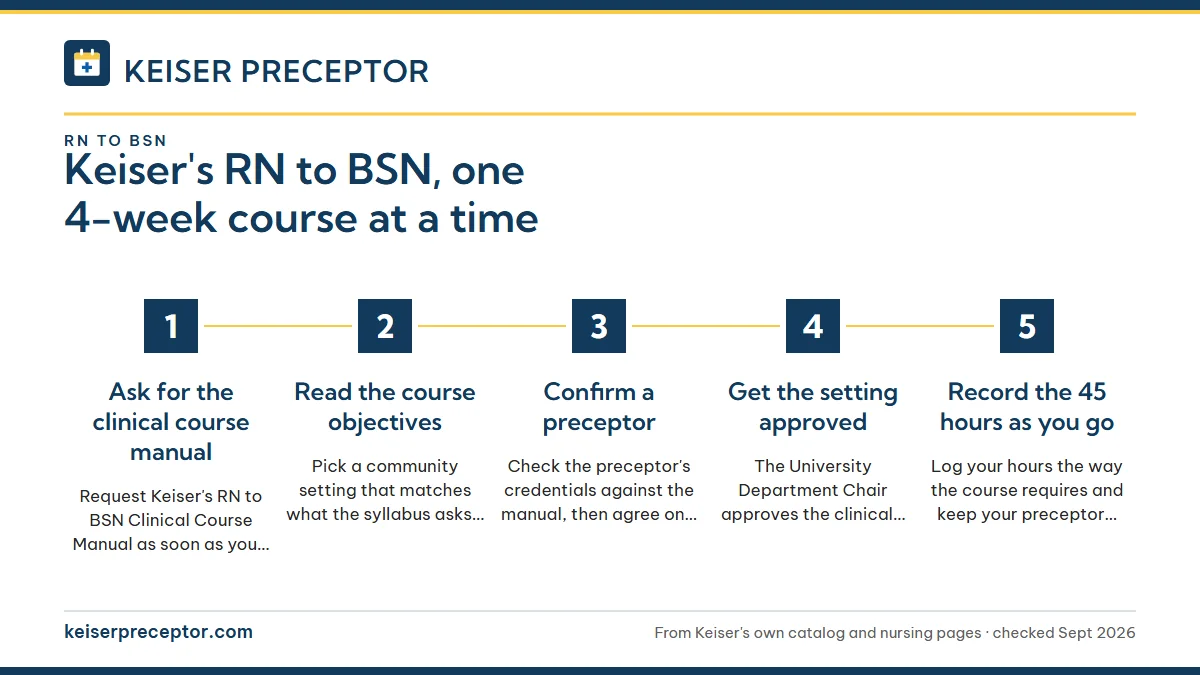
- Ask for the clinical course manualRequest Keiser's RN to BSN Clinical Course Manual as soon as you are admitted. It holds the preceptor rules that apply to NUR4636.
- Read the course objectivesPick a community setting that matches what the syllabus asks you to practice, not only the one closest to home.
- Confirm a preceptorCheck the preceptor's credentials against the manual, then agree on dates that fit inside the course's term.
- Get the setting approvedThe University Department Chair approves the clinical setting. Send the details your course requests early enough that approval is in hand before the term opens.
- Record the 45 hours as you goLog your hours the way the course requires and keep your preceptor informed of your schedule from the first week.
After the BSN: Keiser's graduate programs
A BSN opens the Graduate School's master's programs, which look for a cumulative GPA of 3.0 and an active unrestricted Florida RN license. The MSN in Nursing has no practicum course. The MSN FNP has five 8-week practicums and also asks for a year or more of recent hands-on patient care before admission.
The FNP's clinical model will feel familiar after NUR4636: students find their own clinical sites and preceptors, and Keiser approves each one under a signed affiliation agreement before hours begin. The difference is scale. Instead of one 45-hour placement, FNP students line up more than 500 precepted hours across five courses, so the habits you build finding a community preceptor now pay off later.
Why RN to BSN students choose our placement desk
You are working as a nurse while you study, and a short term leaves little room for cold calls to clinics. We take on the search: finding a community preceptor and setting near where you live that fit NUR4636, confirming the preceptor's interest and schedule, and assembling the details your course and the Department Chair review, so your request goes in complete.
If a preceptor has to step back, your placement advisor starts on a replacement straight away. When the BSN is behind you and an FNP or DNP is next, the same desk handles those larger searches, built around Keiser's own process. Read how it works for the full picture, then send us your term through the form below.
Questions Keiser students ask
Do Keiser RN to BSN students have to find their own preceptor?
Yes, for NUR4636 Community Nursing I. Keiser's catalog and program page place the job of securing preceptors with the student, and the clinical setting is one you choose and the University Department Chair approves. Keiser keeps the detailed preceptor rules in its RN to BSN Clinical Course Manual; it is not on the public website, so ask your advisor for a copy.
How many clinical hours does Keiser's RN to BSN require?
The published figure is 45 clinical hours in NUR4636. The outline also lists NUR9999 Community Nursing II at 4 credits, a placeholder with no description, so any hours it carries are not public. The catalog also contains NUR4817 Nursing Roles Practicum at 45 hours, though that course is missing from the current outline. Confirm your own course list with your advisor.
Can I take Keiser's RN to BSN with an out-of-state RN license?
Online admission accepts an RN license from your state of residence along with a current U.S. RN license. The on-campus hybrid format is different: it requires a Florida RN license. If you plan to complete NUR4636 outside Florida, confirm with your advisor that the setting you have in mind can be approved before you commit to it.
What grade do I need in Keiser's RN to BSN courses?
The 2026-27 Undergraduate Catalog says every course must be completed with a C or higher to proceed. Because you take one 4-week course at a time, a course below C holds up the next step, and a clinical placement that is not ready on time can delay the courses that follow it.
Can I really finish Keiser's RN to BSN in 12 months?
Keiser says most students finish in about 12 months, and the program page says as few as 12. The catalog's formal length is about 40 months, and the program page header also shows 40 months. Your transfer credit and how continuously you enroll decide which figure is closer for you.
Related pages
Last checked 2026-09-25
We check these pages against Keiser's catalogs, graduate nursing manuals, licensure disclosures and program pages. Your course, the Clinical Coordinator and the 2026-27 Graduate Catalog have the final word.
Keiser asks you to find your own preceptor. Let us run that search.
Tell us your Keiser program, your next practicum and where you live. We find preceptors who fit the course and prepare the CV, license and site details your Preceptor/Mentor Information Form needs, about three months ahead.
- Preceptors matched to the course: adult and older-adult primary care for
NUR602AandNUR603A, pediatrics forNUR604A, women's health forNUR605A - CV, license, certification and site contact ready for Keiser's review and the affiliation agreement
- Across Florida, from Miami to Jacksonville, and in the other states where you are licensed
Start your placement plan
Your program, city and next practicum term is all we need to begin.