Finding your own preceptor as a Keiser FNP student
At Keiser, the FNP preceptor search is yours. The program expects you to bring both a preceptor and a clinical site, and Keiser's part starts once you have a name: approval, the affiliation agreement, supervision and grading. This guide covers what the rule says, what it leaves to you, and how to run the search well.
Hand us the search
Share your practicum, your start term and where you live. Your placement advisor takes it from there.
What Keiser's FNP page says
The answer sits in the questions-and-answers section of Keiser's FNP program page. Asked how students get assigned a clinical preceptor, Keiser answers: "Students identify their own clinical sites and preceptors. Getting a preceptor can take some time, depending on where you live." The same text ran on the older FNP FAQ page before that page was retired.
Keiser's 2023 Graduate Nursing Program Policy and Procedure Manual is blunter: students in the MSN-FNP "must acquire all clinical sites for the program in which they are enrolled." The older clinical manual describes a partnership instead, with the student working alongside clinical faculty or the Clinical Coordinator to secure an agreement with a qualified site. The sources differ in tone and agree on substance: you propose, Keiser vets.
What stays on Keiser's side
Owning the search does not mean going it alone once the search is done. As soon as you bring a name, a full layer of Keiser review and support takes over.
Keiser's part, once you have a preceptor
- Reviewing your Preceptor/Mentor Information Form through the Clinical Faculty and/or Clinical Coordinator
- Approval of the preceptor by the Program Director, based on the CV or resume and license
- Site approval, handled by the Clinical Coordinator with the Program Coordinator overseeing, per the 2023 manual
- A signed affiliation agreement between the agency and the university
- Orienting new preceptors and supplying course objectives and evaluation criteria
- Site visits, phone conferences, evaluations and your final grade
All of that structure sits downstream of the search, and none of it starts until a clinician has agreed to precept you at a site willing to sign. The placement process guide follows the chain from there.
What the search involves
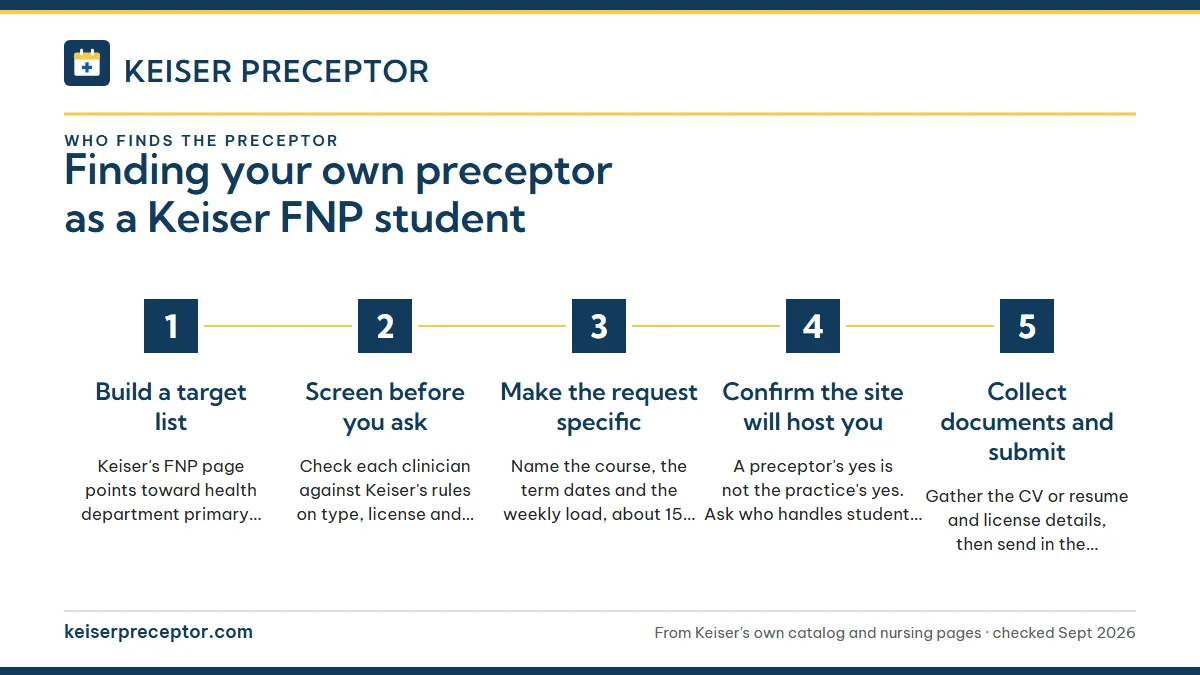
"Find a preceptor" sounds like one task. In practice it is several smaller ones, and any of them can stall. You need a clinician Keiser will accept, at a site that will sign, with patients of the right ages and enough open days to fit your hours inside one 8-week term.
- Build a target listKeiser's FNP page points toward health department primary care, physician offices, retail and urgent care clinics, and fast track clinics. Start close to home, since your preceptor has to practice at the site where you train.
- Screen before you askCheck each clinician against Keiser's rules on type, license and experience before making a request. The preceptor requirements guide sets out the full list.
- Make the request specificName the course, the term dates and the weekly load, about 15 to 16 hours for a 120-hour practicum. A clear, bounded request is easier to say yes to.
- Confirm the site will host youA preceptor's yes is not the practice's yes. Ask who handles student agreements and whether the site has hosted Keiser students before.
- Collect documents and submitGather the CV or resume and license details, then send in the Preceptor/Mentor Information Form.
How other Keiser programs differ
The own-search rule is an FNP rule. Keiser's other nursing programs handle clinical placement in different ways, so check which pattern applies to you before you start calling offices.
- WHNP: the 2026-27 catalog promises help obtaining a site for clinicals in South Florida, while students outside that region pick their own. See WHNP placement.
- DNP: the student brings a practice site and an employer supervisor or mentor, and the Nursing Chair approves the project topic and mentor.
- RN to BSN:
NUR4636requires 45 clinical hours in a community setting the student selects, subject to approval by the University Department Chair, with a preceptor the student lines up. - Pre-licensure BSN tracks (Accelerated, FastTrack, Traditional) and the ASN: clinicals run through the program, and the Accelerated BSN page mentions a placement services team that helps students secure sites.
Start with your workplace and your network
Many Keiser students look first at the clinic or hospital where they already work. Keiser permits it with conditions: you train outside your usual department, under someone other than your direct boss, during hours you are not on shift, and never on your own unit. The workplace clinical rules cover the insurance waiver and the rest.
Colleagues, former instructors and clinicians you have worked beside make up the next circle. A warm introduction tends to get a faster answer than a cold message to a front desk. Keep a simple record of whom you contacted and when; the same list will serve your next practicum.
Why where you live matters
Keiser itself warns that location affects how long the search runs. How many family practices are nearby, how many other students are asking the same offices, and whether local health systems route student requests through a central office all shape how long it runs.
Students outside Florida carry an extra layer. Keiser asks for two licenses, a Florida RN license and one for the state hosting your clinicals, and some states set their own conditions for out-of-state programs. The out-of-state guide walks through both of Keiser's state lists.
The search, handled by specialists
Finding your own preceptor is Keiser's rule; doing it alone is optional. Keiser FNP students choose us because this search is our specialty. We look for an in-person preceptor near where you live, test the fit against Keiser's rules and your exact practicum, settle clinic days that work in an 8-week term, and put together the credentials and site details your form needs.
You still submit to Keiser, and Keiser still decides. What changes is that your file arrives early and complete, with a preceptor who already fits the rules. If a preceptor drops later in the program, we are on call to find the next one.
Questions Keiser students ask
Will Keiser find an FNP preceptor for me if I cannot?
Keiser's public documents describe no backup placement for FNP students; Keiser's program page and its 2023 manual each put the search in the student's hands. Faculty and the Clinical Coordinator can advise, and they must approve what you find. If your own search stalls, start earlier, widen the radius, or hand the search to our placement desk.
When should I start looking for a preceptor?
Keiser's guidance is to start planning roughly three months out from each clinical course. Because graduate terms last 8 weeks, that point falls in the middle of an earlier term, not the one right before your practicum. Start sooner if you live where preceptors are scarce. The three-month lead time guide lays out the dates.
What does "student identified" preceptor mean in Keiser's manual?
The older Graduate Nursing Programs Clinical Manual says Keiser endorses preceptors or mentors that students identify, based on their qualifications and experience. In plain terms, you propose a clinician and Keiser vets that person through the form, the CV and license, and the Program Director's approval. Identifying a preceptor is not the same as having one approved.
Is a retail clinic or urgent care acceptable for Keiser FNP hours?
Both appear on the FNP page's list of suggested settings, alongside physician offices and health department primary care. Whether one works for a given practicum depends on its patients: an urgent care may see plenty of adults for NUR602A but too few children for NUR604A. Course faculty approve the fit before your hours begin.
Can I do clinicals in a state other than the one I live in?
Keiser's catalog pairs a Florida RN license with a license from whichever state hosts your clinicals, so the clinical state is a choice with licensing consequences. New York is a special case: Keiser's disclosure and its Graduate School FAQ both say FNP clinicals cannot happen there. Confirm any out-of-state plan with the Clinical Coordinator before you start asking preceptors.
Related pages
Last checked 2026-09-25
We check these pages against Keiser's catalogs, graduate nursing manuals, licensure disclosures and program pages. Your course, the Clinical Coordinator and the 2026-27 Graduate Catalog have the final word.
Keiser asks you to find your own preceptor. Let us run that search.
Tell us your Keiser program, your next practicum and where you live. We find preceptors who fit the course and prepare the CV, license and site details your Preceptor/Mentor Information Form needs, about three months ahead.
- Preceptors matched to the course: adult and older-adult primary care for
NUR602AandNUR603A, pediatrics forNUR604A, women's health forNUR605A - CV, license, certification and site contact ready for Keiser's review and the affiliation agreement
- Across Florida, from Miami to Jacksonville, and in the other states where you are licensed
Start your placement plan
Your program, city and next practicum term is all we need to begin.