Keiser WHNP clinical placement, in South Florida and beyond
Keiser's 2026-27 Graduate Catalog splits WHNP placement by geography: in South Florida, Keiser provides assistance in obtaining a clinical site; anywhere else, you select the site yourself. Either way, each WHNP clinical course requires an approved preceptor and site, plus the Clinical Coordinator's clearance, before you are allowed to register.
Get your placement plan
Tell us your Keiser program and where you live. A placement advisor replies with the preceptor and site options that fit your Keiser course.
The catalog's placement sentence, in full
The rule sits in the WHNP program's Clinical Experiences text in the 2026-27 Graduate Catalog: "Students will be responsible for selecting an appropriate site that can provide the types of activities, clients, and clinical supervision if clinicals will be completed outside of the South Florida region. Assistance will be provided in obtaining a clinical site if clinicals are completed in South Florida."
Two points follow from that wording. Where you complete clinicals, not where you enrolled or which campus you list, decides which half of the sentence applies to you. And the South Florida promise is assistance in obtaining a site, which describes help rather than a named placement. The same catalog passage mentions the opportunity for international clinical practice, which WHNP faculty can explain. For the program as a whole, see the Keiser WHNP program guide.
Three Keiser sources, three descriptions
Keiser describes WHNP placement differently in three places. The catalog is the governing document, and the Clinical Coordinator confirms how it applies to you.
| Source | What it says |
|---|---|
| 2026-27 Graduate Catalog (effective August 31, 2026) | You select an appropriate site outside South Florida; assistance in obtaining a site is provided in South Florida |
| WHNP program page (live) | Students work with the program team to secure appropriate placement at clinical sites |
| Graduate Nursing Program Policy and Procedure Manual (2023) | The women's health program will have enough sites available and will consider student input; program administrators make the final decision on each assigned site |
The 2023 manual reads as full assignment, the web page as a partnership, and the catalog as help that depends on location. Where they differ, go by the 2026-27 catalog and ask the Clinical Coordinator to confirm in writing which path you are on before you plan a single clinical day.
Inside South Florida: what assistance covers
The catalog defines neither the South Florida region nor what assistance involves. Students training in Miami-Dade, Broward or Palm Beach counties sit inside any ordinary reading of the phrase; if you live at the edge of that area, ask the Clinical Coordinator before you assume either path. Ask as well what the help looks like in practice, whether a list of sites, an introduction or an assigned placement.
Assistance still leaves room for your own choice. The 2023 manual says the program will consider input from students regarding sites, so a site you identify, with a willing preceptor and documents in order, is input the Clinical Coordinator can act on. A student with a preferred OB-GYN practice near home, or a schedule that only works on certain days, has good reason to bring an option instead of waiting for one. The South Florida preceptor guide covers the region's systems and settings.
Outside South Florida: selecting your own site
For clinicals anywhere else, from Orlando and Jacksonville to another state, the catalog puts the selection on you. The standard is a site that can offer the activities, clients and supervision the course requires, which for WHNP means primary care for adolescents and adults, perinatal care, and women's health across the lifespan.
Licensing shapes where you can train. Keiser's WHNP admission rules pair an active, unrestricted Florida RN license with a nursing license in whichever state hosts your clinicals, and applicants living outside Florida must show in writing that their home state permits the clinical rotations and later NP licensure. The WHNP licensure disclosure Keiser updated in November 2025 repeats the FNP "does not meet" states and adds Maryland. The out-of-state guide sets out both of Keiser's state lists.
Keiser's public documents carry no WHNP-only preceptor rules, so the older Clinical Manual's general standard for graduate preceptors is the working guide: a year or more in the role, the right to practice as an APRN or another current health care license with no encumbrance, specialty approval and certification where they apply, and ideally a graduate degree. The preceptor requirements page covers the FNP detail.
Clearance comes before registration
This is the WHNP rule FNP students never meet. Each WHNP clinical course note in the catalog reads: "Requires preceptor and clinical site approval prior to registration. A student must be 'cleared' by the Clinical Coordinator in advance to taking the didactic and clinical course for this rotation." The FNP course descriptions carry no such note.
The approvals an FNP student completes before the first clinical hour must be done before a WHNP student can even enroll in the course pair. Work backward from registration, not from the first clinical day, when you plan your three-month lead time.
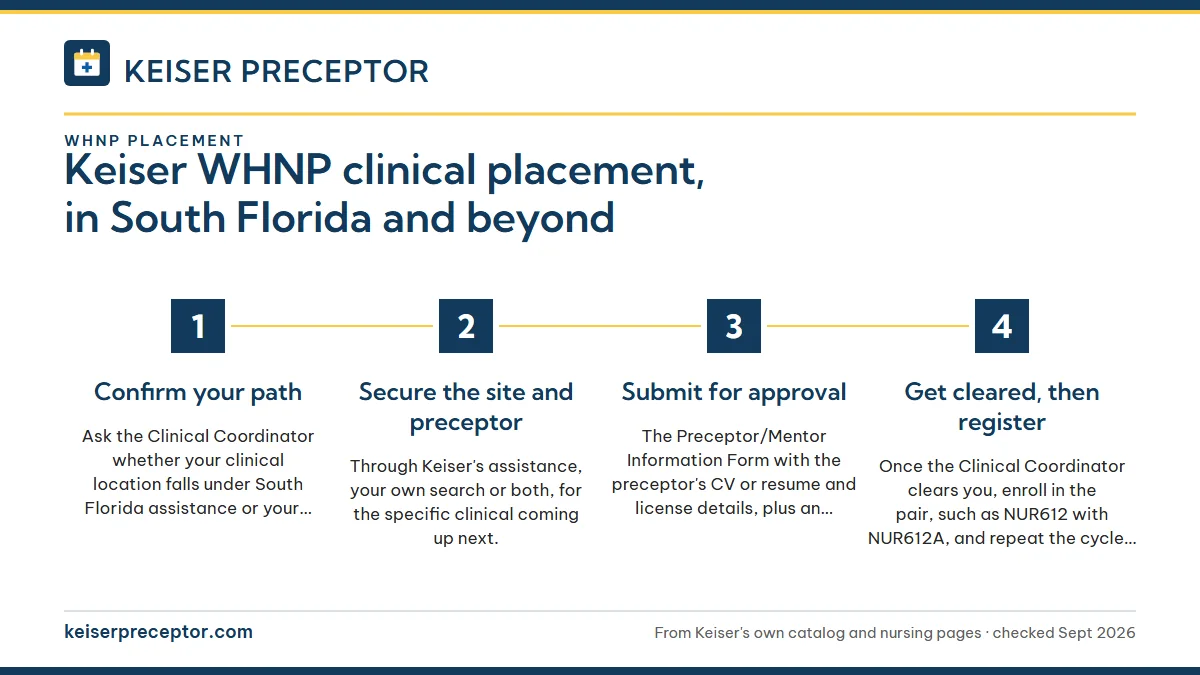
- Confirm your pathAsk the Clinical Coordinator whether your clinical location falls under South Florida assistance or your own selection.
- Secure the site and preceptorThrough Keiser's assistance, your own search or both, for the specific clinical coming up next.
- Submit for approvalThe Preceptor/Mentor Information Form with the preceptor's CV or resume and license details, plus an affiliation agreement if the site lacks one.
- Get cleared, then registerOnce the Clinical Coordinator clears you, enroll in the pair, such as
NUR612withNUR612A, and repeat the cycle for each clinical.
Registering first and finding a site later does not work for WHNP. Keiser requires the preceptor, the site and your clearance before registration for every clinical pair.
The four WHNP clinicals your sites must support
The catalog course descriptions list four clinicals, each paired with a didactic course. Their hours total 680, while the catalog's degree requirement says 710 precepted hours; the 2023 policy manual also gives 680. The catalog governs, and the Clinical Coordinator can confirm the figure for your cohort. The WHNP clinical courses page covers each course in depth.
| Clinical course | Focus | Hours |
|---|---|---|
NUR612A | WHNP I: Primary Care in Adolescents and Adults | 130 |
NUR613A | WHNP II: Perinatal Care | 130 |
NUR614A | WHNP III: Women's Health Care Across the Lifespan | 160 |
NUR615A | WHNP IV: Women's Health Synthesis | 260 |
Two of the program's three residencies, both on-campus intensive weekends, sit inside the didactic partners NUR612 and NUR614; the third belongs to NUR671. Set clinical days around those weekends, and tell your preceptor the dates early.
How we support Keiser WHNP students
Outside South Florida, the WHNP search belongs to you, and that search is what we do best: we find women's health preceptors and sites near you that fit the specific clinical, from adolescent and adult primary care to perinatal care, and we collect the preceptor's CV with proof of license and certification, and find the person who signs agreements for the site, before the Clinical Coordinator's review.
Inside South Florida, we give students a documented option of their own to bring alongside Keiser's assistance, in the location and on the schedule they want. Because every WHNP clinical needs clearance before registration, we aim to have each placement ready about three months before its term, clinical by clinical across all four. The Clinical Coordinator clears you; our part is that the file on that desk is complete when it arrives. Start with the form below.
Questions Keiser students ask
Will Keiser arrange my WHNP clinical site?
Partly. The 2026-27 Graduate Catalog says assistance will be provided in obtaining a clinical site if clinicals are completed in South Florida, and that students training outside the South Florida region select their own site. The 2023 policy manual and the WHNP program page describe more program involvement, so confirm your path with the Clinical Coordinator.
What counts as South Florida for Keiser's WHNP placement help?
Keiser's catalog leaves the region undefined. Miami-Dade, Broward and Palm Beach fall inside any ordinary reading, but for counties further north or west, ask the Clinical Coordinator in writing whether assistance applies before you plan around it. The answer decides whether you wait for help or start your own search.
Who can serve as a preceptor for Keiser WHNP clinicals?
Keiser lists no preceptor rules unique to the WHNP. Its older Clinical Manual sets a general bar for graduate preceptors: at least a year in the role, APRN authorization or another current, unencumbered health care license, and certification where it applies. Look first to clinicians in women's health settings, and let the Clinical Coordinator confirm the fit.
How many clinical hours is the Keiser WHNP program?
The 2026-27 Graduate Catalog lists NUR612A at 130, NUR613A at 130, NUR614A at 160 and NUR615A at 260 hours, which add to 680, and the 2023 policy manual also says 680. The same catalog's degree requirement says 710 precepted hours. The catalog governs; ask the Clinical Coordinator which total applies to your cohort.
Can Keiser WHNP clinicals happen in another state?
Keiser's admission rules permit it if you hold an unrestricted Florida RN license and also a license for the state hosting your clinicals, plus written confirmation from your home state covering both the rotations and later NP licensure. Keiser's November 2025 WHNP disclosure marks some states, Maryland among them, as not meeting requirements, so check both of Keiser's state lists first.
Related pages
Last checked 2026-09-25
We check these pages against Keiser's catalogs, graduate nursing manuals, licensure disclosures and program pages. Your course, the Clinical Coordinator and the 2026-27 Graduate Catalog have the final word.
- Keiser University Graduate Catalog 2026-2027
- Keiser University MSN Women's Health Nurse Practitioner program page
- Keiser University Graduate Nursing Program Policy and Procedure Manual (2023)
- Keiser University WHNP professional licensure disclosure
- Keiser University Graduate Nursing Programs Clinical Manual
Keiser asks you to find your own preceptor. Let us run that search.
Tell us your Keiser program, your next practicum and where you live. We find preceptors who fit the course and prepare the CV, license and site details your Preceptor/Mentor Information Form needs, about three months ahead.
- Preceptors matched to the course: adult and older-adult primary care for
NUR602AandNUR603A, pediatrics forNUR604A, women's health forNUR605A - CV, license, certification and site contact ready for Keiser's review and the affiliation agreement
- Across Florida, from Miami to Jacksonville, and in the other states where you are licensed
Start your placement plan
Your program, city and next practicum term is all we need to begin.