Finding your own Keiser preceptor or getting placement help
Keiser leaves the FNP preceptor search to its students, and there are three ways to run it: on your own, through people you know, or with a placement service. Any of them can end in a Keiser-approved preceptor. The right choice depends on your runway, your contacts, the course ahead and the hours you can spare for the search.
Get your placement plan
Tell us your Keiser program and where you live. A placement advisor replies with the preceptor and site options that fit your Keiser course.
What stays the same on every route
Keiser's side of the process looks identical whichever route you take. The Program Director approves the preceptor, the practice and Keiser sign an affiliation agreement, and faculty clear the arrangement before your first hour. Your preceptor still needs the right role, a clean, current license and at least a year in practice, and cannot be the person who manages you at work. Keiser also expects that clinician to see patients at the practice hosting you and to supervise you directly the whole time.
What changes from route to route is who does the finding, the phoning and the file building, and how much of your own week that work consumes. For the background on why the search falls to you in the first place, read finding your own preceptor at Keiser.
Route one: running the search yourself
A solo search means building a list of practices within your driving range that see the right patients for the course, then calling, emailing and following up until a clinician says yes. After that you explain Keiser's expectations, collect the CV and license details, and find out who at the practice signs contracts.
It works best when you have several months before the term, live in an area with plenty of primary care, are comfortable making cold approaches, and can offer flexible clinic days. It asks the most of your time, and it runs alongside a full course load and Blackboard participation three times a week, on top of any shifts you work.
The risk is timing. A search that stalls for a few weeks can push a practicum past the start of its 8-week term, and Keiser's review still has to happen after the yes.
Route two: leaning on your network
Your network is often the quickest source of a first yes: nurse practitioners you have worked beside, physicians from your unit, a former manager who moved into primary care, or classmates whose preceptors have room for another student. A warm introduction gets a hearing that a cold call rarely does.
Workplace preceptors come with Keiser conditions. Keiser expects that rotation to happen away from your regular department, with a preceptor who does not manage you, on time that is not part of your paid shifts. The specifics are on our workplace clinical rules page; read them before approaching anyone at your employer.
The limit of a network is coverage. Colleagues from an adult medicine unit may be ideal for NUR602A and NUR603A and have no link at all to the children and adolescents NUR604A needs, or the women's health focus of NUR605A.
Route three: a placement service
With a placement service, the search, the fit check and the file are handled for you. Your placement advisor contacts clinicians near your home whose patients suit the course, tests each one against Keiser's preceptor rules, and gathers everything Keiser's Preceptor/Mentor Information Form and the Clinical Coordinator will want to see, aiming to finish around three months before the term.
This route pays off most when the term is close, when the next course needs a patient population your network cannot reach, when you live outside Florida and have license and state questions to work through, or when you would rather spend your hours on coursework. It also brings a backup: if a preceptor withdraws, a replacement search starts straight away. How we run it step by step is on how it works.
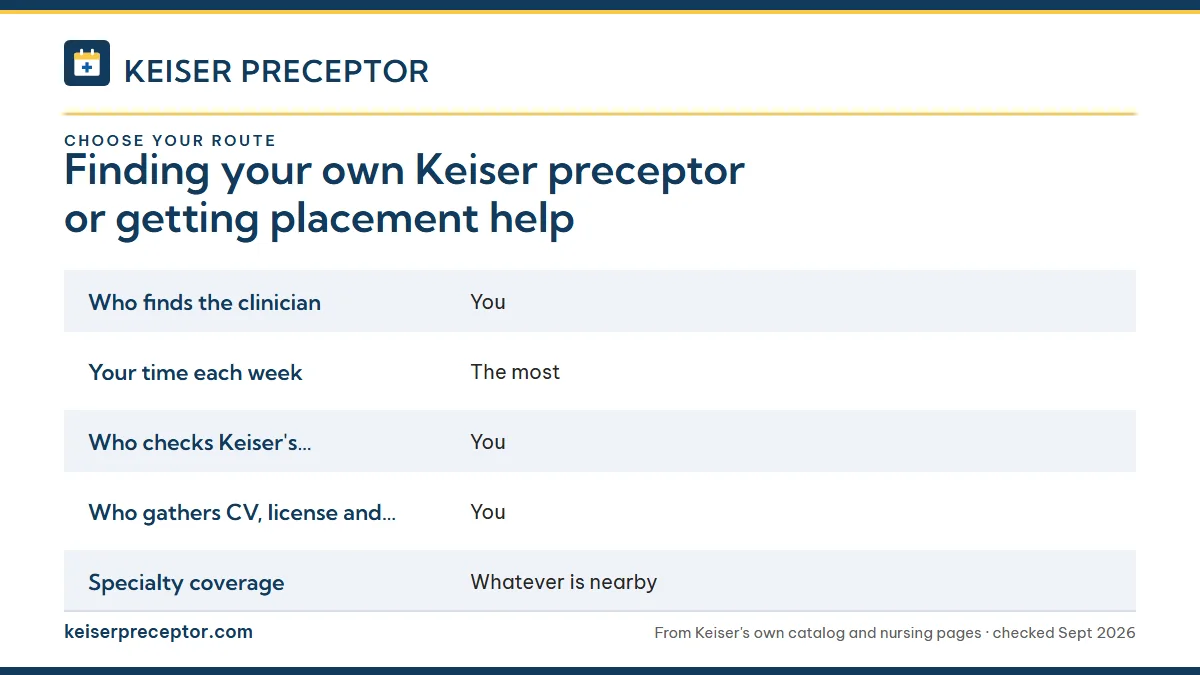
The three routes side by side
Every column ends at the same place, Keiser's own review, but the work to get there is shared very differently.
| On your own | Your network | Placement service | |
|---|---|---|---|
| Who finds the clinician | You | You, through people you know | Your placement advisor |
| Your time each week | The most | Moderate | The least |
| Who checks Keiser's preceptor rules | You | You | We do, before you hear a name |
| Who gathers CV, license and site contact | You | You, with your contact's help | We prepare it for you |
| Specialty coverage | Whatever is nearby | Whoever you know | Searched course by course |
| If the preceptor withdraws | You restart alone | Back to your contacts | Replacement search starts at once |
| Who approves | Keiser | Keiser | Keiser |
The gap shows most in the final weeks before a term, when a stalled search needs fresh leads quickly and each unanswered voicemail costs days you cannot get back.
Five questions that settle it
- How many weeks remain before your next practicum's term begins?
- Do you personally know a clinician who meets Keiser's rules and sees the right patients?
- Which course comes next, and do practices near you see that population?
- Do you hold RN licenses in more than one state, or plan clinicals outside Florida?
- How many hours a week can you give to calls and follow-up on top of coursework and work?
If your answers point to a short runway, no warm contact or a specialty course, a placement service will likely save you the most time and stress. If you have months in hand and a strong lead, start with your network and keep us in mind for the courses it cannot cover.
Mixing routes makes sense across five practicums. A colleague in adult primary care might take NUR602A and NUR603A while we search for the pediatric and women's health courses. Ask for a quote on only the courses you need; our cost page explains what shapes it.
Questions Keiser students ask
Does Keiser treat a preceptor found by a service any differently?
Keiser's older clinical manual says it endorses student-identified preceptors on the basis of their qualifications and experience. The same review applies however the clinician came to you: the Program Director approves the preceptor, the site signs the affiliation agreement, and faculty clear the arrangement before hours begin.
How early should I choose a route?
Decide early enough to change course if the first route stalls. Keiser suggests planning each practicum about three months ahead, so settle your approach before that window opens. A student who tries alone for two months and then switches leaves the service, and Keiser's review, very little time.
Can I start alone and bring in a placement service later?
Yes. Share the list of practices you have already contacted and what each said, so nobody receives a second, confusing request. Your placement advisor picks up from there, widens the search and builds the Keiser file, so the groundwork you have already done still counts.
What if someone in my network offers to precept but is not an NP?
Physicians qualify: Keiser lists MDs and DOs as acceptable FNP preceptors, and NPs from other specialties can precept in limited numbers, while Keiser's first choice remains a master's-prepared FNP. Physician assistants are absent from Keiser's list. Our Keiser preceptor requirements guide covers the full set of rules before you say yes.
Related pages
Last checked 2026-09-25
We check these pages against Keiser's catalogs, graduate nursing manuals, licensure disclosures and program pages. Your course, the Clinical Coordinator and the 2026-27 Graduate Catalog have the final word.
Keiser asks you to find your own preceptor. Let us run that search.
Tell us your Keiser program, your next practicum and where you live. We find preceptors who fit the course and prepare the CV, license and site details your Preceptor/Mentor Information Form needs, about three months ahead.
- Preceptors matched to the course: adult and older-adult primary care for
NUR602AandNUR603A, pediatrics forNUR604A, women's health forNUR605A - CV, license, certification and site contact ready for Keiser's review and the affiliation agreement
- Across Florida, from Miami to Jacksonville, and in the other states where you are licensed
Start your placement plan
Your program, city and next practicum term is all we need to begin.