How to choose a preceptor placement service as a Keiser student
A placement service earns its fee only if it knows Keiser's process as well as you do: the Preceptor/Mentor Information Form, the affiliation agreement, Program Director approval and the 8-week practicum term. Use the checklist below to judge any service, ours included. The right one finds a preceptor near you who suits the course and hands you a file ready for Keiser's review.
Get your placement plan
Tell us your Keiser program and where you live. A placement advisor replies with the preceptor and site options that fit your Keiser course.
Start with Keiser's process, not the sales pitch
Every placement service says it finds preceptors. The real test is whether it builds the search around Keiser's own rules: which clinicians Keiser accepts, what the Clinical Coordinator reviews, the signed agreement each site needs, and the calendar of 8-week terms that sets every deadline.
Ask any service to walk you through Keiser's steps from first contact to first clinic day. One that works with Keiser students regularly will explain the Preceptor/Mentor Information Form, Program Director approval, the affiliation agreement and faculty clearance without reaching for notes. If the answer is generic, the file it hands you will probably be generic too, and Keiser's reviewers will send it back.
You can check the answer against Keiser's own sequence on our Keiser clinical placement process guide before the call.
What the best service does for a Keiser student
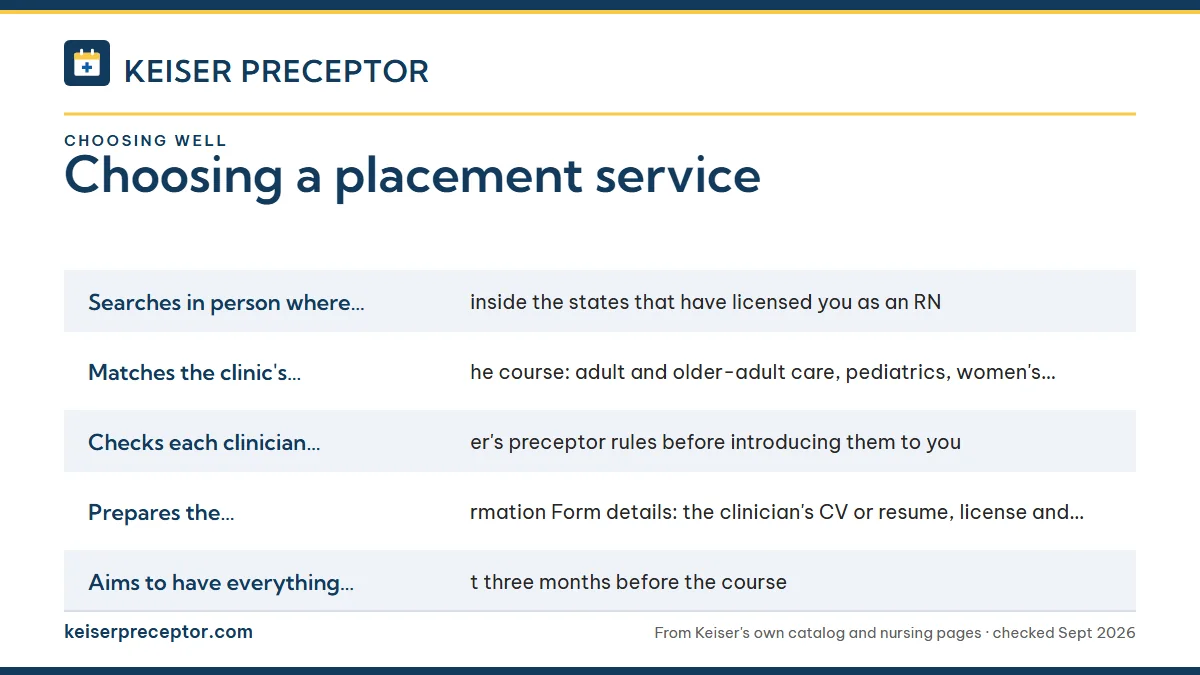
- Searches in person where you live, inside the states that have licensed you as an RN
- Matches the clinic's caseload to the course: adult and older-adult care, pediatrics, women's health or broad family practice
- Checks each clinician against Keiser's preceptor rules before introducing them to you
- Prepares the Preceptor/Mentor Information Form details: the clinician's CV or resume, license and board certification, the practice's contract signer, and the days and dates you will attend
- Aims to have everything ready about three months before the course
- Stays on call through the term and replaces a preceptor who withdraws
- Gives you a written quote built from your course, location and timeline
Each item maps to a point where Keiser students lose time. A service that covers all seven removes the usual causes of a late start, from the wrong specialty to a missing license detail.
Questions to ask before you commit
A short call answers most of what you need to know. Put these questions to any service and listen for specifics about Keiser rather than general reassurance.
- How do you check a preceptor against Keiser's requirements, and which requirements do you check?
- Exactly what will I receive for Keiser's review, and by when?
- How do you match a clinic to a particular course, such as
NUR604AorNUR691A? - What happens if my preceptor withdraws in week three of the term?
- How do you handle a student licensed outside Florida, given Keiser's state lists?
- Is the quote in writing, and what exactly does it cover?
Good answers name Keiser's forms, titles and terms. Vague answers suggest a service that treats every school the same, which leaves the Keiser-specific work to you.
Warning signs worth walking away from
- A promise that Keiser will approve the preceptor. Approval belongs to Keiser's faculty and Program Director, so no outside service can promise it
- Clinicians offered for a course they do not fit, for example a clinic that sees only adults put forward for the pediatric course
- A practicum built mainly on telehealth, when Keiser caps telehealth at 25% of direct patient care hours
- A site in a state that has not licensed you as an RN, or one flagged on Keiser's own state lists
- Encouragement to list your immediate supervisor as your preceptor
- A vague quote, or one that changes after you have committed
- No plan for a preceptor who drops out partway through the term
Any one of these can cost you a term. Keiser's older graduate clinical manual is clear that falling short on hours means repeating the whole course, clinical hours included, so a weak placement is an expensive shortcut.
How we measure up against the checklist
We built our service around Keiser's clinical process, and the checklist above is simply a description of our daily work. Your placement advisor searches in person near your home, matches the practice to the course in front of you, and checks every clinician against Keiser's rules before you hear their name.
Next comes the paperwork Keiser's review depends on: every detail the Preceptor/Mentor Information Form asks for, a current CV, proof of licensure and board certification, the practice's contract signer, and the clinic dates you and the preceptor have agreed. We work to have it all in place roughly three months ahead of the course. Your advisor remains a message away for the whole term, and should a preceptor step away mid-term, a new search begins the same day.
Approval stays with Keiser's faculty and Program Director. What we control is the quality of the file they open, and we make it complete and rule-ready on the first submission. Our quotes come in writing, and the cost page explains what shapes them. Step by step, the process is set out on how it works.
Weigh a service against doing it yourself
A placement service is one of three routes, alongside searching on your own and working your professional network. For a student with months of runway and a warm lead in the right specialty, a solo search can work well. For a student with a term six weeks away, a pediatric course and no contacts, the case for help is much stronger. FNP students can also combine routes across the five practicums, bringing in a service only for the courses their own contacts cannot cover.
Our side-by-side comparison, placement help or your own search, sets out who does what on each route and five questions that point to the right one for you. When you are ready, send your details with the form below.
Questions Keiser students ask
Can a service place me at a practice without a Keiser agreement?
A site can host you only once it has a signed affiliation agreement with Keiser, which Keiser and the site execute between them. A good service finds out who at the practice signs contracts and passes that on, so Keiser can move quickly, and flags early when a new agreement will be needed.
Should a service ask for my preceptor's license and certification?
Yes. Keiser reviews the preceptor's license and certification with a current CV or resume before approving anyone, so a service that skips those details is handing that work back to you. Expect the license state, status and number, plus national certification for nurse practitioners.
How can I test whether a service understands Keiser's clinical hours?
Ask how many precepted hours the FNP requires. A service that knows Keiser will mention that the 2026-27 Graduate Catalog lists 540, while the live FNP page and the 2023 policy manual say 510, and that the catalog governs. Our Keiser clinical hours page lays out the sources.
Is a placement service worth it for the RN to BSN community course?
It can be. NUR4636 needs 45 clinical hours in a setting the student chooses and the University Department Chair approves, and Keiser makes students responsible for securing the preceptor. If you have no community health contacts, handing the search over saves time in a 4-week term.
Will a placement service keep my Typhon logs for me?
Typhon logging stays with you as the student, because each entry records your own encounters and Keiser reviews it as your work. What a good service does is place you where the caseload fills the right age groups and diagnoses, so your log builds naturally as the term goes on.
Related pages
Last checked 2026-09-25
We check these pages against Keiser's catalogs, graduate nursing manuals, licensure disclosures and program pages. Your course, the Clinical Coordinator and the 2026-27 Graduate Catalog have the final word.
Keiser asks you to find your own preceptor. Let us run that search.
Tell us your Keiser program, your next practicum and where you live. We find preceptors who fit the course and prepare the CV, license and site details your Preceptor/Mentor Information Form needs, about three months ahead.
- Preceptors matched to the course: adult and older-adult primary care for
NUR602AandNUR603A, pediatrics forNUR604A, women's health forNUR605A - CV, license, certification and site contact ready for Keiser's review and the affiliation agreement
- Across Florida, from Miami to Jacksonville, and in the other states where you are licensed
Start your placement plan
Your program, city and next practicum term is all we need to begin.