Your preceptor backed out. Here is how to keep the practicum alive.
A preceptor who leaves is a problem measured in weeks, because every Keiser practicum lives inside one 8-week term. The students who recover fastest do three things the same day: tell Keiser, protect the hours already logged, and restart the search with a complete file ready. Our placement desk stays on call for exactly this moment.
Get your placement plan
Tell us your Keiser program and where you live. A placement advisor replies with the preceptor and site options that fit your Keiser course.
First, find out exactly what changed
"My preceptor dropped out" covers very different situations, and each has its own fix. Before you contact anyone, get a clear answer from the preceptor or the practice about what happened and whether any part of the arrangement survives.
- The preceptor is leaving the practice, but the site stays open to students.
- The preceptor is taking leave for part of the term and will return.
- The practice has withdrawn, so the site and its agreement are off the table.
- The preceptor can still take you, but for fewer hours or on different days.
If the site stays and a colleague could step in, you may keep the location and its affiliation agreement and change only the person. Keiser's policy manual expects any stand-in clinician to hold the same credentials and experience as the designated preceptor, and a new named preceptor goes through Keiser's own review before taking over.
If it happens before the term starts
A dropout before the first day is the recoverable version, and the clock is your main enemy. Tell your Clinical Faculty or Clinical Coordinator right away that the approved arrangement has fallen through, so nobody expects hours to begin with someone who has left.
Then restart the search with everything the first one taught you. Ask the departing preceptor for a name; clinicians often know a colleague who precepts. Check whether any site you approached earlier said "not this term" rather than "no". If the term is close, work through our guide for a preceptor search on a tight timeline.
Keep your plan for clinical course completion current. When the preceptor or dates change, course faculty need the new start and end dates and clinical days before the practicum begins.
If it happens partway through the term
A mid-term loss is harder because the remaining weeks keep shrinking. Your priority is making sure the hours you already worked are documented and the replacement can absorb what is left before week 8.
Keiser's policy manual says that when an alternate site becomes necessary, the Program Coordinator and Clinical Coordinator coordinate it together with agency representatives. Keiser's older graduate clinical manual also warns that a student cannot expect a preceptor to continue past the term, and that falling short on clinical hours means retaking the course in full. The detail on those rules lives in our guide to what Keiser's manuals say when a site falls through.
Before you log a single hour with a covering clinician, confirm with course faculty that the person meets Keiser's rule of the same credentials and experience as your approved preceptor.
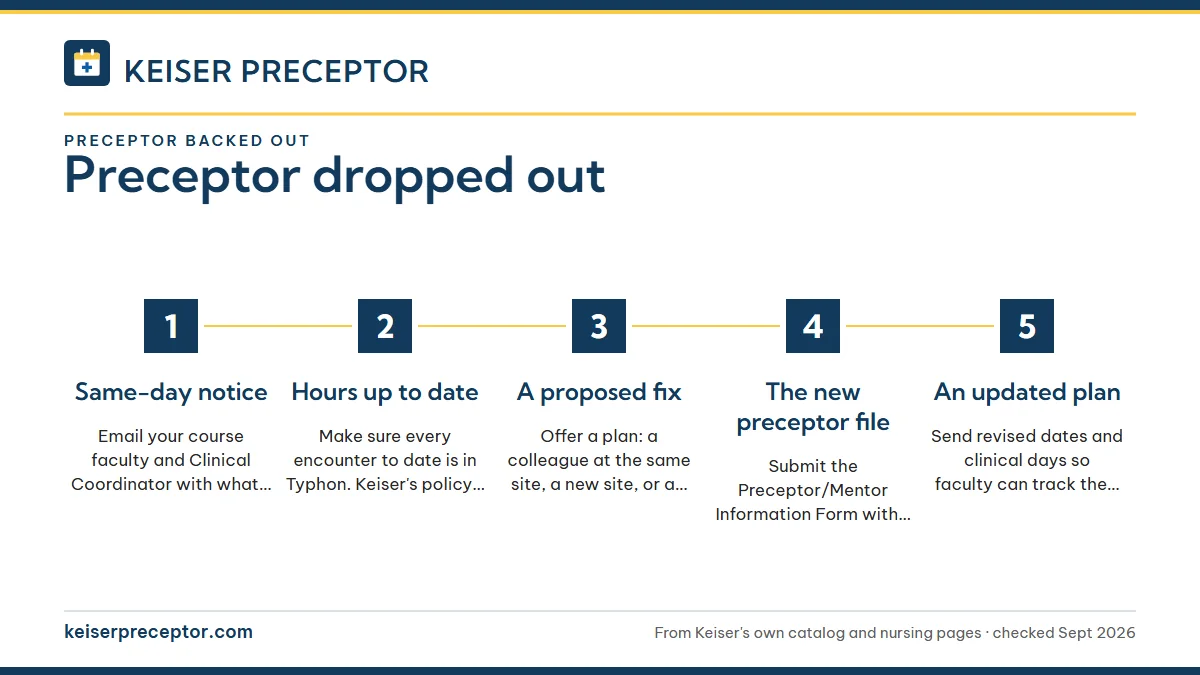
What to send Keiser, in order
Keep the tone factual. Faculty can help fastest when a student arrives with the problem, the numbers and a plan at once.
- Same-day noticeEmail your course faculty and Clinical Coordinator with what happened, the date it takes effect and the hours completed so far.
- Hours up to dateMake sure every encounter to date is in Typhon. Keiser's policy manual asks for documentation within 7 days of each encounter.
- A proposed fixOffer a plan: a colleague at the same site, a new site, or a mix, with the weeks and days you expect to cover.
- The new preceptor fileSubmit the Preceptor/Mentor Information Form with the new preceptor's CV or resume and license and certification details.
- An updated planSend revised dates and clinical days so faculty can track the new arrangement.
How our replacement search works
Students who placed with us have their course, location, license states and schedule on file already, so a replacement search starts the day the preceptor leaves. Our placement desk looks first for clinicians who can take on the hours left in the weeks left, in the same patient focus as your practicum, near where you live.
The moment a new preceptor agrees, we collect their credentials and CV, find out who signs agreements at the practice, and lay out clinical days that fit the remaining weeks. The change still needs Keiser's approval, and we hand faculty everything they need to give it.
Students who come to us mid-crisis get the same treatment. Tell us which practicum you are in, how many hours are logged and how many weeks remain, and the search starts at once. Our how it works page shows the full service.
Make the next preceptor stick
A yes given without the full picture is a fragile yes. Before the next preceptor commits, walk through the eight weeks together: the days you will attend, the hours per week, the week 4 and week 8 evaluations, and the faculty visit, which may be on site or virtual.
Share the course objectives and evaluation criteria early, confirm planned time off, and keep a second clinician warm as a backup. For future practicums, start about three months ahead so a late surprise still leaves room to recover. Our Keiser preceptor evaluations guide explains what the preceptor signs and when.
Clear expectations protect the preceptor as much as you. A clinician who knows the weekly hours, the paperwork and the faculty contact points from the start is far more likely to see all eight weeks through.
Questions Keiser students ask
Does Keiser have to find me a new preceptor?
Keiser's published FNP materials leave the search with the student. Its policy manual does describe the Program Coordinator and Clinical Coordinator coordinating an alternate site with agency representatives when one becomes necessary, so tell them immediately and ask what support applies to your term. Keep your own search running in the meantime.
Do the hours I already completed still count?
Hours worked under your approved preceptor and logged in Typhon are part of your clinical record for the course. How they combine with hours under a new preceptor is a question for your course faculty, so raise it in your first message along with the exact number of hours logged to date.
Can another clinician at the same practice take over?
Often that is the quickest fix, because the site and its affiliation agreement may stay in place. Keiser's policy manual expects any stand-in to hold the same credentials and experience as the designated preceptor, and a new named preceptor still needs Keiser's approval through the Preceptor/Mentor Information Form.
Can my preceptor let me finish the hours next term?
Keiser's clinical manual says an extension of the clinical period with the preceptor cannot be assumed, and a course whose clinical hours are not met is retaken in full. Ask course faculty before counting on any carryover, and read our guide to delayed graduation to see how a repeated course moves your finish date.
How do I stop this from happening in my next practicum?
Line up the next preceptor about three months before the term, confirm the full eight weeks and any planned leave before the Keiser file goes in, and keep a backup name. Our placement desk builds each match that way and stays on call through the term.
Related pages
Last checked 2026-09-25
We check these pages against Keiser's catalogs, graduate nursing manuals, licensure disclosures and program pages. Your course, the Clinical Coordinator and the 2026-27 Graduate Catalog have the final word.
Keiser asks you to find your own preceptor. Let us run that search.
Tell us your Keiser program, your next practicum and where you live. We find preceptors who fit the course and prepare the CV, license and site details your Preceptor/Mentor Information Form needs, about three months ahead.
- Preceptors matched to the course: adult and older-adult primary care for
NUR602AandNUR603A, pediatrics forNUR604A, women's health forNUR605A - CV, license, certification and site contact ready for Keiser's review and the affiliation agreement
- Across Florida, from Miami to Jacksonville, and in the other states where you are licensed
Start your placement plan
Your program, city and next practicum term is all we need to begin.