Behind on hours in an 8-week Keiser practicum: how to catch up
In an 8-week term, a shortfall grows faster than most students expect: every week you fall behind leaves fewer weeks to spread the rest across. The fix is honest arithmetic, a conversation with faculty before week 4 if you can, and more supervised time that fits Keiser's rules. Where one preceptor cannot supply enough, our placement desk can find a second.
Get your placement plan
Tell us your Keiser program and where you live. A placement advisor replies with the preceptor and site options that fit your Keiser course.
Do the arithmetic before anything else
Start with three numbers: the hours your practicum requires, the hours already logged in Typhon, and the weeks left in the term. Keiser's FNP page describes roughly 15 to 16 clinical hours a week, which suits a 120-hour practicum; a 60-hour practicum spread the same way needs about 8. The final Integration Practicum, NUR691A, carries 180 hours in the 2026-27 Graduate Catalog and 150 on Keiser's FNP page, so confirm which figure your course faculty use.
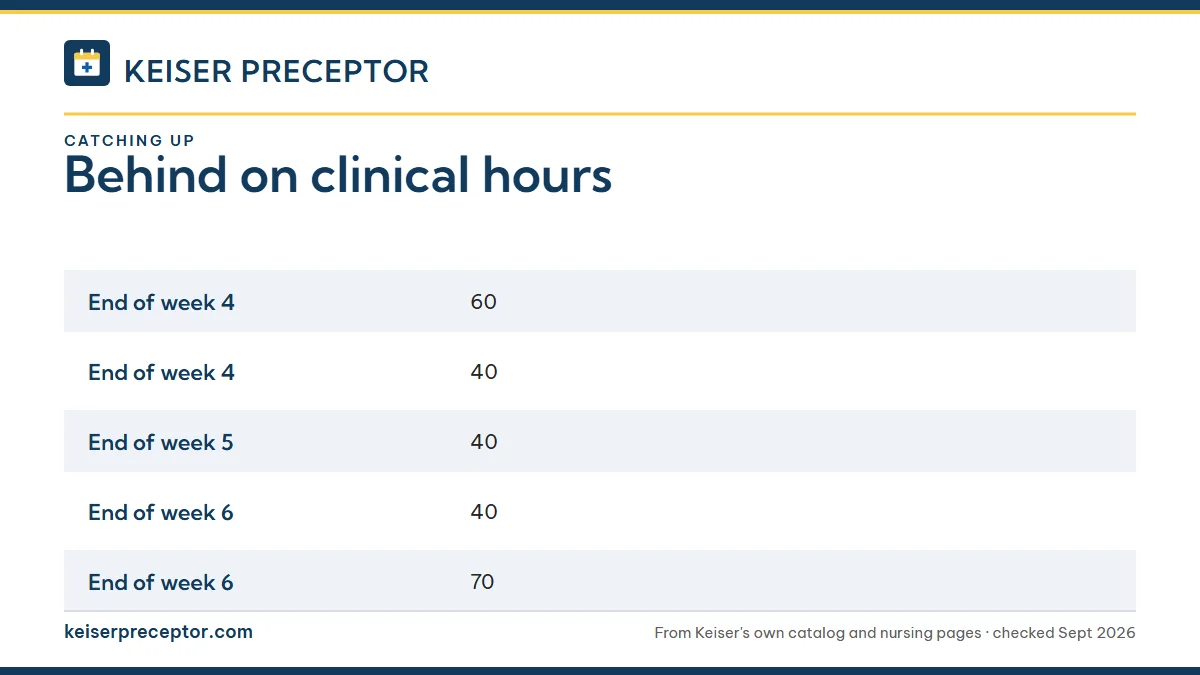
The table shows why timing matters more than the size of the gap. The same 80 hours owed means 20 hours a week after week 4 and 40 a week after week 6.
| Point in the term | Hours logged | Hours still owed | Needed per remaining week |
|---|---|---|---|
| End of week 4 | 60 | 60 | 15 (on pace) |
| End of week 4 | 40 | 80 | 20 |
| End of week 5 | 40 | 80 | About 27 |
| End of week 6 | 40 | 80 | 40 |
| End of week 6 | 70 | 50 | 25 |
Why a shortfall costs so much at Keiser
Keiser checks progress mid-course. Its policy manual has an academic advisor review direct care hours at the midpoint of the rotation, and the preceptor completes a midterm evaluation at week 4. A gap that shows up there is still fixable. A gap discovered in week 7 usually is not.
The end of the term is firm. Keiser's older graduate clinical manual, still posted on its site, says a preceptor cannot be expected to continue once the term closes, and that missing the required clinical hours means taking the course over in its entirety, hours included. Because each practicum pair needs final grades posted before the next pair starts, one repeated course pushes every later practicum back a term. Our guide to delayed graduation traces that ripple.
Catch-up moves that stay inside Keiser's rules
More hours only help if they count. Keiser's rules on direct patient care, telehealth and documentation shape every option below; the full definitions are in our guide to what counts as clinical hours at Keiser.
- Add sessions with your current preceptor: an extra weekday, an evening clinic or a weekend block.
- Use telehealth where your preceptor offers it, within Keiser's cap of 25% of direct patient care hours.
- Log every encounter promptly. Keiser's policy manual asks for documentation within 7 days, and unlogged hours are easy to lose.
- Plan longer days with care: Keiser's sleep and safety policy limits clinical work to 16 consecutive hours without restful sleep.
- Add a second approved preceptor, at the same site or another one, for the hours your first preceptor cannot cover.
Rounding up, padding or logging hours you did not work is clinical misconduct under Keiser's policy manual, and it puts far more at risk than a short week.
Tell faculty early, with a plan
Course faculty see your Typhon logs, your preceptor's evaluations and the result of at least one site visit per semester, so a shortfall rarely stays hidden. Telling them first, with numbers and a plan, keeps the conversation about solutions.
Bring the hours required, the hours logged, the weeks left, the cause, and the specific fix you propose: extra days, a second preceptor, or both. If the plan changes your clinical days or dates, update the plan for clinical course completion that faculty already hold.
The phone conference Keiser's faculty hold with each student during the term is a natural moment to raise it if you have not already. Earlier is always better, and a student who flags the gap at week 3 has far more options than one who explains it at week 8.
Common causes, and the fix for each
Falling behind usually traces to one of a handful of causes. Naming yours points straight at the remedy.
- Late start: approval or the affiliation agreement landed after the term began. Fix it with extra days now, and start the next search about three months ahead.
- Thin schedule: the preceptor can only offer one day a week. A second approved preceptor fills the rest.
- Low patient volume: a slow clinic yields fewer hours. Ask about busier sessions or add a higher-volume site.
- Work conflicts: your job keeps colliding with clinic days. Look for sites with evening or weekend hours.
- Preceptor leave: vacation or illness mid-term. See our guide for when a preceptor drops out.
Where our placement desk comes in
When the answer is more supervised time than one clinician can give, our placement desk finds an additional preceptor near you who fits the same practicum, then pulls together the new clinician's CV, credentials and practice contact for Keiser's review. We propose clinical days that cover the remaining hours without breaking the 16-hour rule.
For the practicums still ahead, we line up each preceptor about three months before the term, with the days mapped across all eight weeks from the start. That is the most reliable way to keep a future term from starting behind. Keiser signs off on each arrangement, with everything it asks for already in the file. Read how it works or use the form below.
Questions Keiser students ask
What happens if I do not finish my Keiser clinical hours by week 8?
Keiser's clinical manual says failing to meet the clinical hours means retaking the whole course, clinical hours included, and that an extension with the preceptor cannot be assumed. Talk to your course faculty as early as possible about your options, because the answer depends on the course and on how far short you are.
Can I work more than 16 hours in one day to catch up?
Keiser's sleep and safety policy limits clinical work to 16 consecutive hours without restful sleep. A long day is allowed within that limit, but stacking several long days rarely helps your learning or your evaluations. Spreading extra sessions across the remaining weeks is safer and more convincing to faculty.
Do telehealth visits count toward Keiser clinical hours?
Yes, within a limit. Keiser's policy manual allows telehealth to make up no more than 25% of your overall direct patient care hours. Log those visits the same way as in-person encounters, within 7 days, and keep a running total so you know how much room remains under the cap.
Can I have two preceptors in one Keiser practicum?
Keiser's approval rules apply to every preceptor and every site, so a second preceptor goes through the same Preceptor/Mentor Information Form, CV and license review, and a site with its own affiliation agreement if it is a different practice. Ask your course faculty whether a split arrangement suits your course before you line one up.
How do I check how many hours I have logged so far?
Keiser's students track clinical hours and case logs in Typhon, which totals hours by age group and diagnosis. Compare that total with your course requirement every week rather than at the midpoint. Our Typhon case logs guide explains what faculty review there.
Related pages
Last checked 2026-09-25
We check these pages against Keiser's catalogs, graduate nursing manuals, licensure disclosures and program pages. Your course, the Clinical Coordinator and the 2026-27 Graduate Catalog have the final word.
Keiser asks you to find your own preceptor. Let us run that search.
Tell us your Keiser program, your next practicum and where you live. We find preceptors who fit the course and prepare the CV, license and site details your Preceptor/Mentor Information Form needs, about three months ahead.
- Preceptors matched to the course: adult and older-adult primary care for
NUR602AandNUR603A, pediatrics forNUR604A, women's health forNUR605A - CV, license, certification and site contact ready for Keiser's review and the affiliation agreement
- Across Florida, from Miami to Jacksonville, and in the other states where you are licensed
Start your placement plan
Your program, city and next practicum term is all we need to begin.