What counts as a Keiser clinical hour
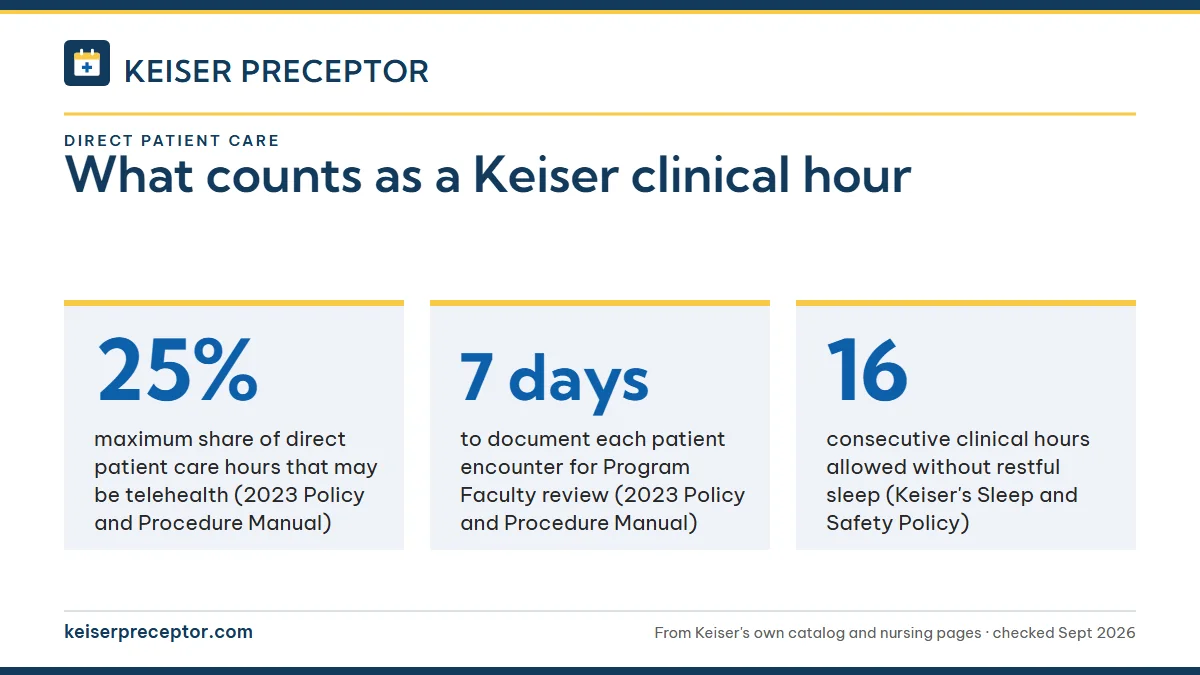
A Keiser clinical hour is time spent assessing, diagnosing, treating or evaluating real patients at an approved site, with an approved preceptor directly supervising you. Telehealth may fill no more than a quarter of those hours, each encounter has to be documented within 7 days, and no clinical stretch may pass 16 hours without restful sleep.
Get your placement plan
Tell us your Keiser program and where you live. A placement advisor replies with the preceptor and site options that fit your Keiser course.
Keiser's definition of direct patient care
The Practicum Experience Policy in Keiser's 2023 Graduate Nursing Program Policy and Procedure Manual defines the hours in a single sentence: "Direct Client Patient Care hours consist of assessment, diagnosis, treatment and/or evaluation of a real client patient at the clinical site under the supervision of a qualified preceptor."
Three conditions sit inside that sentence. The patient is real, so simulation, case studies and practice exams sit outside it. The work happens at the clinical site, meaning the one covered by your affiliation agreement. And a qualified preceptor supervises, which at Keiser means the clinician approved for that practicum.
The policy then widens the frame a little: direct care hours may also include chart review, ordering or reviewing tests, presenting to your preceptor and entering data in the EMR. The work around a visit therefore belongs in the same hours as the visit. The totals those hours add up to, course by course, are on the clinical hours page.
Three things must be in place before hour one
An hour only counts when the arrangement behind it has cleared Keiser. The manuals set out the conditions:
- A signed affiliation agreement. Keiser requires an executed agreement with each clinical site before any clinical experience begins there. See affiliation agreements.
- An approved preceptor. The Program Director approves your preceptor from the Preceptor/Mentor Information Form, and clinical faculty sign off on the arrangement before your first hour.
- Direct supervision on every shift. Keiser's 2023 clinical sites policy has preceptors directly supervising students at all times, and anyone covering for your preceptor must hold the same credentials and experience.
If your preceptor is out for a day, ask course faculty before you work alongside a stand-in, rather than assuming a colleague at the same practice qualifies.
Time at a site before the agreement is signed and your preceptor is approved is not a practicum hour, however much you learned.
The 25% telehealth cap
Virtual visits can count, within a limit. Keiser's policy says telehealth "may not comprise more than 25% of the overall Direct Patient Care hours." Against the catalog's 540 FNP hours, a quarter is 135 hours; against the 510 on the program page it is about 128.
The word "overall" points to a program-wide ceiling, but the policy is silent on whether faculty also apply it course by course. A 60-hour pediatric practicum spent mostly on video visits could pass a program-wide test and still concern the faculty member grading that course. Ask course faculty how they apply the cap before you accept a preceptor whose schedule leans on virtual care, and flag telehealth encounters plainly in your log so the share is easy to see.
Hours that fall outside the rules
Some time in a clinic looks like clinical work and still does not count toward a Keiser practicum:
- Your paid shifts. Keiser's clinical hours carry no compensation, and a student may not be paid for work done as a nursing student. Time on the clock at your job is employment, not practicum time.
- Your own unit. Keiser rules out a rotation on the unit where you are currently employed. A rotation at your employer needs a different department, a preceptor other than your immediate supervisor, and hours outside your normal schedule; the workplace rules add the insurance waiver.
- Simulation and residency weekends. The catalog lists the FNP residencies as a degree requirement separate from the precepted hours, and the simulation and OSCE in Advanced Health Assessment happen before clinicals begin.
- Work with an unapproved clinician. Hours under someone Keiser never reviewed, such as a colleague who was not named on your form, sit outside the definition.
The 7-day documentation rule
Keiser's practicum policy is specific on timing: "Students will document all patient encounters for review by the Program Faculty within 7 days of the encounter taking place." The window runs from each encounter, so every clinic day carries its own deadline, and a missed week of entries can put a whole run of patients out of compliance together.
The simplest habit is to enter each encounter the evening of the clinic day while the details are fresh, then check the week's totals before your next shift. Your academic advisor reviews direct care hours at the midpoint of the rotation, so a clean log by week 4 matters. The Typhon case log guide covers what each entry records and who reads it.
The 16-hour rest rule
Keiser's Sleep and Safety Policy sets a firm ceiling: no more than 16 consecutive clinical hours without restful sleep. It exists for patient safety, and it matters most to students tempted to fix a shortfall with one very long day.
The rule counts clinical time, so the usual way to break it is stacking sessions: a full clinic day followed by an evening urgent care session with the same preceptor, or a weekend double meant to rescue a slow month. A night shift at your paid job before a clinic day is not named in the rule, but it runs against its purpose, so schedule clinical days after real sleep. If you fall behind, spread the catch-up over several weeks, which also fits Keiser's advice to use the whole 8-week term.
How we set you up with hours that count
Each preceptor we bring to a Keiser student is checked against the practicum before you see a name: steady in-person patient volume, the population the course is built around, and clinic days that fit Keiser's rest and telehealth limits. Where a practice runs heavily on virtual visits, we say so up front, giving you time to ask faculty about the cap.
We also assemble what Keiser needs before your first hour, about three months ahead of the term: the details for the Preceptor/Mentor Information Form, the preceptor's CV or resume and license, and the site contact for the affiliation agreement. Approval stays with Keiser's faculty and Program Director; our part is making sure the file in front of them is complete and correct. Start with the form.
Questions Keiser students ask
Does shadowing a provider count as Keiser clinical hours?
Keiser's definition rests on you taking part in assessment, diagnosis, treatment or evaluation of real patients under your preceptor. Time spent only watching is not named in that definition, so check with course faculty before logging it. As the practicum goes on, aim for encounters where you do part of the work yourself and then present the patient to your preceptor.
Can hours with a physician assistant count toward my Keiser FNP practicum?
Keiser's FNP preceptor list covers master's-prepared nurse practitioners, with an FNP preferred, plus MDs and DOs. Physician assistants are not on that list, so hours spent under a PA are unlikely to be approved as precepted hours. If a PA would be your main supervisor, raise it with course faculty first; the preceptor requirements set out who qualifies.
Does charting after clinic count toward my Keiser hours?
It can. Keiser's practicum policy lets direct care hours include chart review, ordering or reviewing tests and entering data in the EMR, as well as time presenting to your preceptor. Keep that work tied to patients you saw at the site that day, and log it with the visit so faculty see one complete encounter rather than a separate block of desk time.
Can I do a 24-hour weekend to catch up on Keiser hours?
Not in one stretch. Keiser's Sleep and Safety Policy stops any clinical stretch at 16 hours unless you have had restful sleep, and the FNP program recommends spreading hours across the whole 8-week term. Two long days with a night's sleep between them fit the rule; a single overnight marathon does not. The pacing guide shows weekly targets by course.
How is Keiser's telehealth share tracked?
Keiser's policy caps telehealth at 25% of overall direct patient care hours but does not publish how the share is recorded. Mark every virtual visit clearly in your log and keep a running tally, so you and faculty can see the percentage at the midpoint review and again before the term closes, when there is still time to add in-person days.
Related pages
Last checked 2026-09-25
We check these pages against Keiser's catalogs, graduate nursing manuals, licensure disclosures and program pages. Your course, the Clinical Coordinator and the 2026-27 Graduate Catalog have the final word.
Keiser asks you to find your own preceptor. Let us run that search.
Tell us your Keiser program, your next practicum and where you live. We find preceptors who fit the course and prepare the CV, license and site details your Preceptor/Mentor Information Form needs, about three months ahead.
- Preceptors matched to the course: adult and older-adult primary care for
NUR602AandNUR603A, pediatrics forNUR604A, women's health forNUR605A - CV, license, certification and site contact ready for Keiser's review and the affiliation agreement
- Across Florida, from Miami to Jacksonville, and in the other states where you are licensed
Start your placement plan
Your program, city and next practicum term is all we need to begin.