Doing Keiser clinicals at the place you work
You can complete a Keiser practicum at your own employer, but only in a department you are not normally assigned to, with a preceptor outside your direct chain of command, and on time outside your regular shifts. The site still needs an affiliation agreement and the preceptor still needs Keiser's approval, exactly as an outside placement would.
Get your placement plan
Tell us your Keiser program and where you live. A placement advisor replies with the preceptor and site options that fit your Keiser course.
Keiser's workplace rule, in its own words
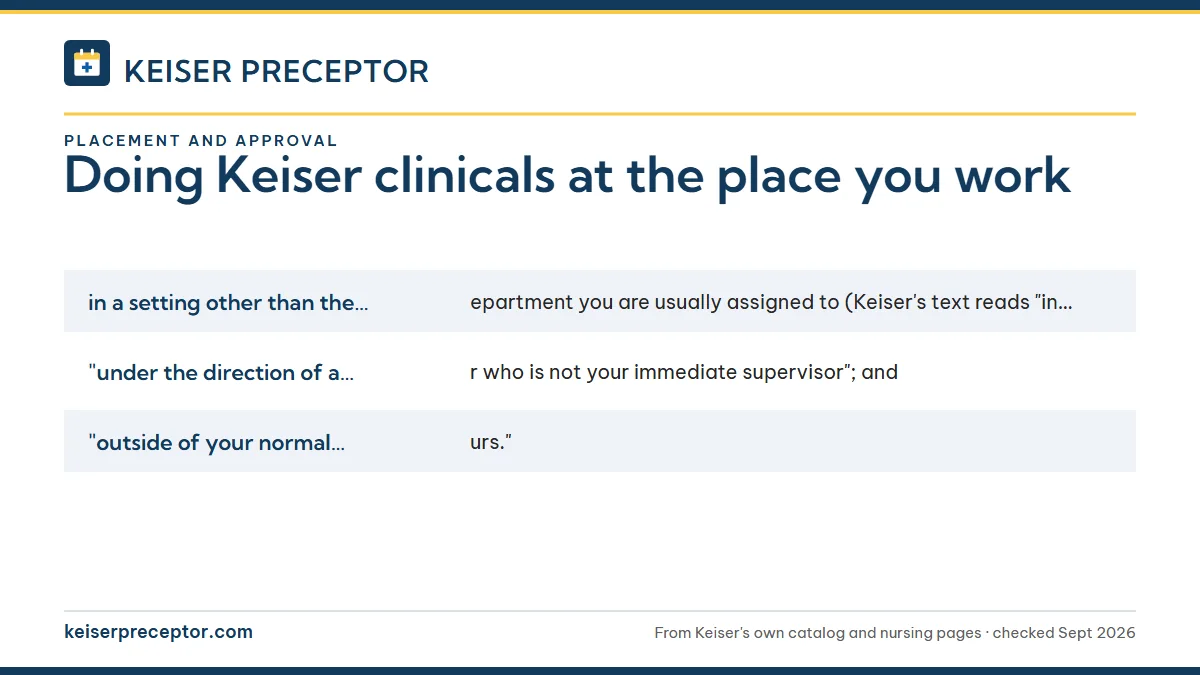
Keiser's FNP program page answers the employer question with three conditions. Students tend to remember them loosely, so it pays to read them as written. A rotation at your own workplace has to be:
- in a setting other than the work department you are usually assigned to (Keiser's text reads "in a different setting that your usual assigned work department");
- "under the direction of a preceptor who is not your immediate supervisor"; and
- "outside of your normal working hours."
A separate line on the same page closes the obvious loophole: "Students are not permitted to be assigned to the clinical area or unit in which they are currently employed." Your own unit is off the table on any shift, including your days off, whatever the staffing office says.
Swapping shifts so you can train on your own unit does not satisfy Keiser. The rule bars the unit where you are employed, whatever the schedule.
What counts as a different department
Keiser publishes no list of qualifying departments, so the test is practical: a clinical area where you are not on the staff roster, doing work that matches the practicum you are enrolled in. For an FNP student that usually means an outpatient or primary care service rather than the inpatient floor you already know. Keiser's program page suggests settings such as physician offices, retail clinics, urgent cares, fast track clinics and health department primary care.
Some illustrations, each still subject to faculty approval. An emergency nurse at a large system might train in that system's family medicine clinic for NUR602A. A labor and delivery nurse might work with an affiliated OB-GYN office for NUR605A. A nurse on a children's hospital floor might look to the same hospital's outpatient pediatric clinic for NUR604A. The match with the course matters as much as the change of department, and the practicum course guide sets out what each course covers.
Your supervisor cannot sign as your preceptor
At a workplace site, the preceptor must sit outside your reporting line. Keiser's wording is "not your immediate supervisor", and one practical effect is that the person rating you at week 4 and week 8 is judging you as a student, not managing you as an employee. A nurse practitioner or physician in the other department is the usual answer.
Everything else about eligibility still applies: an active license, at least a year of experience, practice at the site, and a preference for a master's-prepared FNP, with other NPs, MDs and DOs accepted within Keiser's limits. The 2023 policy manual adds that preceptors supervise directly at all times, and that anyone standing in must have the same credentials and experience. The preceptor requirements page holds the full list.
Keeping clinical hours and paid hours apart
The third condition, outside your normal working hours, ties into two other Keiser rules. The program page states that clinical hours carry no compensation, and the older Clinical Manual says students may not receive payment for work they perform as nursing students. A clinical shift at your employer is unpaid student time, scheduled apart from your paid shifts, even when the badge and the parking garage are the same.
Your Typhon log has to show that separation. Every encounter you record should come from student time with your approved preceptor, and the 2023 manual treats misrepresenting clinical hours as clinical misconduct. Mind fatigue as well: Keiser's Sleep and Safety Policy limits clinical time to 16 consecutive hours without restful sleep, and a clinical day right after a night shift works against the rest that policy protects. The clinical hours rules page explains what counts toward the total.
The paperwork is the same for employees
Working somewhere does not make it an approved Keiser site. An affiliation agreement signed by both sides has to be in place before any clinical experience begins there, and the 2023 manual accepts either Keiser's standard form or the agency's own paper. The person who signs for your employer may not be the manager who knows you, so ask early who that is and where student agreements go.
Your preceptor still submits through the Preceptor/Mentor Information Form, with a current CV and license information attached, and the clinical faculty still approve the arrangement before hours start. On insurance, Keiser's older Clinical Manual allows a waiver of the professional liability requirement when the rotation is at your employer. Confirm with the Clinical Coordinator that the waiver applies to your course before relying on it; the liability insurance page explains the requirement itself.
When your employer is the wrong fit
Some employers lack the right department. A hospital with no outpatient primary care is a poor match for the adult primary care focus of NUR602A and NUR603A, and a system without women's health services struggles to cover NUR605A. Others have the department but no one willing to precept that term. In either case, widen the search early rather than waiting on a maybe from a colleague down the hall.
Mixing sources works well. You might use your employer for one practicum and outside sites for the rest, since Keiser's five FNP practicums each run as their own 8-week term. Each site needs its own agreement and each preceptor its own approval, so plan the sequence across all five practicums instead of one term at a time.
How we help working nurses at Keiser
Keiser admits FNP and WHNP students who hold an active RN license and have a year or more of recent clinical practice, so many arrive with an employer that looks like the easy answer. We test that answer against Keiser's rule first: a department that fits the course, a qualified preceptor outside your chain of command, and clinical days that sit outside your shifts.
Where your employer fits, we gather your preceptor's CV and credentials and identify who signs agreements for your employer, so the Clinical Coordinator's review starts complete. Where it falls short, we search outside sites near you so the practicum can start on time. Keiser's clinical faculty make the final call; the file they receive is already whole. Start with the form below.
Questions Keiser students ask
Can my nurse manager be my preceptor at Keiser?
Keiser's FNP program page says a workplace preceptor has to sit outside your direct reporting line, and the rotation has to run in another department. A nurse practitioner or physician in a different department of the same employer can qualify, provided they meet Keiser's preceptor requirements and the Program Director approves them.
Can I do Keiser clinical hours on my own unit if I am off the clock?
Keiser states that students are not permitted to be assigned to the clinical area or unit where they currently work. Being off shift changes the timing but not the location, and a workplace rotation at Keiser needs both a different department and hours outside your normal schedule.
Does my employer need an affiliation agreement if I already work there?
Yes. Being on the payroll gives your employer no standing as a Keiser clinical site; the agreement has to be fully signed before your first clinical day there. Either Keiser's template or your employer's own form can serve, signed for Keiser by its Associate Vice Chancellor, or by the Graduate School's Dean as alternate.
Can I be paid while doing Keiser clinicals at my job?
Keiser treats clinical hours as unpaid. The program page says clinical hours carry no compensation, and Keiser's older Clinical Manual bars payment to students for the work they do as nursing students. That is one reason Keiser requires a workplace rotation to fall outside your normal working hours.
Do I need my own liability insurance for clinicals at my employer?
Keiser requires professional liability insurance for graduate clinicals. Its older Clinical Manual allows a waiver when the rotation is at the student's employer, but that manual predates the current catalog, so confirm with the Clinical Coordinator before relying on the waiver and keep a copy of whatever you submit.
Related pages
Last checked 2026-09-25
We check these pages against Keiser's catalogs, graduate nursing manuals, licensure disclosures and program pages. Your course, the Clinical Coordinator and the 2026-27 Graduate Catalog have the final word.
Keiser asks you to find your own preceptor. Let us run that search.
Tell us your Keiser program, your next practicum and where you live. We find preceptors who fit the course and prepare the CV, license and site details your Preceptor/Mentor Information Form needs, about three months ahead.
- Preceptors matched to the course: adult and older-adult primary care for
NUR602AandNUR603A, pediatrics forNUR604A, women's health forNUR605A - CV, license, certification and site contact ready for Keiser's review and the affiliation agreement
- Across Florida, from Miami to Jacksonville, and in the other states where you are licensed
Start your placement plan
Your program, city and next practicum term is all we need to begin.