Who approves what in a Keiser clinical placement
No single Keiser office signs off on a practicum. You find the preceptor, then Clinical Faculty, the Clinical Coordinator, the Program Director and the agreement signers each clear one piece, and hours start only after the clinical faculty approve the whole arrangement. Knowing which title owns which piece keeps the right document moving to the right desk.
Get your placement plan
Tell us your Keiser program and where you live. A placement advisor replies with the preceptor and site options that fit your Keiser course.
The short answer: several titles, one sequence
Keiser's graduate nursing documents spread clinical approval across named roles instead of a single placement office. For FNP students the search comes first and it is yours, because Keiser's FNP program page makes locating a site and a preceptor the student's job. Every step after that search belongs to a Keiser title. The placement process guide walks the full path from first call to first hour; this page is the map of who holds each gate along it.
Two documents describe the roles. Keiser's graduate nursing Policy and Procedure Manual, revised in 2023, deals with sites, agreements and oversight. The older Graduate Nursing Programs Clinical Manual deals with preceptor approval, faculty visits and evaluations. The two use slightly different titles for overlapping jobs, so when a question falls between them, ask course faculty or the Clinical Coordinator who holds the title in your term.
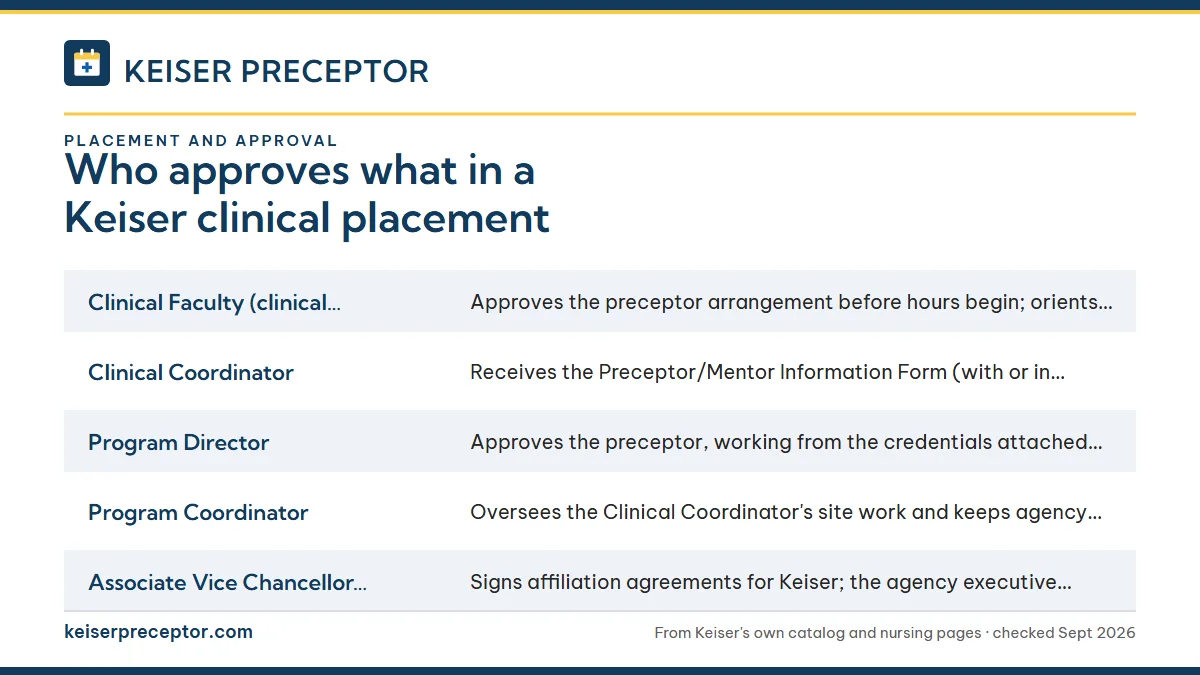
Keiser's approval titles at a glance
| Title | What Keiser's documents assign to it | Where Keiser says it |
|---|---|---|
| Clinical Faculty (clinical course faculty) | Approves the preceptor arrangement before hours begin; orients new preceptors; completes site visits and phone conferences; judges whether course goals were met | Older Clinical Manual |
| Clinical Coordinator | Receives the Preceptor/Mentor Information Form (with or in place of faculty); approval, assignment, use and evaluation of sites; clears WHNP students before registration | Clinical Manual; 2023 policy manual; 2026-27 Graduate Catalog |
| Program Director | Approves the preceptor, working from the credentials attached to the form | Older Clinical Manual |
| Program Coordinator | Oversees the Clinical Coordinator's site work and keeps agency agreements; arranges alternate sites jointly with the Clinical Coordinator | 2023 policy manual |
| Associate Vice Chancellor (Dean of the Graduate School as alternate) | Signs affiliation agreements for Keiser; the agency executive of record signs for the site | 2023 policy manual |
| Department Chair, MSN FNP | Approves hours spent in a specialty area; handles clinical incidents | Older Clinical Manual |
| Academic advisor | Checks your direct-care total halfway through the rotation | 2023 policy manual |
Keiser's documents name titles, never people. Address forms and questions to the title, and let course faculty tell you who holds it this term.
Clinical Faculty: the approval that starts your hours
The one approval with a hard timing rule belongs to the clinical faculty. Keiser's older Clinical Manual states it plainly: "The clinical faculty must approve the preceptor arrangement before students begin their clinical hours." The same manual gives the clinical faculty, together with the DNP director, "final authority over the appropriateness of a clinical site and preceptor arrangement."
Clinical Faculty stay involved long after that first yes. The manual has them orient new preceptors to the role, complete at least one site visit per semester and one telephone conference per term, and decide whether you met the course goals if a preceptor's rating comes back unfavorable. Faculty, or the Program Director, also receive your plan for clinical course completion before the practicum opens; it sets out your start and end dates and the days you will be in clinic. The site visits guide and the evaluations guide pick up those steps.
A preceptor agreeing to take you is where Keiser's review begins, not where it ends. Clinical hours wait for the clinical faculty's approval of the whole arrangement.
Clinical Coordinator and Program Coordinator: the site side
Sites run through their own chain. The 2023 policy manual sums it up in one line: "Approval, assignment, utilization, and evaluation of clinical practice sites are the responsibility of the Clinical Coordinator with oversight from the Program Coordinator." Its clinical sites policy layers on three more points: no student attends a site the Program has not approved, the Program can turn down a site that misses its criteria, and faculty review each location, physically or remotely, ahead of the practicum.
The older manual routes the Preceptor/Mentor Information Form to the Clinical Faculty and/or the Clinical Coordinator, so the coordinator is often the first reader of your preceptor's credentials. For WHNP students the role carries an extra gate, since the catalog requires Clinical Coordinator clearance before you register for each clinical pair. The WHNP placement page covers that rule.
Replacement sites fall to the same pair. Once Keiser judges an alternate necessary, the 2023 manual has the two coordinators arrange it together with people from the agency.
Program Director and the agreement signers
Preceptor approval sits one level up. Under the older Clinical Manual, the preceptor named on your form is approved by the Program Director, who reviews the credentials you attached. Those attachments carry as much weight as the form itself, and the form guide lists what they are.
The contract with the site is signed higher still. Per the 2023 policy manual, Keiser's signature on an affiliation agreement comes from its Associate Vice Chancellor, with the Graduate School's Dean as the named alternate, and the site's comes from its agency executive of record. The paper itself can be Keiser's standard template or the agency's own, and it is reviewed at least yearly. The affiliation agreements page explains why no clinical day happens at a site until one is fully executed.
Chairs, advisors and other titles you may meet
Roles that appear in narrower situations
- Department Chair, MSN FNP: approves hours spent in a specialty area under the older manual's FNP hours table, and handles clinical incidents.
- Program Chair: reviews a positive drug screen together with the Dean.
- Academic Program Coordinator: gives input, alongside faculty and the Nursing Advisory Board, when potential sites are first identified, per the 2023 manual.
- Campus Vice President: receives incident reports, which Keiser expects within 24 hours.
- Nursing Chair: approves the DNP project topic and the mentor.
- University Department Chair: approves the clinical setting an RN to BSN student chooses for
NUR4636.
Most FNP students deal mainly with Clinical Faculty, the Clinical Coordinator and, through their paperwork, the Program Director. The other titles surface only when their situation arises, which is exactly why it helps to know them before it does.
Why Keiser students bring us in before the first approval
Each title above reviews a different slice of the same placement, and any one of them can send it back. We build the packet around those reviewers: a preceptor who fits Keiser's criteria, an up-to-date CV with proof of license and certification for the Program Director, the site contact who can sign an agreement, and your clinical days and dates for the completion plan.
The result is a placement that reaches every desk whole, roughly three months ahead of the course, with each document addressed to the title that needs it. The approvals stay Keiser's to give. Our job is that every reviewer opens a file with nothing missing and nothing outside Keiser's rules. Tell us about your next practicum with the form below.
Questions Keiser students ask
Who approves my preceptor at Keiser University?
Two approvals are involved. Keiser's older Clinical Manual has the Program Director approve the preceptor, based on the CV and license details you submit, and the clinical faculty's approval of the full arrangement must come before your first clinical hour. The site separately needs Program approval and a signed affiliation agreement.
Does the Keiser Clinical Coordinator find FNP clinical sites?
For FNP students, the finding is theirs. Keiser's program page gives that search to the student, and the 2023 policy manual says MSN-FNP students must acquire all clinical sites. The Clinical Coordinator's documented job is approving, assigning, using and evaluating sites under the Program Coordinator's oversight, and clearing WHNP students before registration.
Who signs a Keiser affiliation agreement?
Keiser's side is signed by the Associate Vice Chancellor, with the Graduate School's Dean as the named alternate, and the site's side by its agency executive of record, according to the 2023 policy manual. The document can be Keiser's standardized template or the agency's official agreement, and it must be fully executed before clinical experiences start there.
Who do I contact at Keiser if my clinical site falls through?
Tell your clinical faculty and the Clinical Coordinator first, in writing. The 2023 manual makes the two coordinators, program and clinical, responsible for arranging any alternate site Keiser decides you need, working with the agency. The guide on when a site falls through lays out the steps that protect your term.
Who reviews my clinical hours during a Keiser practicum?
Several people see them. Encounters you document, within 7 days of each one, go to Program Faculty for review. Midway through the rotation your academic advisor checks the direct-care total, and your preceptor scores you twice, at the midterm and at the end of the term, on Keiser's Clinical Evaluation Form. Typhon holds the hours and case logs.
Related pages
Last checked 2026-09-25
We check these pages against Keiser's catalogs, graduate nursing manuals, licensure disclosures and program pages. Your course, the Clinical Coordinator and the 2026-27 Graduate Catalog have the final word.
Keiser asks you to find your own preceptor. Let us run that search.
Tell us your Keiser program, your next practicum and where you live. We find preceptors who fit the course and prepare the CV, license and site details your Preceptor/Mentor Information Form needs, about three months ahead.
- Preceptors matched to the course: adult and older-adult primary care for
NUR602AandNUR603A, pediatrics forNUR604A, women's health forNUR605A - CV, license, certification and site contact ready for Keiser's review and the affiliation agreement
- Across Florida, from Miami to Jacksonville, and in the other states where you are licensed
Start your placement plan
Your program, city and next practicum term is all we need to begin.