From your first message to your first clinical day
You tell us your Keiser program, the practicum coming up and where you live. We search for a preceptor near you whose patients fit that course, gather everything Keiser's reviewers ask to see, and aim to have it ready about three months before the term opens. Keiser's faculty make the approval decision; our job is a file that is complete when it reaches them.
Start your placement brief
Tell us your Keiser program, the next practicum and where you live. Your placement advisor replies with a plan for that course.
What we ask you at the start
A good search begins with a precise brief. Your placement advisor asks which Keiser program you are in, the next clinical course by its catalog number, the term it falls in, and each state that has issued you an active RN license. We also ask how far you are willing to drive and which weekdays you can give to clinic.
Those answers shape everything after them. Keiser expects FNP and WHNP students to hold a Florida RN license plus one in the state that hosts their clinicals, so a student near Savannah and a student in Broward County need two very different searches. The course number tells us which patients the preceptor must see, and the term date sets the deadline we plan back from.
Useful to have in front of you
- Your Keiser program: MSN FNP, WHNP, DNP, RN to BSN or another track
- The practicum ahead, for example
NUR602A,NUR604AorNUR4636 - The opening date of the term that course runs in
- Each state where your RN license is active
- Your home ZIP code and a realistic driving radius
- Any clinicians you have already asked, and how they answered
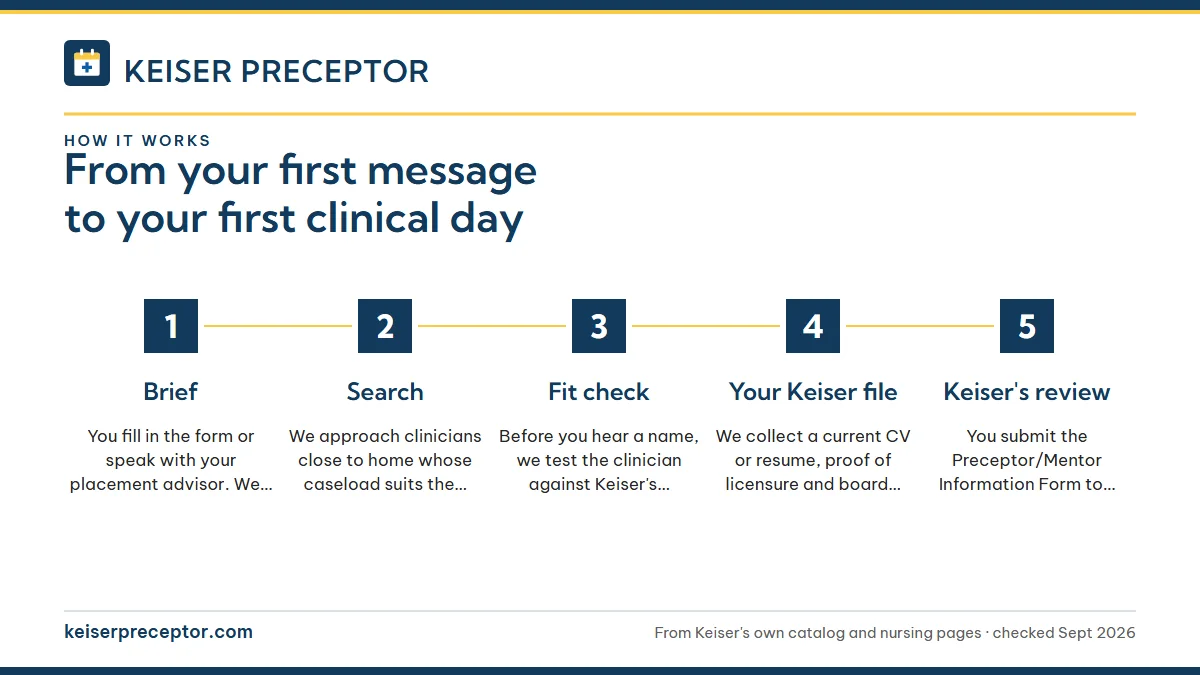
Six steps from brief to first clinical day
Each step mirrors a stage of Keiser's own clinical sequence, so the work we hand you slots straight into Keiser's review instead of being redone.
- BriefYou fill in the form or speak with your placement advisor. We confirm the course, the term and your license picture, and flag anything Keiser should hear about early, such as a site across a state line.
- SearchWe approach clinicians close to home whose caseload suits the course, whether that means adults and older adults, children, women's health or a general family practice.
- Fit checkBefore you hear a name, we test the clinician against Keiser's preceptor rules: the right role and degree, a license in good standing with no restrictions, a year or more in practice, a clinical home at the site, and no supervisory link to you at work.
- Your Keiser fileWe collect a current CV or resume, proof of licensure and board certification, the practice address with the name of whoever signs agreements, and the clinic days and dates you have settled together.
- Keiser's reviewYou submit the Preceptor/Mentor Information Form to your Clinical Faculty or Clinical Coordinator. The Program Director approves the preceptor, the affiliation agreement is signed, and faculty clear the arrangement before any hours count.
- Hours and backupYou begin clinic and log encounters in Typhon. Your placement advisor stays reachable all term and opens a replacement search at once if the preceptor has to step away.
Matching the preceptor to the course, not only the degree
A clinician who looks right on paper can still be a poor fit for a given practicum. Each FNP practicum centers on a patient population, and Typhon tallies your hours by patient age group and diagnosis, so the clinic's caseload matters as much as the title on the door.
NUR602A and NUR603A point us toward practices full of adult and older-adult patients. NUR604A calls for children and adolescents, NUR605A for women's health, and the final Integration Practicum, NUR691A, suits a busy family practice. For WHNP students the four clinicals, NUR612A through NUR615A, stay in women's health; a DNP student's NUR801A and NUR802A hinge on the right practice setting plus a mentor; and NUR4636 in the RN to BSN calls for a community site.
Keiser prefers a master's-prepared FNP for FNP students, allows NPs from adult, pediatric, psychiatric or women's health backgrounds in limited numbers, and takes MDs and DOs. The complete rule set is on our Keiser preceptor requirements guide.
The file we build for Keiser's review
Keiser looks at the preceptor and the site before a single hour counts, and a missing piece sends the request back to you. We assemble every item so your Clinical Coordinator can read the whole picture in one pass.
- The details Keiser's Preceptor/Mentor Information Form asks for, filled in accurately
- A current CV or resume for the preceptor
- License number, state and status, plus national certification where it applies
- The practice's legal name, address and the contact who signs affiliation agreements
- Your plan for clinical course completion: first and last dates and your clinic weekdays
Keiser holds a contract with every clinical site, drawn up on its own template or on the site's agreement. Who signs on Keiser's side, and why the contract comes first, is explained on our affiliation agreements page.
Clinical hours start only once Keiser has approved your preceptor and the contract with the site carries both signatures, so plan your first clinic day around both.
Planning back from the term date
Keiser advises starting to plan each clinical course around three months before it opens, and we treat that as the target for a finished file. Graduate practicums run in 8-week terms that open on fixed Mondays, such as October 26, 2026 and January 11, 2027, so a late search has almost no room to slide. Keiser also wants course faculty to have your clinical dates before the practicum begins.
Students who reach us with less runway still get a full search, run on a tighter schedule, with a plain account of what is realistic for that term. FNP students can ask us to map all five practicums at once, which lets each search begin at the right point in the calendar. Our three-month lead time guide sets the planning window against Keiser's dates.
On call until your hours are done
A placement is finished when your hours are, not when the form is signed. Your placement advisor stays reachable through the term, and if a preceptor leaves the practice, falls ill or withdraws, we begin a replacement search that day and prepare the new file for Keiser's review.
Speed matters because Keiser's older graduate clinical manual does not let students count on a preceptor staying past the end of the term, and missing hours means repeating the entire course. The first moves after a withdrawal are set out on our preceptor dropped out page.
Use the form below or our contact page to send your details, and your placement advisor will reply with a plan for your next course.
Questions Keiser students ask
Do I still deal with Keiser myself?
Yes. Keiser corresponds with its own students, so you submit the Preceptor/Mentor Information Form, answer your Clinical Coordinator and take part in faculty conferences. We prepare the content, keep every detail accurate and help you respond quickly when Keiser has a question about the preceptor or the site.
Can you find a preceptor outside Florida?
Yes, we search wherever you live and hold an RN license. Keiser's two published lists of restricted states disagree with each other, and some states add rules for programs based elsewhere, so settle the state question first. Both lists appear together on our page for out-of-state FNP students.
How long does a preceptor search take?
It varies with the course, the patients it calls for and how many eligible clinicians practice within your reach. Keiser's own FNP page warns that the wait for a preceptor varies with where you live, which is why we work to finish your file roughly three months ahead of the term.
What if I already have a preceptor for some of my courses?
Tell your placement advisor which practicums are covered and we focus the search on the gaps. We can still check a clinician you found against Keiser's rules and help assemble that file, so every course in your sequence reaches Keiser in the same complete shape.
Will I speak with the preceptor before anything goes to Keiser?
Yes. Once a clinician agrees in principle, you talk with them to confirm the schedule, what the clinic expects of students and your first day. That conversation also settles the weekdays that go into your plan for clinical course completion, so Keiser sees dates both of you have agreed.
Related pages
Last checked 2026-09-25
We check these pages against Keiser's catalogs, graduate nursing manuals, licensure disclosures and program pages. Your course, the Clinical Coordinator and the 2026-27 Graduate Catalog have the final word.
Keiser asks you to find your own preceptor. Let us run that search.
Tell us your Keiser program, your next practicum and where you live. We find preceptors who fit the course and prepare the CV, license and site details your Preceptor/Mentor Information Form needs, about three months ahead.
- Preceptors matched to the course: adult and older-adult primary care for
NUR602AandNUR603A, pediatrics forNUR604A, women's health forNUR605A - CV, license, certification and site contact ready for Keiser's review and the affiliation agreement
- Across Florida, from Miami to Jacksonville, and in the other states where you are licensed
Start your placement plan
Your program, city and next practicum term is all we need to begin.