Affiliation agreements: the contract behind every Keiser clinical site
Before you log a single hour at a site, Keiser and that site must have a signed affiliation agreement. It can be Keiser's standard template or the agency's own contract, and it needs a signature from each organization. This guide covers what Keiser's documents say, who signs, and how to keep the agreement from holding up your start.
Get your placement plan
Tell us your Keiser program and where you live. A placement advisor replies with the preceptor and site options that fit your Keiser course.
No agreement, no clinical hours
Keiser's older Graduate Nursing Programs Clinical Manual states the rule plainly: "All clinical sites must have a duly executed Affiliation Agreement with Keiser University prior to starting clinical experiences at the site." The FNP program page says the same from the university's side: "All clinical sites will have a contract with the college and all preceptors will be approved by the college before students begin their clinical experiences."
That makes the agreement a gate, not paperwork to finish during the term. It stands next to preceptor approval, which runs through the Preceptor/Mentor Information Form. A preceptor can be fully approved and still unable to host you if the practice has not signed.
Keiser's template or the agency's
Keiser's 2023 Graduate Nursing Program Policy and Procedure Manual allows either "the standardized Keiser University Nursing Affiliation Agreement template" or "the agency's official affiliation agreement." A small practice with no contract of its own may simply sign Keiser's template. A hospital system or large medical group may prefer its own paper, which then goes through Keiser's review before anyone signs.
Either way, the agreement is between the site and the university, not between the site and you, and the 2023 manual has agreements reviewed at least once a year. If your site has hosted Keiser students before, ask the Clinical Coordinator whether its agreement is current; a live agreement can take this step off your list.
Who signs for each side
Final approval needs signatures from both organizations. For Keiser, the 2023 manual names the Associate Vice Chancellor and, when that officer is unavailable, the Dean of the Graduate School. For the site, it names the agency executive of record: the person with authority to commit the practice or health system.
Your preceptor is often not that person. In a physician-owned office the signer may be an owner or practice manager; in a larger organization it may be an office that handles contracts or student affiliations. Finding that name early is the most useful thing you can do for the agreement.
Inside Keiser, the Program Coordinator oversees clinical sites and keeps agency agreements, and the Clinical Coordinator handles site approval. The approvals and roles guide sorts out the titles.
Your part in getting it signed
You do not sign the agreement, but Keiser expects you to help move it. The older clinical manual describes the student working in partnership with the clinical faculty or Clinical Coordinator to secure an official agreement with a qualified site and preceptor.
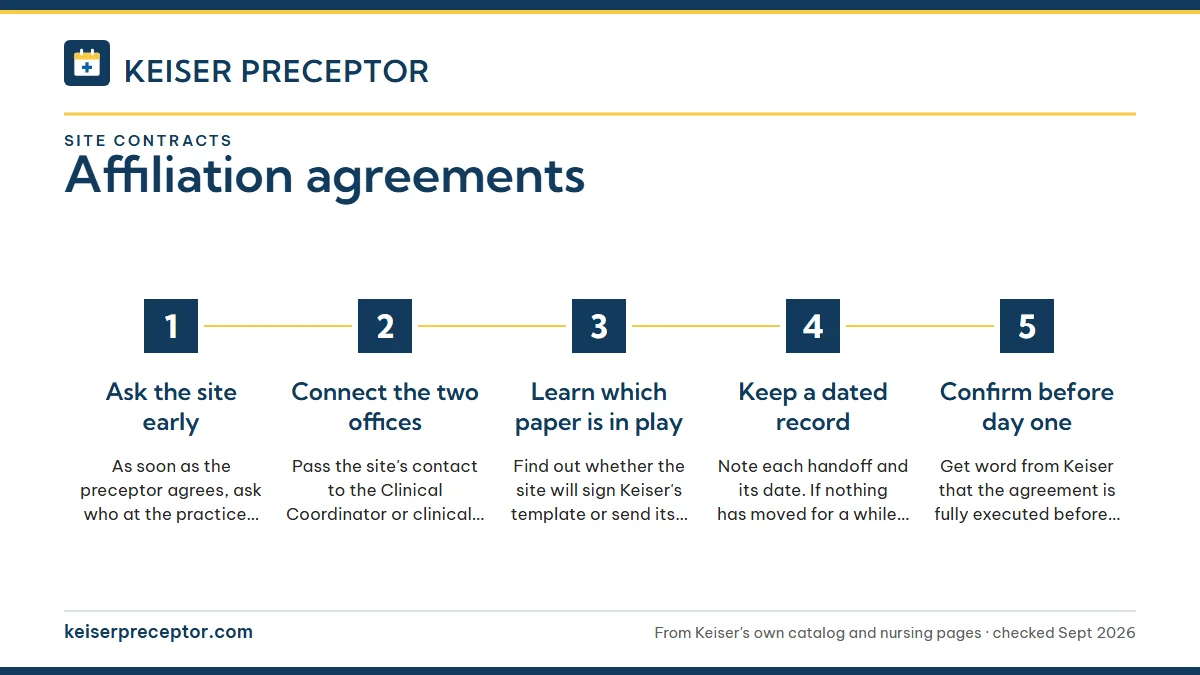
- Ask the site earlyAs soon as the preceptor agrees, ask who at the practice handles student agreements and whether one with Keiser already exists.
- Connect the two officesPass the site's contact to the Clinical Coordinator or clinical faculty, and make sure the site knows whom to reach at Keiser.
- Learn which paper is in playFind out whether the site will sign Keiser's template or send its own, since its own will need Keiser's review.
- Keep a dated recordNote each handoff and its date. If nothing has moved for a while, a polite check-in with both sides is reasonable.
- Confirm before day oneGet word from Keiser that the agreement is fully executed before your first clinical day.
Special cases
A few situations change how the agreement step plays out. Each one below has its own guide.
- Your own workplace: Keiser allows it under conditions, and the older manual permits a liability insurance waiver when the rotation is with your employer. The workplace rules explain the limits.
- A site outside Florida: the agreement is still required, and some states add conditions for out-of-state programs. Delaware, for one, has schools notify its Board of Nursing before using Delaware clinical facilities and send copies of their written agreements with each agency. See out-of-state FNP students.
- A site that falls through: the 2023 manual has the Program Coordinator and Clinical Coordinator coordinate any alternate site with agency representatives. See when a site falls through.
- A second practicum at the same site: the agreement belongs to the site, so a return usually needs the preceptor arrangement and dates confirmed for that course rather than a new contract, as long as the agreement is current. Confirm with the Clinical Coordinator.
What the agreement means for your preceptor
The older clinical manual describes the preceptor role as one provided through the affiliation agreement with voluntary expert clinicians. In other words, the agreement is what lets a volunteer clinician teach you inside their practice under Keiser's supervision, with faculty site visits and evaluations each term.
It is also separate from the Preceptor/Mentor Agreement, a shorter document the preceptor receives with the course objectives and evaluation criteria. Keep the two straight when you talk to the site: one is a contract between organizations, the other is the preceptor's own guide to the role.
Why Keiser students let us start the paperwork early
The agreement is where a promising placement can sit untouched for weeks, so we fold it into the search from the first call. When your placement advisor secures a preceptor, we also find the site's agreement contact, learn whether the site will use Keiser's template or its own, and hand you that information with the rest of your file about three months before the course.
Keiser and the agency do the signing; we make sure the right people are talking from the start, so the contract is moving while the preceptor's approval is still under review.
Questions Keiser students ask
Does my preceptor sign the affiliation agreement?
Usually not. Keiser's 2023 manual has the agreement signed by the agency executive of record, meaning someone who can commit the practice or health system, together with Keiser's Associate Vice Chancellor or the Dean of the Graduate School. A preceptor who owns the practice may be that executive; a staff clinician typically is not.
How long does a Keiser affiliation agreement take?
Keiser publishes no standard timeline. It depends on whether the site already has a current agreement, whether it signs Keiser's template or sends its own, and how quickly each signer responds. Keiser's advice to plan about three months before a clinical course leaves room for this step. See the three-month lead time.
Can I start clinical hours while the agreement is being signed?
Keiser's older clinical manual requires a duly executed agreement before clinical experiences begin at a site, and the FNP program page says every site will have a contract with the college before students begin. Wait until Keiser confirms the agreement is fully signed before your first clinical day, even if your preceptor is ready sooner.
What if the site insists on its own contract?
That is allowed. Keiser's 2023 policy manual accepts the agency's official affiliation agreement as an alternative to Keiser's template. The site's document then goes through Keiser's review and signature, which can take longer than a template the site signs as is, so pass the site's contact to the Clinical Coordinator as early as you can.
Does a site need a new agreement for each Keiser student?
Keiser's documents describe agreements between the university and the agency, reviewed at least annually, rather than a contract for each student. A site that already holds a current agreement may be ready for you sooner. Ask the Clinical Coordinator about the site's status before you assume a new contract is needed.
Related pages
Last checked 2026-09-25
We check these pages against Keiser's catalogs, graduate nursing manuals, licensure disclosures and program pages. Your course, the Clinical Coordinator and the 2026-27 Graduate Catalog have the final word.
Keiser asks you to find your own preceptor. Let us run that search.
Tell us your Keiser program, your next practicum and where you live. We find preceptors who fit the course and prepare the CV, license and site details your Preceptor/Mentor Information Form needs, about three months ahead.
- Preceptors matched to the course: adult and older-adult primary care for
NUR602AandNUR603A, pediatrics forNUR604A, women's health forNUR605A - CV, license, certification and site contact ready for Keiser's review and the affiliation agreement
- Across Florida, from Miami to Jacksonville, and in the other states where you are licensed
Start your placement plan
Your program, city and next practicum term is all we need to begin.