Keiser's post-master's DNP: practice courses, mentors and the 1,000 hours
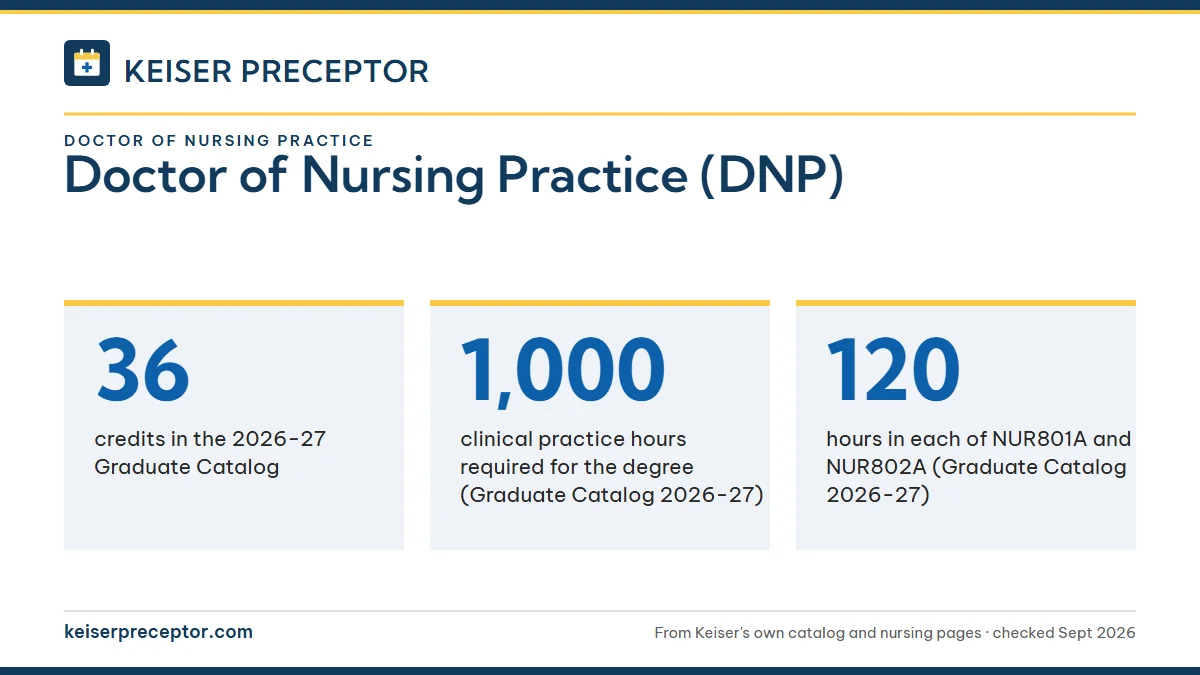
Keiser's Doctor of Nursing Practice is a 36-credit online program for nurses who already hold a master's in nursing, built from 8-week courses and one doctoral residency at the Flagship campus. The degree requires 1,000 clinical practice hours, though Keiser's documents build that total in different ways. Your project team pairs an employer mentor with a Keiser faculty mentor, and the Nursing Chair approves your topic and mentor.
Get your placement plan
Tell us your Keiser program and where you live. A placement advisor replies with the preceptor and site options that fit your Keiser course.
The DNP at a glance
The DNP is post-master's only and runs online in 8-week blocks, with one or two courses running at once. Keiser's catalog and its DNP program page describe the same program with different numbers in several places, so each row below names where the figure comes from. The 2026-27 Graduate Catalog is the one that governs.
| Item | Keiser's figure | Source |
|---|---|---|
| Credits | 36; the program page describes 12 courses | Catalog; program page |
| Length | About 24 months; 18 to 24 months full time | Catalog; program page |
| Course format | 8-week courses, one or two at a time | Catalog |
| Residency | One two-day doctoral residency at the Flagship campus; 2 to 4 days on the program page | Catalog; program page |
| Clinical practice hours | 1,000 for the degree | Catalog |
| Transfer credit | Final 30 credits taken at Keiser; up to 18 transfer credits on the program page | Catalog; program page |
| Time limits | Five years for the degree; eight years from program start for the applied project phase | Catalog |
Who Keiser's DNP admits
To enter, the catalog wants a nursing master's earned with at least a 3.0 CGPA, a current unrestricted RN license from the state you live in, a minimum of one recent year in clinical practice, a clean criminal background check and an interview. Depending on the clinical site, a drug screen can be added.
Two differences from Keiser's NP programs stand out. The DNP looks for an RN license from your home state rather than a Florida license, and it leads to no new license, so Keiser publishes no licensure disclosure for it. The program page pictures its applicants as advanced practice nurses, from nurse practitioners and clinical nurse specialists to nurse anesthetists and nurse midwives, while the catalog's admission list sets no APRN requirement.
The Graduate School FAQ does include the DNP in its list of MSN, FNP and DNP state restrictions. If you live outside Florida, compare that list with your state in the out-of-state guide before you apply.
How the DNP courses are sequenced
The first stretch is the doctoral core, seven 3-credit courses from NUR700 to NUR706: the introduction to the DNP project; advocacy, leadership and ethics; the science behind evidence-based practice; epidemiology and biostatistics; organizational management, quality and safety; information management; and economics and business planning. One elective follows, chosen from adult teaching and learning, acute and emergent health problems, or health care administration.
The practice phase pairs a 1-credit project course with a 2-credit clinical practice course: NUR801, the topic and literature review, with NUR801A, then NUR802, methodology and IRB submission, with NUR802A. ADP902, the applied doctoral project, comes next and is taken three times, and the residency must be finished before your first ADP902 term.
In the catalog, NUR801 lists NUR700 as its prerequisite, so by our reading the first practice course could begin in your second 8-week term; the graduate calendar guide lists the term starts. The program page's outline swaps the three ADP902 terms for DNP Project III and IV plus Clinical Practice III and IV. Follow the catalog, and see the DNP clinical practice courses guide for each course in depth.
1,000 practice hours, counted two ways
The degree calls for 1,000 hours of clinical practice in the catalog, yet the hours printed on its own course lines come to 510: 120 in NUR801A, 120 in NUR802A, and 90 in each of the three ADP902 terms.
Keiser's 2023 graduate nursing policy manual and the 2022 DNP Student Handbook get to 1,000 by other arithmetic, 60 plus 480 plus 460: sixty hours tied to the project courses, four practice courses of 120 hours each, and four core courses carrying 115 hours apiece. The 2026-27 catalog shows no third or fourth practice course and no clinical hours inside the core courses.
Keiser has not published how the two versions reconcile. Before NUR801A begins, ask your faculty mentor or the program in writing how the 1,000 will be tallied in your case, and file the reply with your records. The catalog governs, and the clinical hours guide sets the DNP figures beside Keiser's other programs.
Do not assume the 510 hours in the catalog course lines complete the DNP; the degree requirement is 1,000, and only Keiser can tell you how the rest is earned.
Mentors, preceptors and practice settings
Keiser's DNP wording moves between mentor and preceptor. In the Graduate School FAQ, the project team has three members: you, a supervisor or mentor from your employer, and a faculty mentor from Keiser, with the Nursing Chair signing off on both topic and mentor. That FAQ also draws a line, saying preceptors belong to the FNP rather than the DNP, yet the catalog's descriptions of NUR801A and NUR802A both mention a preceptor.
The two practice courses also face different settings: NUR801A is set inside an organization and NUR802A out in the community, each at about 15 hours a week. The 2022 handbook adds that practice courses need on-site hours at instructor-approved sites, and it lists a nursing practice site among the admission items, which the 2026-27 catalog's admission list leaves out.
Keiser's documents stop short of saying who finds the practice-course preceptor. The safest plan is to treat the setting and mentor as yours to bring, and to confirm both with your faculty mentor well before the term. Every Keiser clinical site needs a signed affiliation agreement before hours start, and a DNP practice site is no exception.
The residency and what finishing takes
The DNP has one residency, held at the Flagship campus. The catalog makes it two days, the program page has described it as 2 to 4, and Keiser's Graduate School FAQ is clear that residencies happen in person. Because it must come before your first ADP902 term, schedule it no later than the term before the applied project begins.
Finishing takes a 3.0 GPA, the last 30 credits earned at Keiser, the 1,000 practice hours, a final project with its presentation, the residency, and completion inside five years. The applied project phase carries its own limit of eight years from program start, and the catalog allows dismissal for students who stop making progress in it.
If the residency falls in a practice term, give your mentor the dates when you set the schedule. At about 15 hours a week, two days away that surface midway through NUR802A are harder to make up than two days planned in from the start.
Why DNP students choose us
A DNP project rests on its practice setting. When your employer cannot host the organizational or community work, or your project calls for a second setting, your placement advisor searches for a site and a qualified mentor that fit NUR801A and NUR802A, near where you live and early enough for approval.
Your advisor collects what the approval chain will look for: the mentor's CV or resume and credentials, license details, who at the site handles the affiliation agreement, and the days you plan to be on site. Your faculty mentor and the Nursing Chair then review one complete file. Keiser decides on the topic, the mentor and the site, and our part is making sure nothing in that file is missing or out of line with Keiser's rules. Read how it works, or send your project area through the form below.
Questions Keiser students ask
Do I need to be an APRN to apply to Keiser's DNP?
Keiser's 2026-27 catalog lists a nursing master's, a 3.0 CGPA and an unrestricted RN license from your home state, with no mention of APRN status. The program page, on the other hand, describes its applicants as advanced practice nurses. If you hold a nursing master's without APRN certification, confirm your eligibility with Keiser before applying.
Can my employer be my Keiser DNP practice site?
Keiser's DNP team model names a supervisor or mentor from your employer, which points to your workplace as a natural setting. The workplace conditions on Keiser's FNP page, another unit and someone other than your boss as preceptor, are stated for FNP rotations rather than DNP work. Because NUR801A and NUR802A call for organizational and community settings, confirm your plan with your faculty mentor.
How long does Keiser's DNP take?
Plan on roughly two years. The catalog's estimate is about 24 months, while the program page quotes a range of 18 to 24 for full-time students, taking one or two 8-week courses at once. The degree must be finished within five years, and the applied project phase has a separate eight-year limit counted from your program start date.
How many transfer credits does Keiser's DNP accept?
The program page says up to 18 credits of transfer credit. The 2026-27 catalog, however, requires the final 30 of the program's 36 credits to be taken at Keiser, which by simple arithmetic leaves room for no more than six. The catalog governs, so ask admissions to evaluate your transcript before you count on a shorter path.
Does Keiser's DNP have a nurse practitioner track?
The 2026-27 catalog shows none. Keiser's MSN program page points MSN graduates toward FNP practice through the DNP, but the catalog DNP carries no FNP option and leads to no new license, which is why Keiser publishes no DNP licensure disclosure. At Keiser, the route to FNP practice is the MSN Family Nurse Practitioner program.
Related pages
Last checked 2026-09-25
We check these pages against Keiser's catalogs, graduate nursing manuals, licensure disclosures and program pages. Your course, the Clinical Coordinator and the 2026-27 Graduate Catalog have the final word.
Keiser asks you to find your own preceptor. Let us run that search.
Tell us your Keiser program, your next practicum and where you live. We find preceptors who fit the course and prepare the CV, license and site details your Preceptor/Mentor Information Form needs, about three months ahead.
- Preceptors matched to the course: adult and older-adult primary care for
NUR602AandNUR603A, pediatrics forNUR604A, women's health forNUR605A - CV, license, certification and site contact ready for Keiser's review and the affiliation agreement
- Across Florida, from Miami to Jacksonville, and in the other states where you are licensed
Start your placement plan
Your program, city and next practicum term is all we need to begin.