Keiser's DNP practice courses and the 1,000-hour rule
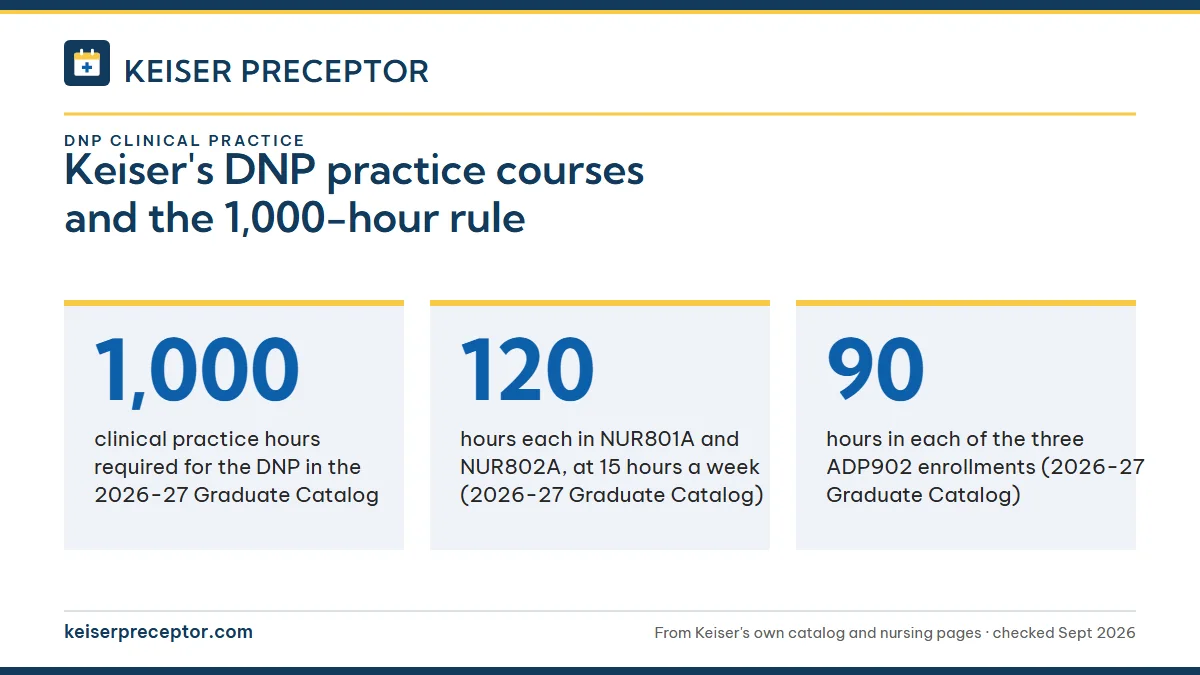
Keiser's post-master's DNP requires 1,000 clinical practice hours, yet the 2026-27 catalog's practice courses list 510 of them: NUR801A and NUR802A at 120 hours each, then ADP902 three times at 90. Here is what each course asks for, who guides the hours, and the different ways Keiser's documents build the full 1,000.
Get your placement plan
Tell us your Keiser program and where you live. A placement advisor replies with the preceptor and site options that fit your Keiser course.
The DNP practice courses at a glance
The DNP is a 36-credit online program that moves in 8-week blocks, with one course or two carried in each block. Its practice hours sit in three course lines. The first two each run beside a DNP project course, so the hours and the project advance in the same term, and ADP902 is the applied project itself.
| Practice course | Runs with | Setting and guide | Catalog hours |
|---|---|---|---|
NUR801A DNP Clinical Practice I | NUR801 DNP Project I: Topic & Literature Review | A preceptor in an organizational setting, 15 hours a week | 120 |
NUR802A DNP Clinical Practice II | NUR802 DNP Project II: Methodology & IRB Submission | A preceptor in a community setting, 15 hours a week | 120 |
ADP902, taken three times | The applied doctoral project itself | A faculty mentor | 90 each |
Keiser's program page draws the degree differently. It swaps the three ADP902 enrollments for DNP Project III and IV plus a pair of courses titled Clinical Practice III and IV, all under a 12-course header. The catalog outline, with 15 course lines, is the governing version, and your advisor can confirm which one your plan of study follows.
NUR801A: practice inside an organization
The first practice course puts you with a preceptor in an organizational setting for 120 hours, about 15 a week across the 8-week term. It runs beside NUR801, where you settle your project topic and write the literature review, so the organization you practice in often becomes the source of your project question. NUR801 requires only NUR700, so the catalog's prerequisites alone could put this practice course in your second term.
Pick this site with the whole project in mind. A health system, practice group or agency where you can watch decisions being made, and where someone will still answer your questions when you reach implementation, serves you far better than a convenient site you leave after eight weeks. The 2022 DNP Student Handbook and the 2023 policy manual describe practice hours as on-site time at instructor-approved sites.
NUR802A: practice in a community setting
The second practice course moves you into a community setting under a preceptor, again 120 hours at roughly 15 a week. Its partner course, NUR802, covers methodology and IRB submission, so this is the term when your project design has to hold up to formal review.
Community settings include public health departments, community clinics, nonprofit health programs and other services that reach a population beyond one organization's walls. Keiser prints two different settings for the two courses, so plan for two distinct experiences and let course faculty confirm each one before hours begin. Because the IRB submission in NUR802 describes where your project will run, a community partner who understands the project and intends to stay involved makes that submission far easier to write.
ADP902 three times, after the Flagship residency
ADP902, the Applied Doctoral Project, is taken three times at 90 hours each, with a faculty mentor guiding the work. At two credits per enrollment that is 45 hours per credit, the university's minimum for a practicum, while the two practice courses run at 60. These are the terms in which the project is carried out, evaluated and readied for presentation.
Before the first ADP902, you complete the doctoral residency at the Flagship campus in West Palm Beach. The catalog calls it a two-day residency; the program page says 2 to 4 days, so hold the longer window until the Graduate School gives you dates. The catalog also sets two clocks worth asking about: five years for the degree, and an eight-year limit on the applied project phase counted from program start.
How Keiser's documents reach 1,000 hours
Every Keiser source agrees on the 1,000-hour requirement. They part ways on where the hours are earned.
- 2026-27 Graduate Catalog: a degree minimum of 1,000 practice hours, but only 510 printed in course descriptions (
NUR801A120,NUR802A120,ADP902three times at 90). - The policy manual's 2023 revision and the DNP handbook from 2022: the project courses contribute 60 hours, four practice courses at 120 apiece contribute 480, and four core courses at 115 apiece supply the last 460.
- Program page: four Clinical Practice courses and four DNP Project courses, numbered I through IV, closer to the older documents' pattern than to the catalog's.
The catalog governs, but it leaves 490 hours without a course attached, so get the answer before you plan your terms. It decides how many practice terms you need, how many sites or mentors you arrange and how you log time. The clinical hours page sets the DNP figures beside every other Keiser program's.
Before you commit to a NUR801A site, have course faculty or the Nursing Chair spell out which courses make up your 1,000 hours.
Preceptor, mentor or both
Keiser uses several words for the person who guides DNP practice hours. The catalog descriptions of NUR801A and NUR802A both mention working with a preceptor. The Graduate School FAQ sketches a three-person team (you, a supervisor or mentor from your employer, and a faculty mentor from Keiser) and gives the Nursing Chair sign-off on both the topic and the mentor. Elsewhere on that FAQ page, preceptors are described as an FNP arrangement that DNP students do not use, a line at odds with the catalog.
Taken together, the working model is a guide at the practice site plus a faculty mentor, with Keiser approving both. The older clinical manual gives clinical faculty, working with the DNP director, final authority over a site and preceptor arrangement, and no site hosts hours until its affiliation agreement with Keiser is signed. The approvals and roles page sorts out each title.
Why DNP students choose us for practice placements
If your employer supplies one setting, the second practice course still calls for a different one, and a project mentor outside your own reporting line is often easier to approve. We search for organizational and community practice sites that suit NUR801A and NUR802A, in person where you live, and shape each match around the project you are building.
For each practice course, your placement advisor prepares the review file: the mentor's or preceptor's resume and license, the name of whoever signs the site's agreement, and a dated schedule of your on-site days, ready roughly three months ahead of the course start. When a mentor or site pulls out mid-project, we find a new one and rebuild the paperwork around your project. The Nursing Chair and course faculty make the decision, and we give them a complete, rule-ready submission to decide on. How it works walks through each step.
Questions Keiser students ask
Can my employer be my DNP practice site?
Keiser's own model points that way. The Graduate School FAQ builds the project team around an employer supervisor or mentor plus a Keiser faculty mentor, and the Nursing Chair approves the topic and mentor. Keep in mind that the catalog sets the first practice course in an organization and the second in the community, so one employer may not cover both.
Do I need to be an APRN for Keiser's DNP?
The program page's FAQ pictures the typical applicant as an advanced practice nurse: NPs, nurse midwives, nurse anesthetists and clinical nurse specialists. The catalog's own admission list reads differently, asking for a nursing master's with a cumulative 3.0, an unrestricted RN license where you live and a year of recent practice, with no mention of APRN status. Admissions can settle which applies.
Can one site cover both NUR801A and NUR802A?
The catalog assigns the first practice course to an organization and the second to the community, so plan on two distinct experiences. Whether one large organization could supply both depends on faculty approving each arrangement separately. Ask before you commit, because changing practice sites in the middle of a DNP project costs time.
Does Keiser's DNP have a state licensure disclosure?
Keiser publishes licensure disclosures for programs that lead to a license, such as the FNP and WHNP, and the post-master's DNP does not lead to one. The state lists that shape where NP students may train belong to those programs, and the licensure disclosures page covers them.
How many months is Keiser's DNP?
Plan on roughly two years. The catalog estimates about 24 months, and the program page quotes 18 to 24 for full-time students. Each course lasts 8 weeks, and the graduate calendar has every 2026 and 2027 Monday start for mapping your practice terms.
Related pages
Last checked 2026-09-25
We check these pages against Keiser's catalogs, graduate nursing manuals, licensure disclosures and program pages. Your course, the Clinical Coordinator and the 2026-27 Graduate Catalog have the final word.
Keiser asks you to find your own preceptor. Let us run that search.
Tell us your Keiser program, your next practicum and where you live. We find preceptors who fit the course and prepare the CV, license and site details your Preceptor/Mentor Information Form needs, about three months ahead.
- Preceptors matched to the course: adult and older-adult primary care for
NUR602AandNUR603A, pediatrics forNUR604A, women's health forNUR605A - CV, license, certification and site contact ready for Keiser's review and the affiliation agreement
- Across Florida, from Miami to Jacksonville, and in the other states where you are licensed
Start your placement plan
Your program, city and next practicum term is all we need to begin.