Reading Keiser's professional licensure disclosures
Keiser posts a professional licensure disclosure for each nursing program that leads to a license, marking every state as meets or does not meet for educational requirements. The FNP and WHNP versions, updated November 2025, hold the answers online students need most, and the Graduate School FAQ keeps a separate restriction list that disagrees with them.
Get your placement plan
Tell us your Keiser program and where you live. A placement advisor replies with the preceptor and site options that fit your Keiser course.
What a Keiser licensure disclosure tells you
Keiser's licensure disclosures page links one PDF per program. Each PDF runs through the states and gives each a status: the program meets that state's educational requirements for licensure, or it does not. For a nurse practitioner student, that status speaks to the question that matters after graduation: whether the program you finish lines up with what your state expects of an NP applicant.
Keiser's professional licensure page adds a caution worth reading before any list: "Keiser University has not determined if the program meets all of the requirements in your home state or the state you plan on seeking employment." In other words, the disclosure covers education. Licensure itself runs through your state board, which can have conditions of its own.
That is why the disclosure is a starting point rather than a final answer. Pair it with the Graduate School FAQ list, your board's rules and a direct confirmation from Keiser, in that order.
Which Keiser programs carry a disclosure
Keiser's disclosures page covers the programs that lead to a license. Here is what each one reports, as read on September 25, 2026.
| Program | Disclosure | What it reports |
|---|---|---|
| MSN Family Nurse Practitioner | FNP disclosure, updated November 2025 | Does not meet in thirteen states; meets in every other state plus DC and Puerto Rico, with a placement note for New York |
| MSN Women's Health NP | WHNP disclosure, updated November 2025 | The FNP's thirteen states plus Maryland |
| Doctor of Nurse Anesthesia Practice | DNAP disclosure | Meets in all states |
| ASN and BSN | ASN/BSN disclosure, June 2024 | Meets in all states |
| Doctor of Nursing Practice | None | The post-master's DNP leads to no new license |
The DNP's missing disclosure is expected, since its students are already licensed nurses and finish with no new license. The Graduate School FAQ still names the DNP in its state restriction question, though, so DNP applicants check that list even without a disclosure to read.
The FNP and WHNP states marked does not meet
Keiser's November 2025 FNP disclosure marks thirteen states as not meeting educational requirements: Alabama, Alaska, Arizona, California, Connecticut, Louisiana, Minnesota, New Hampshire, Oregon, Pennsylvania, South Dakota, Tennessee and Washington. Every other state meets, as do the District of Columbia and Puerto Rico.
New York carries a qualifier. The disclosure lists it as meeting requirements but notes: "Practicum and internship placements cannot be made in NY and must be completed where approved." That line shapes the plan for every New York student, and the New York guide explains how.
The WHNP disclosure repeats the FNP's thirteen states and adds Maryland, making fourteen. The Maryland guide looks at what that means alongside Maryland's own board rules.
Check three states, not one: where you live, where your practicums will happen and where you plan to seek NP licensure. For many students they are the same state. For a student near a border, or one planning a move after graduation, they may not be, and each state's status matters. The California guide is a useful example of a state where both Keiser's disclosure and the state's own approval list point the same way.
The Graduate School FAQ's separate list
Keiser's Graduate School FAQ answers a question about current MSN, FNP and DNP state restrictions with a different set of places: Nevada, the District of Columbia, Hawaii, Idaho, Kansas, Louisiana, Maryland, Minnesota, New York, North Carolina, North Dakota, Oregon and Washington. It adds that New York students can be accepted but complete their clinicals in a bordering state.
| Group | States |
|---|---|
| On both lists | Louisiana, Minnesota, Oregon, Washington |
| FNP disclosure only (does not meet) | Alabama, Alaska, Arizona, California, Connecticut, New Hampshire, Pennsylvania, South Dakota, Tennessee |
| Graduate School FAQ only | District of Columbia, Hawaii, Idaho, Kansas, Maryland (also on the WHNP disclosure), Nevada, New York (clinicals), North Carolina, North Dakota |
Keiser publishes nothing that reconciles the two, so neither can be read as the full picture. Ask the Graduate School which applies to your state and keep its reply. The out-of-state FNP guide shows the cautious combined reading and the state boards whose approval lists Keiser was missing from.
What SARA membership settles, and what it leaves to the states
Keiser is a member of SARA, the interstate agreement for distance education. Students sometimes read that membership as permission to train anywhere. Keiser's own catalog corrects the idea: SARA "has no effect on state professional licensure requirements."
In practice, a state can be comfortable with Keiser's online courses and still apply its own nursing rules to clinical placements and NP licensure. New York shows the gap clearly. Its education department says clinical placements in the state's licensed professions need prior approval, even for out-of-state institutions that belong to SARA. Several other boards keep lists of out-of-state programs approved for clinicals, and SARA membership does not put a school on them.
So treat SARA as background. The disclosure, the FAQ list and your board's rules are what decide whether your plan works.
Using the disclosures for your own plan
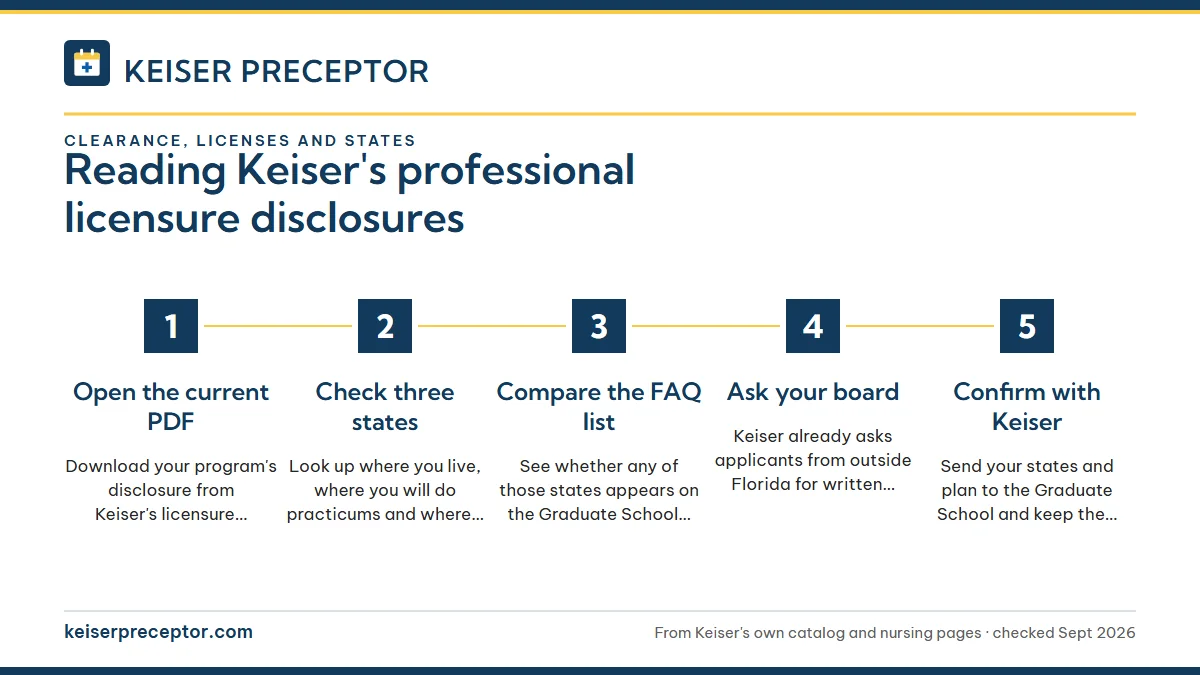
- Open the current PDFDownload your program's disclosure from Keiser's licensure disclosures page and note the updated date printed on it.
- Check three statesLook up where you live, where you will do practicums and where you plan to be licensed as an NP.
- Compare the FAQ listSee whether any of those states appears on the Graduate School FAQ's restriction list.
- Ask your boardKeiser already asks applicants from outside Florida for written verification from their home state, so put your questions to the board in writing.
- Confirm with KeiserSend your states and plan to the Graduate School and keep the answer with your application records.
The Florida RN license guide covers the verification letter and the licenses Keiser asks for at admission.
Why Keiser students choose us once the state question is settled
When your state checks out, the next step is the one Keiser leaves to you: finding the preceptor and site. We search in the state your plan uses, near where you live, and check each preceptor against Keiser's rules before you see a name. For a New York student, that means sites in a neighboring state that Keiser's lists allow, and for a student near a border it means checking which side of the line fits both Keiser and the board.
We then gather what Keiser's review needs, from the preceptor's CV and license to the agreement contact and the clinical dates. Approval rests with Keiser's faculty, who receive a file with every piece in place. Tell us your state and program in the form below.
Questions Keiser students ask
What does "does not meet" mean on a Keiser licensure disclosure?
It means Keiser reports that the program does not meet that state's educational requirements for licensure. For FNP and WHNP students, that bears directly on becoming licensed as a nurse practitioner in that state after graduation. If your state carries that status, talk with Keiser's Graduate School before you apply.
Is Keiser's online FNP open to students in every state?
No. The November 2025 FNP disclosure marks thirteen states as not meeting educational requirements, and the Graduate School FAQ restricts a partly different group of states plus the District of Columbia. New York residents can be accepted but complete clinicals elsewhere. Confirm your own state with Keiser before applying.
Does SARA membership mean I can do Keiser clinicals in my state?
Not by itself. Keiser's catalog says SARA has no effect on state professional licensure requirements, and some states set their own rules for clinical placements by out-of-state programs. New York, for one, requires prior approval for placements even from SARA member schools. Check your board's rules directly.
How current are Keiser's licensure disclosures?
The FNP and WHNP disclosures read on September 25, 2026 were marked updated November 2025, and the ASN/BSN disclosure June 2024. Keiser can revise them, so download the current PDF from the licensure disclosures page whenever you check a state rather than relying on a saved copy.
Why does Maryland appear on the WHNP disclosure but not the FNP one?
Keiser does not explain the difference. Maryland meets on the FNP disclosure, does not meet on the WHNP disclosure, and appears on the Graduate School FAQ restriction list. Maryland's board also approves NP programs before certifying graduates, so Maryland students in either track should get Keiser's answer in writing.
Related pages
Last checked 2026-09-25
We check these pages against Keiser's catalogs, graduate nursing manuals, licensure disclosures and program pages. Your course, the Clinical Coordinator and the 2026-27 Graduate Catalog have the final word.
Keiser asks you to find your own preceptor. Let us run that search.
Tell us your Keiser program, your next practicum and where you live. We find preceptors who fit the course and prepare the CV, license and site details your Preceptor/Mentor Information Form needs, about three months ahead.
- Preceptors matched to the course: adult and older-adult primary care for
NUR602AandNUR603A, pediatrics forNUR604A, women's health forNUR605A - CV, license, certification and site contact ready for Keiser's review and the affiliation agreement
- Across Florida, from Miami to Jacksonville, and in the other states where you are licensed
Start your placement plan
Your program, city and next practicum term is all we need to begin.