Who can precept a Keiser FNP student
Keiser prefers a master's-prepared Family Nurse Practitioner as your preceptor, allows a limited number of other nurse practitioners, and accepts physicians with an MD or DO. Every preceptor also needs an active, unencumbered license, at least a year of experience and a practice at your clinical site. Here are the rules in full, where each comes from, and how to match a preceptor to each practicum.
Get your placement plan
Tell us your Keiser program and where you live. A placement advisor replies with the preceptor and site options that fit your Keiser course.
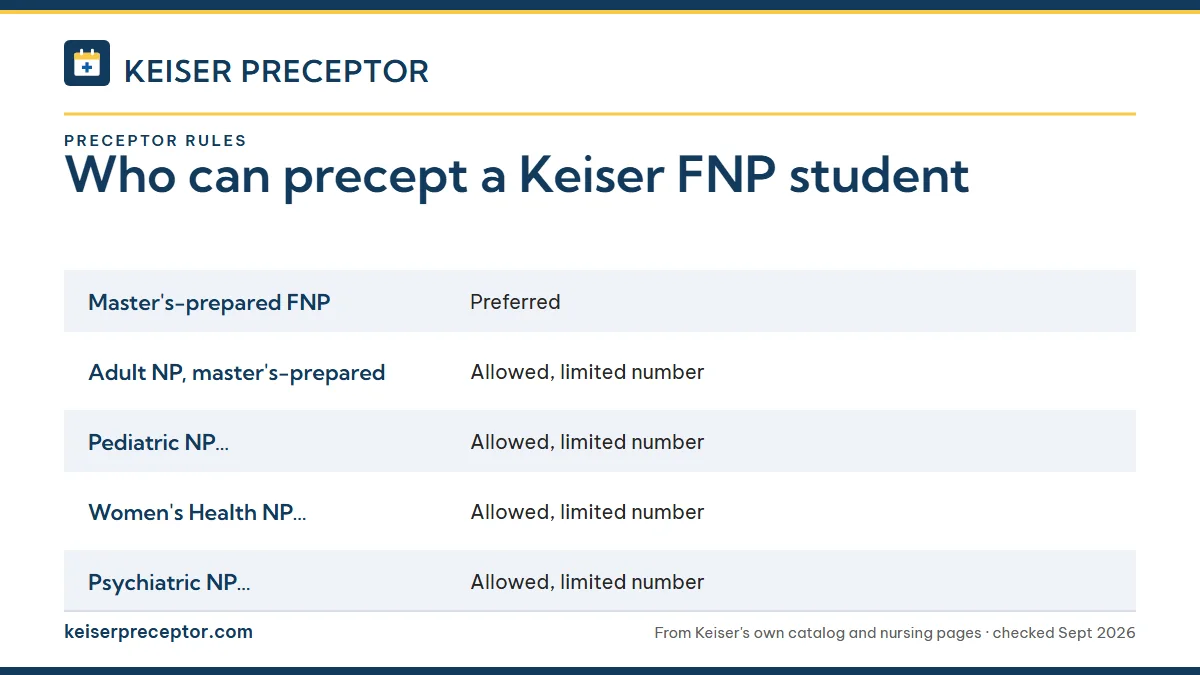
Keiser's wording on who can precept
Keiser's FNP program page sets out the options in one passage: "While it is preferred that the preceptor be a Masters prepared Family Nurse Practitioner, you may use a limited number of other professionals as preceptors such as Masters prepared Adult Nurse Practitioners, Pediatric Nurse Practitioners, Psychiatric Nurse Practitioners and Women's Health Nurse Practitioners). Medical doctors (MD) and Doctors of Osteopathic Medicine (DO) are acceptable as preceptors."
That gives three tiers. An FNP is the default. Other master's-prepared NPs are allowed, but only for a limited number of your preceptors, and Keiser publishes no figure for that limit. Physicians with an MD or DO are named separately as acceptable. Physician assistants do not appear in the passage, so ask course faculty before you approach one.
| Clinician | Keiser's FNP wording | Usually fits |
|---|---|---|
| Master's-prepared FNP | Preferred | Any practicum, especially NUR602A, NUR603A and NUR691A |
| Adult NP, master's-prepared | Allowed, limited number | NUR602A and NUR603A |
| Pediatric NP, master's-prepared | Allowed, limited number | NUR604A |
| Women's Health NP, master's-prepared | Allowed, limited number | NUR605A |
| Psychiatric NP, master's-prepared | Allowed, limited number | Ask course faculty how it fits a practicum |
| MD or DO | Acceptable | Family medicine, internal medicine, pediatrics or OB-GYN, matched to the practicum |
| Physician assistant | Not listed | Confirm with course faculty first |
License, experience and practice setting
Type is only half the test. Keiser's FNP page adds that the preceptor must hold an active license, practice at the site you choose, have at least a year of experience and be willing to mentor. Keiser's 2023 clinical sites policy is stricter on the license: preceptors "will hold unrestricted state licensure."
Keiser's older Graduate Nursing Programs Clinical Manual lists qualifications for preceptors across all graduate tracks, which it says "include but are not limited to" the following.
- At least one year's experience in the role
- Authorization to practice as an advanced practice nurse in the state, or a current license as a health care professional
- A current unencumbered license
- State approval in a specialty
- Professional certification, if appropriate
- Preferably, an earned graduate degree
Where the older manual and the current program page differ, the program page and catalog carry more weight, and course faculty settle any open question.
Supervision rules on site
The rules cover how the preceptor works with you, not only who they are. Keiser's 2023 policy says preceptors "will always engage in direct supervision of the student," and anyone standing in for a day must have the same credentials and experience as your designated preceptor.
The preceptor also completes your evaluations at week 4 and week 8 of each practicum, takes part in faculty site visits, and receives orientation from Keiser's faculty along with the course objectives and evaluation criteria. See preceptor evaluations and site visits for how each works.
Who is ruled out
Your immediate supervisor cannot precept you. If you train where you work, Keiser requires a department other than your usual one and hours outside your normal schedule, and it bars assignment to the unit where you are currently employed. The workplace clinical rules cover the full set of conditions.
Beyond that, a clinician falls outside Keiser's rules if their type is not on the list, if they do not actually practice at the site, if their license is not current and unrestricted in the state where you train, or if they have less than a year in the role.
Matching a preceptor to each practicum
A preceptor who clears every rule still has to see the right patients. Each FNP practicum centers on a population, and the preceptor's panel should supply enough of those patients to fill the hours.
NUR602AandNUR603A: adults and older adults in primary care, 120 hours each in the 2026-27 catalogNUR604A: children and adolescents, 60 hoursNUR605A: women's health, 60 hoursNUR691A: the final Integration Practicum, 180 hours in the catalog and 150 on the program page
A family practice with a broad panel can suit several of these; a specialty office usually suits one. The FNP practicum courses guide goes course by course.
What Keiser offers preceptors
Keiser's preceptors are volunteers. The older clinical manual describes the role as provided through affiliation agreements with voluntary expert clinicians, and Keiser's public documents list no payment or other incentive for precepting. What Keiser does provide is faculty orientation, the course objectives and evaluation criteria, and two suggested readings: a mentoring text and NONPF's preceptor manual.
Clinicians weighing a request from a Keiser student can read our page for preceptors, which explains what the role involves.
Why students trust us with the match
Keiser students choose us because every candidate is screened against these exact rules before anyone is asked for a yes: the right clinician type for your practicum, an active, unencumbered license in your clinical state, at least a year in practice, a real practice at the site, and no supervisory tie to you.
Your placement advisor then gathers the CV and credential details for your Preceptor/Mentor Information Form. The Program Director approves; we make sure the preceptor you bring fits from the start.
Questions Keiser students ask
Can a physician assistant precept a Keiser FNP student?
Physician assistants are not on the list in Keiser's FNP wording, which names FNPs as preferred, other master's-prepared NPs in limited numbers, and MDs and DOs as acceptable. Keiser publishes no ruling on PAs either way, so ask course faculty or the Clinical Coordinator before you approach one, and expect the Program Director to weigh the request.
How many of my preceptors can be non-FNP nurse practitioners?
Keiser says a "limited number" but publishes no figure. With five practicums, the practical approach is to use FNPs wherever you can and save other NP types for the practicum they fit, such as a Pediatric NP for NUR604A or a Women's Health NP for NUR605A. Course faculty can tell you where the line sits for your cohort.
Does my preceptor need a doctorate?
No. Keiser's FNP wording asks for master's-prepared nurse practitioners, and the older clinical manual lists an earned graduate degree as preferred rather than required. Physicians hold an MD or DO by definition. Experience, licensure and a practice at your site carry more weight in the review than the level of the degree.
Does my preceptor need a Florida license?
Only if you train in Florida. Keiser's 2023 policy asks for unrestricted state licensure, so the preceptor needs a license valid where they practice, the same state as your clinicals. Keiser separately requires you to hold a Florida RN license plus a license in your clinical state if you train outside Florida.
Can a newly licensed NP precept me?
Not in their first year. Keiser's FNP page asks for at least one year of experience, and the older clinical manual phrases it as a minimum of one year's experience in the role, which reads as a year practicing as an NP or physician rather than a year in nursing overall. Ask course faculty if a candidate is close to the mark.
Related pages
Last checked 2026-09-25
We check these pages against Keiser's catalogs, graduate nursing manuals, licensure disclosures and program pages. Your course, the Clinical Coordinator and the 2026-27 Graduate Catalog have the final word.
Keiser asks you to find your own preceptor. Let us run that search.
Tell us your Keiser program, your next practicum and where you live. We find preceptors who fit the course and prepare the CV, license and site details your Preceptor/Mentor Information Form needs, about three months ahead.
- Preceptors matched to the course: adult and older-adult primary care for
NUR602AandNUR603A, pediatrics forNUR604A, women's health forNUR605A - CV, license, certification and site contact ready for Keiser's review and the affiliation agreement
- Across Florida, from Miami to Jacksonville, and in the other states where you are licensed
Start your placement plan
Your program, city and next practicum term is all we need to begin.