Precepting a Keiser nursing student: what Keiser asks of you
A Keiser nurse practitioner student spends one 8-week term in your practice, seeing patients under your direct supervision. Keiser approves you as the preceptor, signs an agreement with your practice, orients you, and checks in through evaluations and a faculty visit. Our placement desk prepares the student's side so your part stays short and predictable.
Get your placement plan
Tell us your Keiser program and where you live. A placement advisor replies with the preceptor and site options that fit your Keiser course.
What the commitment looks like
The student who asks you is most likely enrolled in the online MSN FNP at Keiser, a program built on five practicums, each one 8-week term long and paired with a didactic course. The student works in your practice for a set number of hours, spread across the eight weeks rather than packed into a few days.
For the two adult practicums (NUR602A and NUR603A, 120 hours each), Keiser's FNP page puts the pace at roughly 15 or 16 hours weekly. The pediatric and women's health practicums (NUR604A and NUR605A) are half that size, near 8 hours a week. The last one, the Integration Practicum NUR691A, is bigger again: the current catalog lists 180 hours, the FNP web page 150, and course faculty settle which applies.
Throughout, you supervise directly: Keiser's policy manual expects preceptors to supervise the student directly, every hour. Hours count as direct patient care when the student assesses, diagnoses, treats or evaluates real patients under that supervision.
Who Keiser approves as a preceptor
Keiser's first choice for an FNP student is an FNP who holds a master's. Some of a student's preceptors may instead be NPs trained in adult, pediatric, psychiatric or women's health care, and physicians (MD or DO) qualify too. Keiser also looks for a clean, active license, a year or more in the role, and a clinician who works at the site hosting the student.
You cannot be the student's immediate supervisor. If the student works for your organization, the rotation has to sit in a different department from their usual one and fall outside their normal working hours. If you are unsure whether your credentials fit, the student's Clinical Coordinator can confirm before any paperwork starts. The complete list is on our Keiser preceptor requirements page.
The paperwork, and who handles it
Keiser keeps the preceptor's side of the paperwork light, and our placement desk organizes it so you are asked once.
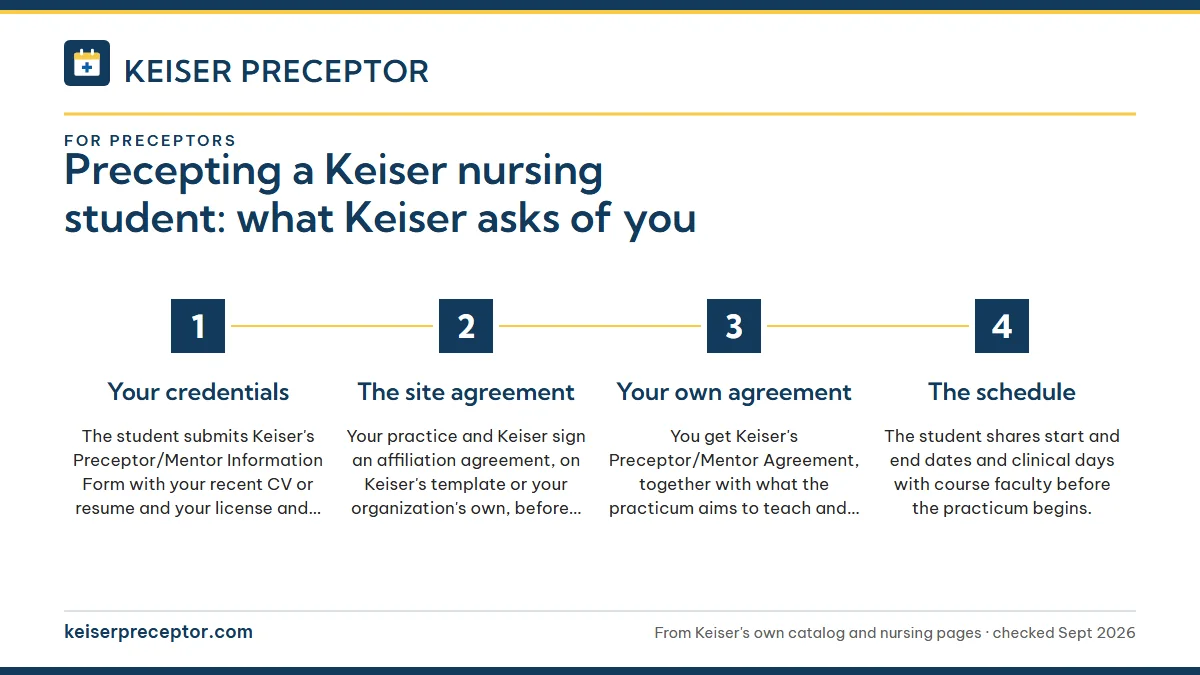
- Your credentialsThe student submits Keiser's Preceptor/Mentor Information Form with your recent CV or resume and your license and certification details. Keiser's Program Director approves the preceptor.
- The site agreementYour practice and Keiser sign an affiliation agreement, on Keiser's template or your organization's own, before clinical work starts. See our affiliation agreements guide.
- Your own agreementYou get Keiser's Preceptor/Mentor Agreement, together with what the practicum aims to teach and the yardstick you will grade against.
- The scheduleThe student shares start and end dates and clinical days with course faculty before the practicum begins.
Faculty sign off on the arrangement before the student's first hour, and under Keiser's policy manual a faculty member reviews your site beforehand, either by visiting or virtually.
Orientation, evaluations and faculty visits
Keiser's Graduate Nursing Programs Clinical Manual, an older document still posted on Keiser's site, assigns clinical faculty to orient new preceptors to the preceptor role, so a first-time preceptor is not left to guess. From there, the term follows a steady rhythm.
- Week 4: you complete the midterm evaluation on Keiser's Clinical Evaluation Form, and the student adds a self-evaluation.
- During the semester: a Keiser faculty member evaluates the placement at least once, face to face at your practice or over video, and holds a phone conference with you at least once per term.
- Week 8: you complete the final evaluation, and the student evaluates you and the site.
- Throughout: the student logs encounters in Typhon, Keiser's tracking system, within 7 days of each visit.
Keiser's minimum ratings rise across the five FNP practicums, so expectations in the Integration Practicum are higher than in the first. Our guides to Keiser preceptor evaluations and faculty site visits cover both in detail.
Keiser's day-to-day expectations
A few Keiser rules shape the student's time in your practice. Telehealth may count for no more than a quarter of direct patient care hours. Clinical work stops at 16 consecutive hours without restful sleep. A student who misses a scheduled day without telling you and faculty is treated as a no call/no show, which Keiser takes seriously.
On a day a colleague covers for you, Keiser's policy manual asks that the colleague match your qualifications and background. Incidents go into a Keiser incident report within 24 hours.
If the student is struggling, say so early, ideally before or at the week 4 evaluation. Where a preceptor's evaluation is unfavorable, Keiser's clinical manual leaves it to the faculty member to decide whether the student met the course goals, so your honest input is exactly what Keiser needs.
Why preceptors like working with our students
Keiser's clinical manual frames precepting as volunteer work by expert clinicians, arranged under the affiliation agreement, and we treat that generosity with respect. We match you with a student whose practicum fits the patients you actually see, near your practice.
Before the student arrives, the file is organized: your CV and license details requested once, the agreement contact identified, and clinical days mapped across all eight weeks. You spend your time teaching, not chasing forms.
Open to precepting a Keiser student? Select the preceptor option ("I'm a preceptor (not a student)") in the form at the bottom of this page, or write through our contact page, and share your specialty, location and preferred terms.
Questions Keiser students ask
Is precepting a Keiser student a paid role?
Keiser treats it as voluntary. Its clinical manual says clinicians take on the preceptor role as volunteers, under the affiliation agreement with their practice, and the student's own clinical hours carry no pay either. Questions about any recognition Keiser offers its preceptors are best put to the student's Clinical Coordinator.
How many hours a week does precepting a Keiser FNP student take?
That varies by course. A 120-hour adult practicum runs at the 15 or 16 hours a week Keiser's FNP page mentions, while a 60-hour one needs about 8, both spread over the 8-week term. The closing Integration Practicum is heavier: 180 hours by the catalog, 150 by the web page.
Can I precept a student who works at my organization?
Yes, within Keiser's workplace rules. You cannot be the student's immediate supervisor, the rotation must be in a department other than the student's usual one, and the clinical hours must fall outside the student's normal working hours. Keiser also bars students from training on the unit where they are employed.
Do I have to sign Keiser's affiliation agreement personally?
Usually not. The affiliation agreement is between Keiser and your practice or agency, with Keiser's signature coming from its Associate Vice Chancellor (or the Graduate School's Dean when needed) and yours from the agency executive of record. Your personal paperwork is the separate Preceptor/Mentor Agreement.
Who do I contact at Keiser during the practicum?
The student's clinical faculty member is your main Keiser contact during the term, including for the site visit and evaluations. The Clinical Coordinator handles preceptor and site paperwork. The student can give you both contacts at the start, and our placement desk makes sure you have them before week 1.
Related pages
Last checked 2026-09-25
We check these pages against Keiser's catalogs, graduate nursing manuals, licensure disclosures and program pages. Your course, the Clinical Coordinator and the 2026-27 Graduate Catalog have the final word.
Keiser asks you to find your own preceptor. Let us run that search.
Tell us your Keiser program, your next practicum and where you live. We find preceptors who fit the course and prepare the CV, license and site details your Preceptor/Mentor Information Form needs, about three months ahead.
- Preceptors matched to the course: adult and older-adult primary care for
NUR602AandNUR603A, pediatrics forNUR604A, women's health forNUR605A - CV, license, certification and site contact ready for Keiser's review and the affiliation agreement
- Across Florida, from Miami to Jacksonville, and in the other states where you are licensed
Start your placement plan
Your program, city and next practicum term is all we need to begin.