A preceptor placement service built around Keiser's clinical process
We find preceptors and clinical sites for Keiser University nursing students, matched to the practicum in front of them and close to home. Everything we do is shaped by Keiser's own rules, from the Preceptor/Mentor Information Form to the 8-week term. That focus is why Keiser students choose us.
Get your placement plan
Tell us your Keiser program and where you live. A placement advisor replies with the preceptor and site options that fit your Keiser course.
What we do for Keiser students
Keiser tells its FNP students that finding clinical sites and preceptors is their job, and that the search can take time depending on where they live. We take that job on. Our placement desk searches for clinicians near you whose patients fit your Keiser course, confirms they meet Keiser's preceptor rules, and puts together what Keiser's Clinical Faculty and Clinical Coordinator will want to see: a current CV, license and board certification, a named contracts contact at the practice, and a day-by-day clinical calendar.
The goal is a complete file in Keiser's hands about three months before the course starts, with a backup plan ready in case a preceptor has to step away mid-term. Every approval belongs to Keiser's faculty and Program Director. We make sure the file they open is whole from the start.
Why we focus on Keiser alone
Keiser's clinical rules are specific, and the details decide whether a preceptor is approved quickly or sent back. Practicums run in 8-week terms paired with didactic courses. Preceptor types are defined, with FNPs preferred and other NPs accepted in limited numbers. Workplace rotations have their own conditions. Every site needs an affiliation agreement signed before the first hour.
Working only with Keiser students means we know those rules by heart. We know that NUR604A needs a clinician who sees children and adolescents, that the Integration Practicum carries the second Fort Lauderdale residency, and that patient encounters are documented for faculty within 7 days. That knowledge shows up as fewer returned forms and faster starts.
It also means we notice when Keiser's own documents disagree with each other, and we plan around the stricter reading until your faculty confirm which one applies.
The principles behind every match
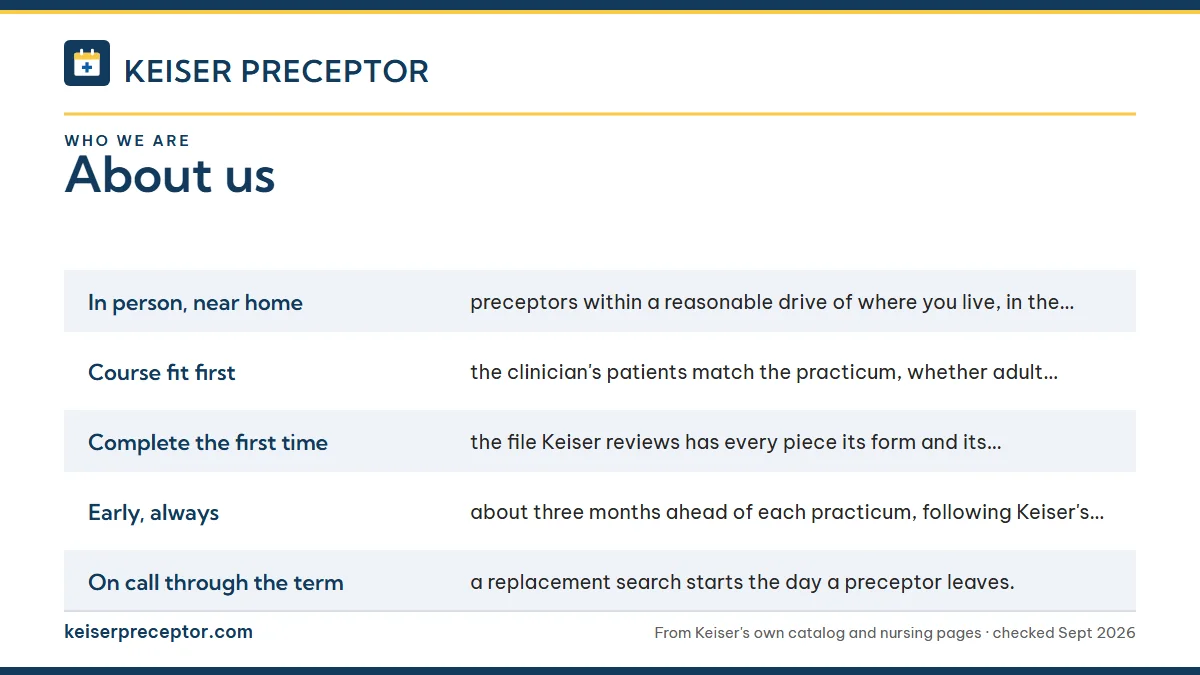
- In person, near home: preceptors within a reasonable drive of where you live, in the state where you hold your RN license.
- Course fit first: the clinician's patients match the practicum, whether adult primary care, pediatrics, women's health or a DNP practice setting.
- Complete the first time: the file Keiser reviews has every piece its form and its Clinical Coordinator ask for.
- Early, always: about three months ahead of each practicum, following Keiser's own advice.
- On call through the term: a replacement search starts the day a preceptor leaves.
Our how it works page walks through the service step by step, and our cost page explains what shapes a quote.
Each principle follows from how Keiser's process actually works, which is why the same standards hold for every Keiser program we support.
How we write this site
Every Keiser fact on this site comes from Keiser's own documents: the 2026-27 Graduate and Undergraduate Catalogs, the graduate nursing manuals, Keiser's program pages, and its licensure disclosures. Each page lists the official sources it relies on.
Keiser's documents sometimes disagree. The FNP clinical hours appear as 540 in the 2026-27 Graduate Catalog, 510 on the FNP page, and 630 in an older clinical manual. The WHNP requirement reads 710 in one part of the catalog while its course hours add to 680. Where that happens, we show both figures, name each source, and point to the catalog and your course faculty for the final word. Our Keiser clinical hours guide lays those numbers side by side.
Who we work with
The bulk of our work is for FNP students, who must bring Keiser a preceptor for every one of five practicums. We also support WHNP students completing clinicals outside South Florida, where the catalog asks them to select their own site; post-master's DNP students who need a practice site and mentor; and RN to BSN students securing a preceptor for the 45 hours in NUR4636. Each group works under different Keiser rules, so every search starts from your program's requirements.
Many of our students live in Florida, and many live in other states where Keiser's rules allow clinicals. Wherever you live, the match is screened against the same Keiser requirements. Our Florida NP preceptors guide covers the home state, and the state guides cover the rest.
Respect for the clinicians who precept
Keiser's graduate clinical manual describes its preceptors as voluntary expert clinicians, and we build every request around that. We ask clinicians only when the student and course genuinely fit their practice, we explain Keiser's expectations up front, and we collect credentials once rather than in a trickle of follow-up emails.
That respect is practical as well as polite: preceptors who know exactly what the eight weeks involve are the ones who see them through. Clinicians weighing the role will find the details in our guide for Keiser preceptors.
We stay reachable for preceptors through the term as well, so a question about the week 4 evaluation or the faculty visit gets a quick, clear answer.
Questions Keiser students ask
Which Keiser students do you help?
Mainly students in Keiser's online MSN FNP program, who find their own preceptors for five practicums. We also help WHNP students with clinicals outside South Florida, DNP students who need a practice site and mentor, and RN to BSN students looking for a NUR4636 preceptor. Keiser arranges clinicals for its pre-licensure BSN and ASN students.
Do you help Keiser students who live outside Florida?
Yes, where Keiser's rules allow clinicals in your state. Keiser's admission rules pair a Florida RN license with a second license in the clinical state for FNP and WHNP students, and its two published state lists do not match. We compare both in our out-of-state guide.
Who approves the preceptors you find?
Keiser does. The Program Director approves each preceptor from the Preceptor/Mentor Information Form, CV and license details, clinical faculty approve the arrangement before hours begin, and the site signs an affiliation agreement with Keiser. Our contribution is a file with every piece Keiser asks for, organized so review can move.
How is using a placement service different from searching alone?
You still end up with a preceptor Keiser must approve, but the search, the screening and the file preparation happen on our side, in parallel, with a backup ready. Our guide comparing placement help and finding your own weighs the options honestly.
How do I get started?
Use the form on any page or on our contact page. Tell us your Keiser program, the practicum ahead, its term start date and where you live. Your placement advisor replies with the next steps and the questions that shape your search, including any timing pressure you mention.
Related pages
Last checked 2026-09-25
We check these pages against Keiser's catalogs, graduate nursing manuals, licensure disclosures and program pages. Your course, the Clinical Coordinator and the 2026-27 Graduate Catalog have the final word.
Keiser asks you to find your own preceptor. Let us run that search.
Tell us your Keiser program, your next practicum and where you live. We find preceptors who fit the course and prepare the CV, license and site details your Preceptor/Mentor Information Form needs, about three months ahead.
- Preceptors matched to the course: adult and older-adult primary care for
NUR602AandNUR603A, pediatrics forNUR604A, women's health forNUR605A - CV, license, certification and site contact ready for Keiser's review and the affiliation agreement
- Across Florida, from Miami to Jacksonville, and in the other states where you are licensed
Start your placement plan
Your program, city and next practicum term is all we need to begin.