Keiser's FNP clinical placement process, start to finish
Every Keiser FNP practicum moves through the same chain. You find a preceptor and a site, Keiser's faculty and Program Director review them, the site and the university sign an affiliation agreement, and only then does your first clinical hour count. This guide follows the chain in order and names the Keiser document behind each link.
Start your Keiser placement
Tell us your practicum and start term. Your placement advisor replies with the next steps.
The chain at a glance
Keiser divides the work cleanly. As an FNP student you own the search; Keiser owns the reviews, the contract and the grading. Each link waits on the one before it, so a search that starts late shows up weeks later as a late first clinical day.
| Step | Who acts | Where Keiser says it |
|---|---|---|
Finish the courses that come before NUR602A | You | 2026-27 Graduate Catalog |
| Find a preceptor and a clinical site | You | FNP program page; 2023 policy manual |
| Preceptor/Mentor Information Form with CV or resume and license | You submit; Clinical Faculty and/or Clinical Coordinator receive | Older clinical manual |
| Preceptor approval | Program Director | Older clinical manual |
| Site approval | Clinical Coordinator, with Program Coordinator oversight | 2023 policy manual |
| Affiliation agreement | The agency and Keiser's authorized signer | 2023 policy manual |
| Plan for clinical course completion | You, to course faculty | Older clinical manual |
| Hours and case logs | You, in Typhon | FNP program page |
| Week 4 and week 8 evaluations | Preceptor, you and Clinical Faculty | Older clinical manual |
Where these documents disagree, the 2026-27 Graduate Catalog governs. The older clinical manual is still posted on Keiser's site, but parts of it predate the current catalog, so course faculty or the Clinical Coordinator have the final say on anything drawn from it.
Before the search: the course gate and the calendar
Your first practicum, NUR602A, sits behind six courses in the catalog: NUR501, NUR502, NUR640, NUR650, NUR661 and NUR671, with a B or better required in the last three. The first clinical course guide covers that gate in detail.
The search should open well before the gate does. Keiser's FNP page wants planning under way roughly three months ahead of each clinical course, and on the 8-week graduate calendar that means reaching out while the practicum is still two terms away. The lead-time guide turns that advice into dates.
Every later practicum repeats the cycle. Keiser's FNP page holds enrollment in the next theory and clinical pair until both courses of the current pair are complete and graded, so there is no working ahead. Plan the search for NUR603A, NUR604A, NUR605A and NUR691A while the practicum before each one is still running.
Finding the preceptor and building the file
Keiser leaves the FNP search to you, and the guide to finding your own preceptor explains what that covers. The search is only finished when a qualified clinician has agreed, the practice has agreed to host you, and the days fit inside an 8-week term.
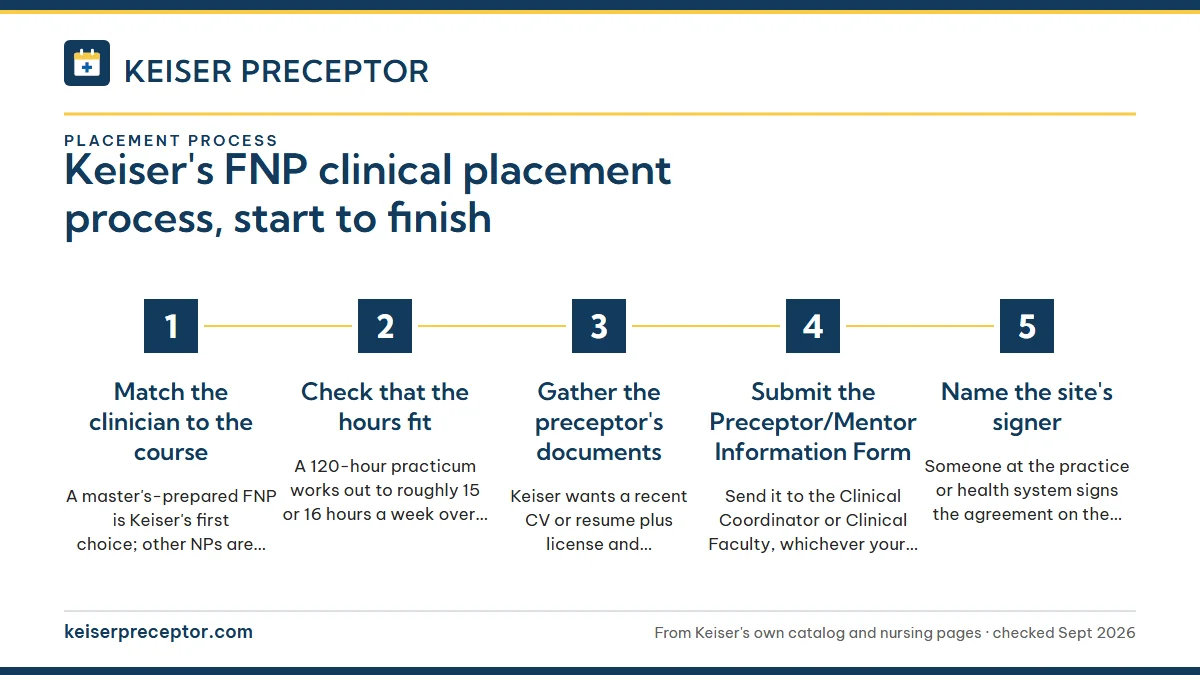
- Match the clinician to the courseA master's-prepared FNP is Keiser's first choice; other NPs are allowed in limited numbers and physicians with an MD or DO are acceptable. The patient mix matters too:
NUR602AandNUR603Aneed adult and older-adult patients,NUR604Aneeds a pediatric panel, andNUR605Aneeds women's health visits. - Check that the hours fitA 120-hour practicum works out to roughly 15 or 16 hours a week over the term, and a 60-hour practicum to about 8. Agree on specific clinic days before anything goes to Keiser.
- Gather the preceptor's documentsKeiser wants a recent CV or resume plus license and certification details. An active, unencumbered license and at least a year of experience are the baseline.
- Submit the Preceptor/Mentor Information FormSend it to the Clinical Coordinator or Clinical Faculty, whichever your course names. The form guide lists what to include.
- Name the site's signerSomeone at the practice or health system signs the agreement on the agency's behalf. Getting that name early saves time later.
Approvals and the affiliation agreement
Three approvals stack up at this stage. The Program Director signs off on the preceptor after reading the CV and license. The Clinical Coordinator is responsible for approving sites, with oversight from the Program Coordinator, and Keiser's 2023 site policy calls for faculty to look at every site, on location or remotely, ahead of the practicum. Finally, the clinical faculty approve the arrangement as a whole before your first hour. The roles guide explains who holds each title.
The contract runs alongside those approvals. No site hosts a Keiser student until it and the university have signed an affiliation agreement, written on Keiser's template or the agency's. The affiliation agreement guide covers the signers and the timing.
Wait for approval before your first clinical day. Keiser's FNP page and its older clinical manual both place preceptor approval ahead of any clinical hours.
Clearance and the completion plan
Clearance runs on its own track, and one missing item can hold a start. For graduate clinicals Keiser's documents list a clear Level 2 background check, a 10-panel drug screen, the Health Care Provider Assessment of Student's Health Status, the required immunizations, current CPR, active health insurance and personal liability insurance. Sites can add screening of their own, and if a site asks for your full background report, the older manual says you provide it.
The last item before day one is a plan for clinical course completion: the start and end dates and the clinical days you and your preceptor have settled on. Under the older clinical manual it goes to your Clinical Course faculty, or to the Program Director, ahead of the first day.
During the term: hours, logs and evaluations
Once the term opens, the chain turns into routine. Keiser recommends spreading hours over all 8 weeks, and its sleep and safety rule bars more than 16 consecutive clinical hours without rest. Every encounter goes into Typhon, which tallies hours by age group and diagnosis, and the 2023 policy manual asks for encounters to be documented within 7 days. Telehealth visits are capped at 25% of your direct care total.
Two evaluation points anchor each term: your preceptor scores you on Keiser's Clinical Evaluation Form at the midterm, week 4, and again at the close, week 8, when your own rating of the preceptor and site is also due. Clinical Faculty make at least one site visit a semester, on site or virtual, plus a phone conference each term. The evaluations guide lists the minimum ratings for each clinical term.
Hour totals depend on the source. The 2026-27 catalog sets 540 precepted hours for the FNP, while 510 appears on the program page and in the 2023 manual, and 630 in the older manual. The catalog governs, and course faculty confirm what your cohort needs.
Why Keiser FNP students bring us in
The front half of this chain, from the first outreach to a complete file, is where calendars slip, and it is the half we take on. Your placement advisor searches for an in-person preceptor near home whose practice fits your exact practicum, confirms a weekly clinic schedule that fits the term, and collects everything Keiser's form and the Clinical Coordinator will ask to see, down to the site's agreement contact.
We aim to have that file ready about three months before the course, so Keiser's reviewers see a complete submission that fits their rules on the first pass. Approval decisions stay with Keiser's faculty and Program Director. If a preceptor steps away later in the program, we stay on call and start the replacement search right away. Tell us your practicum and start term using the form below.
Questions Keiser students ask
How long do Keiser's approvals take once I submit?
Keiser publishes no turnaround time for preceptor, site or agreement approval. The three-month planning window on the FNP page is the best guide, since it has to cover the search, the form review, the Program Director's decision and a signed agreement. If a term is close, ask the Clinical Coordinator which item is still open and what it needs.
Can one preceptor cover more than one Keiser FNP practicum?
Keiser's public documents set no rule either way, so fit decides it. NUR602A and NUR603A are adult primary care, NUR604A is pediatrics and NUR605A is women's health. A family practice that sees all of those groups may carry you through several terms, though each practicum still needs its own dates and faculty sign-off before hours begin.
What happens if I cannot finish my hours within the 8 weeks?
Keiser's older clinical manual says you cannot expect the preceptor to keep going after the term ends and that an extension cannot be assumed. Falling short on clinical hours means taking the course again in full, hours included. That is why Keiser urges spreading hours evenly and why a realistic weekly schedule belongs in your plan from day one.
Is the WHNP placement process the same?
Close, with two differences. The catalog's WHNP course notes require preceptor and site approval before you register, plus clearance from the Clinical Coordinator. And the catalog promises assistance finding a site for WHNP clinicals in South Florida, while students elsewhere select their own. The WHNP placement guide covers both.
Does Keiser use a clinical placement platform?
Keiser's public documents name only Typhon, which graduate students use for hour and case logs. No placement or compliance platform for graduate clinicals appears on keiseruniversity.edu or in the catalogs, so the preceptor search itself happens outside any Keiser system. A clinical site may still ask you to complete its own onboarding steps before your first day.
Related pages
Last checked 2026-09-25
We check these pages against Keiser's catalogs, graduate nursing manuals, licensure disclosures and program pages. Your course, the Clinical Coordinator and the 2026-27 Graduate Catalog have the final word.
Keiser asks you to find your own preceptor. Let us run that search.
Tell us your Keiser program, your next practicum and where you live. We find preceptors who fit the course and prepare the CV, license and site details your Preceptor/Mentor Information Form needs, about three months ahead.
- Preceptors matched to the course: adult and older-adult primary care for
NUR602AandNUR603A, pediatrics forNUR604A, women's health forNUR605A - CV, license, certification and site contact ready for Keiser's review and the affiliation agreement
- Across Florida, from Miami to Jacksonville, and in the other states where you are licensed
Start your placement plan
Your program, city and next practicum term is all we need to begin.