Keiser's Preceptor/Mentor Information Form
The Preceptor/Mentor Information Form is how a preceptor you found becomes a preceptor Keiser has approved. It goes to the Clinical Faculty and/or the Clinical Coordinator with your preceptor's CV or resume and credentials, and the Program Director makes the call. Here is what Keiser says about the form, what is not public, and how to get it through on the first pass.
Get your placement plan
Tell us your Keiser program and where you live. A placement advisor replies with the preceptor and site options that fit your Keiser course.
What the form does
Every Keiser clinical rotation needs an approved preceptor, and this form opens that approval. It tells Keiser who will supervise you, where, and on what credentials. Keiser's older Graduate Nursing Programs Clinical Manual lays out the route: the student submits the form, together with a recent CV or resume and the preceptor's license and certification information, and the Program Director approves the preceptor.
The form is one piece among several. The site needs its own approval and a signed affiliation agreement, and clearance runs in parallel. The placement process guide shows where the form sits in the full sequence.
Getting the current version
This form is not posted on Keiser's public website. The 2023 policy manual says graduate nursing forms sit in the Keiser University Academic Portal, which only enrolled students can reach, and the public FNP forms page lists only admission paperwork.
Because the form lives on the portal, Keiser has not published its fields, and the layout may change between catalog years. Download a fresh copy for each practicum instead of reusing an old file, and if course faculty send a version for your term, use theirs. Everything below describes what Keiser's documents say must accompany the form, not the form's exact boxes.
What to have ready before you submit
Keiser names two attachments outright: a recent CV or resume, and license and certification information. The rest of this list is what reviewers need to check the preceptor against Keiser's rules and move straight to the next step.
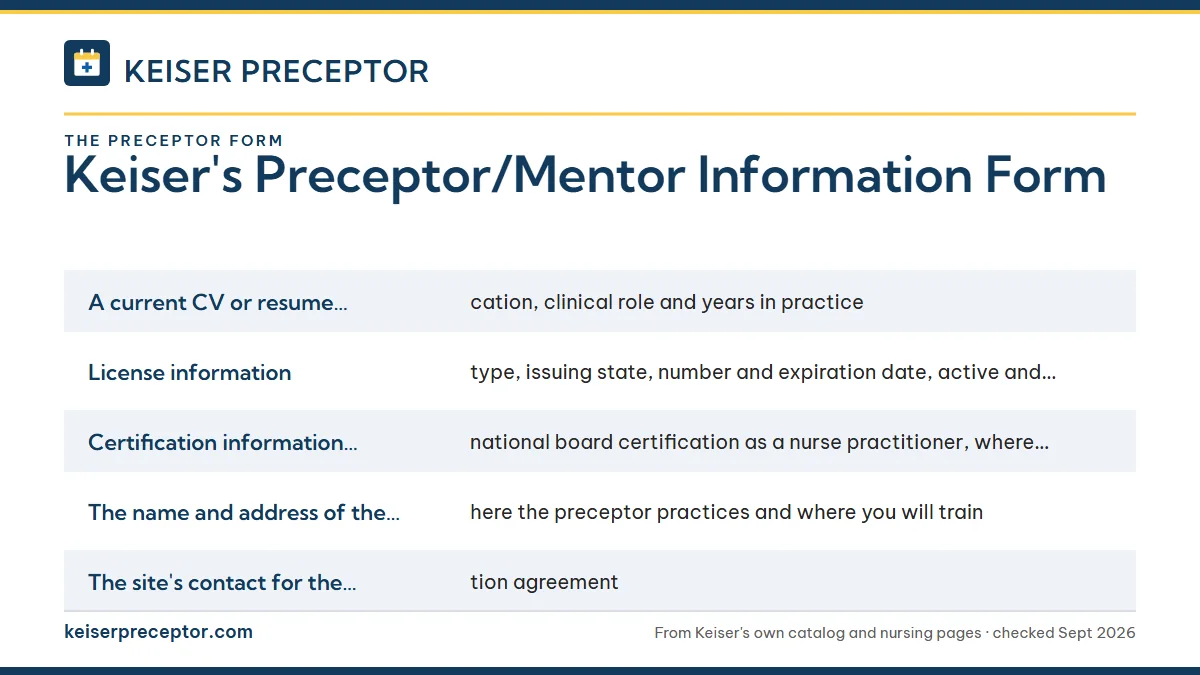
Your preceptor file
- A current CV or resume showing education, clinical role and years in practice
- License information: type, issuing state, number and expiration date, active and unencumbered
- Certification information, such as national board certification as a nurse practitioner, where held
- The name and address of the site where the preceptor practices and where you will train
- The site's contact for the affiliation agreement
- The practicum course, the term, and the clinical days you and the preceptor have agreed
Who reads it and what they look for
Two sets of eyes are on the file. The Clinical Faculty and/or Clinical Coordinator receive and review it, and the Program Director decides on the preceptor using the CV and license. Before any hours start, the clinical faculty also approve the arrangement as a whole: the person, the site and the plan together.
The yardstick is Keiser's preceptor rules. An FNP with a master's degree is the preferred choice, a limited number of other NPs may be used, physicians with an MD or DO qualify, and each preceptor needs an active license and a year or more of experience, and must practice at the site itself. The preceptor requirements guide has the full rules, and approvals and roles explains the titles.
What slows an approval
Keiser does not list reasons a form comes back, but its rules make the weak spots predictable. Each of these is a gap between the file and a Keiser requirement.
- A CV that is out of date or does not show a year in the role
- A license that is expired, restricted, or not held in the state where the preceptor practices
- A clinician type outside Keiser's list, or a specialist whose patients do not match the practicum
- A preceptor who is also your immediate supervisor at work
- No site contact for the agreement, so the contract cannot begin
- No dates or clinical days, so faculty cannot see how the hours fit the term
A submitted form is not an approval. Keiser requires the clinical faculty to approve the preceptor arrangement before any clinical hours begin.
The document your preceptor receives
The form is about the preceptor, and a companion document goes to the preceptor. The older clinical manual describes a Preceptor/Mentor Agreement that reaches the preceptor alongside the course's objectives and its evaluation criteria, and Keiser's faculty orient new preceptors to the role. Keiser's preceptors serve as volunteers.
Your preceptor also completes Keiser's Clinical Evaluation Form twice a term, at the midpoint and at the end, so mention both when you first ask. The evaluations guide describes what the preceptor rates.
Why students let us build the file
The form itself is short; the file behind it takes weeks. Keiser FNP students use us because we build that file as part of the search: a preceptor matched to Keiser's rules and your practicum, an up-to-date CV, license and board certification details, the site's agreement contact and agreed clinical days, ready for you to submit about three months before the course.
Reviewers get everything they need on the first pass, and you stay in control of the submission. Start with the form below.
Questions Keiser students ask
Do I submit a new form for every Keiser practicum?
Keiser's public documents do not say outright. Each FNP practicum is a separate course with its own term and schedule, and approval covers a specific arrangement, so the safe plan is to submit for each one, even when a preceptor returns for a second term. Course faculty can tell you whether a shorter update is accepted for a preceptor Keiser has already approved.
Can my preceptor send the CV straight to Keiser?
Keiser's older clinical manual puts submission on the student: you send the form, and the CV and license details travel with it. Ask your preceptor for a current copy and include it yourself unless course faculty tell you otherwise. Sending everything together keeps the file complete and saves the reviewers from matching loose documents.
How early should the form be in?
Aim for the three-month mark. Keiser's FNP page ties planning to roughly three months before each clinical course, and the older manual wants the preceptor's and site's contact information in Keiser's hands no later than that. Submitting near that mark leaves room for the Program Director's review and the agreement. The lead-time guide maps it onto term dates.
What if my preceptor changes after approval?
Keiser approves the preceptor as a person, so a new preceptor needs approval before you work with them. Tell course faculty and the Clinical Coordinator right away and submit a new form with the new CV and license details. If the change happens partway through a term, read when a site falls through.
Is this form the same as the affiliation agreement?
No. The Preceptor/Mentor Information Form is about the clinician: who they are and whether they meet Keiser's rules. The affiliation agreement is a contract between Keiser and the agency where the clinician practices, signed by an executive at the agency and a Keiser officer. You need both in place, along with faculty approval, before hours begin.
Related pages
Last checked 2026-09-25
We check these pages against Keiser's catalogs, graduate nursing manuals, licensure disclosures and program pages. Your course, the Clinical Coordinator and the 2026-27 Graduate Catalog have the final word.
Keiser asks you to find your own preceptor. Let us run that search.
Tell us your Keiser program, your next practicum and where you live. We find preceptors who fit the course and prepare the CV, license and site details your Preceptor/Mentor Information Form needs, about three months ahead.
- Preceptors matched to the course: adult and older-adult primary care for
NUR602AandNUR603A, pediatrics forNUR604A, women's health forNUR605A - CV, license, certification and site contact ready for Keiser's review and the affiliation agreement
- Across Florida, from Miami to Jacksonville, and in the other states where you are licensed
Start your placement plan
Your program, city and next practicum term is all we need to begin.