Logging Keiser clinicals in Typhon
Keiser graduate nursing students record their clinical hours and patient cases in Typhon, a secure tracking site that totals hours by age group and diagnosis. Program Faculty expect each encounter entered within a week, your academic advisor checks direct care hours at the midpoint, and the finished log is the evidence behind every hour you claim.
Get your placement plan
Tell us your Keiser program and where you live. A placement advisor replies with the preceptor and site options that fit your Keiser course.
What Typhon does in a Keiser practicum
Keiser's FNP answers describe it plainly: "Clinical hours and case logs are tracked by the student in a secure website (Typhon Tracking System) which calculates hours by age group and diagnosis." The phrase that matters is "by the student". Your preceptor supervises and evaluates you, but building the record is your job from the first clinic day.
Keiser's older graduate clinical manual refers to "Graduate Nursing tracking processes (i.e., Typhon, Practicum log)", so a course may ask for a practicum log as well as, or instead of, Typhon. Each syllabus names the record its faculty want, and it is worth checking before the term starts rather than after your first week of patients. For where Typhon sits among Keiser's other student tools, see Keiser student systems.
What to capture for every encounter
Because Typhon builds its totals from age group and diagnosis, those two details have to be right on every entry. A practical checklist for each patient you see:
- The date, matching a clinical day on the plan for clinical course completion you gave course faculty
- The site and the approved preceptor you worked under that day
- The time spent, including chart review, test review, presenting to your preceptor and EMR entry for that patient
- The patient's age group and the diagnoses you worked through
- Whether the visit was in person or by telehealth, so the telehealth share stays visible against Keiser's cap (what counts)
This checklist is ours, not a Keiser form. The fields inside Typhon are set by the program, so where your course instructions differ, follow them. The point of the list is that nothing Keiser reviews later should depend on your memory of a busy Tuesday six weeks ago.
Working inside the 7-day window
Keiser's 2023 practicum policy gives you seven days from an encounter to have it documented for Program Faculty. Treat that as a ceiling rather than a target. A routine that keeps you well inside it:
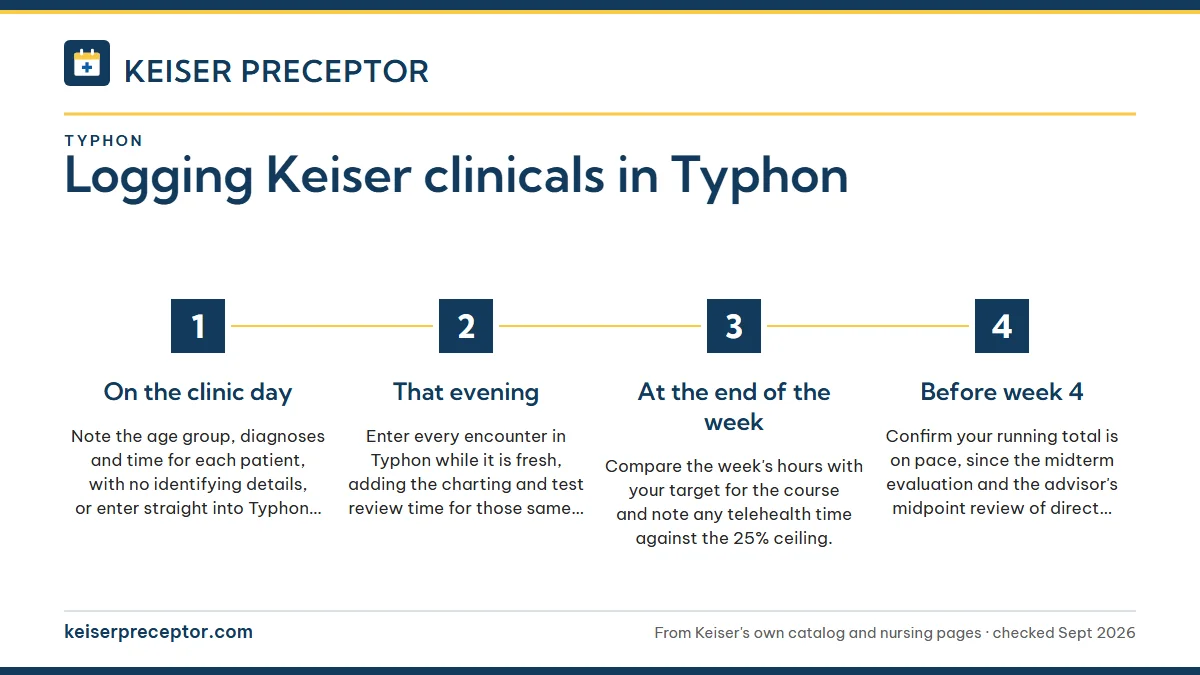
- On the clinic dayNote the age group, diagnoses and time for each patient, with no identifying details, or enter straight into Typhon between visits where the site allows it.
- That eveningEnter every encounter in Typhon while it is fresh, adding the charting and test review time for those same patients.
- At the end of the weekCompare the week's hours with your target for the course and note any telehealth time against the 25% ceiling.
- Before week 4Confirm your running total is on pace, since the midterm evaluation and the advisor's midpoint review of direct care hours both fall around the halfway mark.
Why the age group and diagnosis totals matter
Each FNP practicum is built around a population, and Typhon's age group totals are the quickest way for faculty to see that your patients match it. The 2026-27 Graduate Catalog course titles set the focus:
| Practicum | Catalog focus | What your totals should show |
|---|---|---|
NUR602A | Primary Health Care of the Family I: adults and older adults | Mostly adult and older-adult visits |
NUR603A | Primary Health Care of the Family II | Adult and older-adult primary care |
NUR604A | Primary Health Care of the Family III: children and adolescents | Pediatric and adolescent visits |
NUR605A | Primary Health Care of the Family IV: women | Women's health visits |
NUR691A | Family Nurse Practitioner Integration | A spread across the lifespan |
Keiser's FNP answers talk about hours by population, naming pediatrics, women, young and middle adults, and older adults, so a log that leans heavily on one age group is worth correcting before the midpoint rather than after. Diagnosis totals do the same job for the range of conditions you manage. The FNP practicum courses guide covers each course's setting.
Who reads your log, and when
Several people at Keiser look at the record across an 8-week practicum:
- Program Faculty review encounters as they are documented, which is the reason for the 7-day window.
- Your academic advisor reviews your direct care hours at the midpoint of the rotation.
- Your preceptor completes Keiser's Clinical Evaluation Form at week 4 and week 8; see preceptor evaluations.
- Clinical Faculty complete at least one site visit evaluation a semester, in person or virtually, and hold a phone conference each term; see site visits.
When the term closes, the log is what shows you reached the course's hours. A shortfall means taking the course again in full, clinical hours included, which makes the midpoint check your real deadline. Keep the log and the plan you filed with faculty telling the same story, so any reviewer can match your entries to the days you said you would be at the site.
Keeping the record honest
Keiser's 2023 policy manual treats any misrepresentation of clinical hours as clinical misconduct. In a Typhon log that covers rounding a short afternoon up to a full day, entering a clinic day that did not happen, or listing your approved preceptor for a shift you actually spent with someone else. The clinical conduct rules set out Keiser's wider expectations.
Accuracy protects you as well. If a preceptor's evaluation comes back unfavorable, Keiser leaves the judgment on course goals to the faculty member, and an honest log written at the time is the strongest record you have of what you did. If you find a mistake in an old entry, correct it and tell course faculty, rather than leaving it for someone else to find.
Placements that make logging easy
A log is only as good as the clinic behind it. We look for Keiser preceptors whose patient panel matches the practicum in front of you, adults for NUR602A and NUR603A, children for NUR604A, women's health for NUR605A, so your age group totals build naturally instead of needing a second site late in the term.
We also settle fixed clinic days with the preceptor before your plan for clinical course completion goes to faculty, which turns logging into a weekly routine. Predictable days mean predictable entries, and a week-by-week total you can check against the course target at a glance. If a preceptor steps away mid-term, we stay on call and search for a replacement who can take you for the remaining weeks. Tell us about your next practicum.
Questions Keiser students ask
Do all Keiser nursing programs use Typhon?
Keiser names Typhon in its FNP program answers and in its graduate nursing clinical manual, which covers the graduate tracks. The RN to BSN's logging rules sit in the RN to BSN Clinical Course Manual, which is not public, so ask your course instructor there. For the campus BSN and ASN programs, your clinical instructors tell you how clinical time is recorded.
Can I start a Typhon log before my Keiser preceptor is approved?
There is nothing valid to log yet. Keiser's clinical faculty approve the preceptor arrangement before clinical hours begin, and the site must have a signed affiliation agreement first. Days at the site before both are settled are not practicum hours, so begin the Typhon record on your first approved clinical day and keep that date consistent with your plan.
What if I miss Keiser's 7-day logging window?
The 2023 policy manual states the 7-day window without spelling out a consequence. Enter the encounter as soon as you notice, keep the real date of service, and tell course faculty rather than hoping it passes unnoticed. One late entry explained early is a small matter next to a pattern that turns up at the midpoint review.
Does Typhon tell me when I have enough hours for a Keiser course?
Typhon totals your hours overall and by age group and diagnosis, but the target comes from the course. Measure against the hours in your practicum's 2026-27 Graduate Catalog description, and confirm with faculty where the program page differs, as it does for the final Integration Practicum. The clinical hours guide lists each source's figure.
Related pages
Last checked 2026-09-25
We check these pages against Keiser's catalogs, graduate nursing manuals, licensure disclosures and program pages. Your course, the Clinical Coordinator and the 2026-27 Graduate Catalog have the final word.
Keiser asks you to find your own preceptor. Let us run that search.
Tell us your Keiser program, your next practicum and where you live. We find preceptors who fit the course and prepare the CV, license and site details your Preceptor/Mentor Information Form needs, about three months ahead.
- Preceptors matched to the course: adult and older-adult primary care for
NUR602AandNUR603A, pediatrics forNUR604A, women's health forNUR605A - CV, license, certification and site contact ready for Keiser's review and the affiliation agreement
- Across Florida, from Miami to Jacksonville, and in the other states where you are licensed
Start your placement plan
Your program, city and next practicum term is all we need to begin.