Keiser's clinical conduct rules
Keiser's clinical conduct rules come down to four habits: turn up on the days you planned, never miss a clinical day without telling your preceptor and course faculty, report any incident within 24 hours, and log only hours you truly worked under your approved preceptor. A no call/no show may lead to dismissal, and misrepresenting hours is clinical misconduct.
Get your placement plan
Tell us your Keiser program and where you live. A placement advisor replies with the preceptor and site options that fit your Keiser course.
Attendance starts with your plan
Before a practicum begins, Keiser's clinical manual asks you to give course faculty, or the Program Director, a plan for clinical course completion listing when the practicum starts and ends and which days you will be at the site. That plan becomes the reference point for your attendance, so keep it current.
Treat each clinical day on it as a shift you owe the site. If the schedule shifts, because your preceptor's clinic moves a day or you swap one, tell course faculty and update the plan rather than letting the paper and the reality drift apart. Keiser's advice to spread hours across the whole 8-week term helps here too: with steady weeks behind you, a single missed day is easy to absorb. The pacing guide shows weekly targets.
No call/no show
Keiser's older Graduate Nursing Programs Clinical Manual (2017) is blunt about unannounced absences: missing a clinical day without notifying your preceptor and course faculty is a "no call/no show" that "may result in dismissal from the program." Check your syllabus for the current wording, and treat the rule as live. When you cannot make a clinical day:
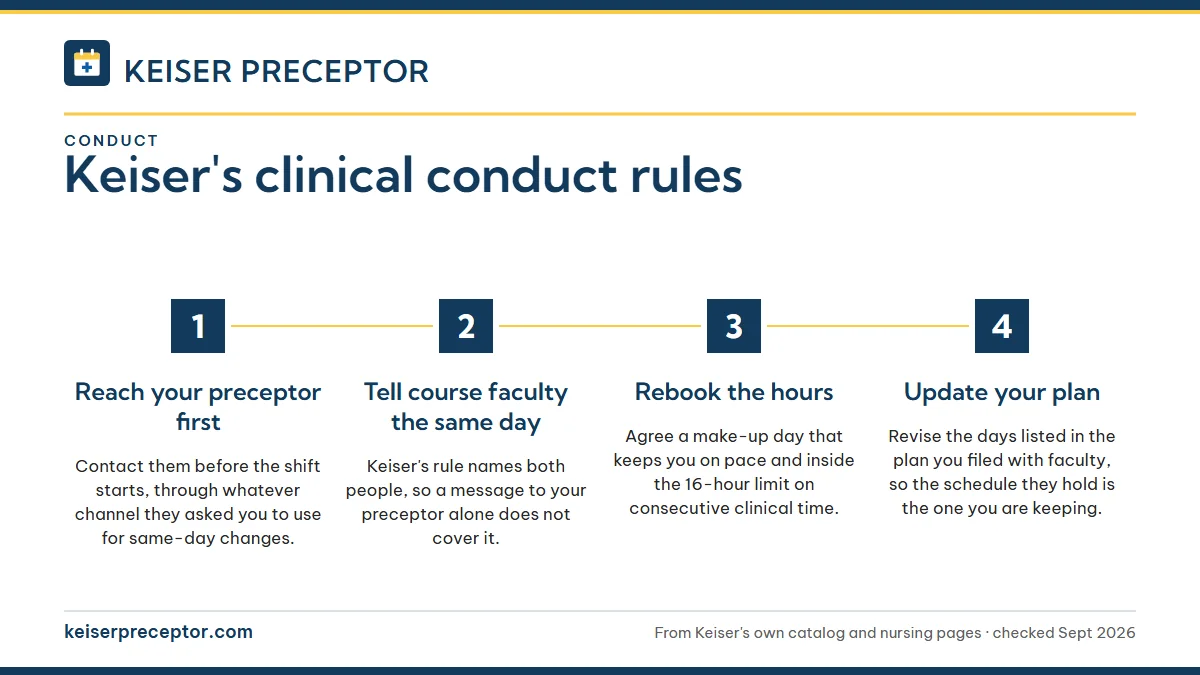
- Reach your preceptor firstContact them before the shift starts, through whatever channel they asked you to use for same-day changes.
- Tell course faculty the same dayKeiser's rule names both people, so a message to your preceptor alone does not cover it.
- Rebook the hoursAgree a make-up day that keeps you on pace and inside the 16-hour limit on consecutive clinical time.
- Update your planRevise the days listed in the plan you filed with faculty, so the schedule they hold is the one you are keeping.
Incident reports within 24 hours
Keiser's clinical manual names an Incident Report and gives you 24 hours to file it. Incident reports go to the Campus Vice President, and in the graduate FNP program the MSN FNP Department Chair handles incidents. If you are unsure whether something counts, report it: a report filed inside the window can always be closed, while a late one can never be made on time.
The clinical site will often have its own reporting process as well. Follow it, then make sure Keiser's report is filed too, because the two serve different people: the site looks after its patients and staff, and Keiser keeps its own record of what happened to a student in its program. Ask course faculty how to submit the Keiser form the same day, and keep copies of anything the site gives you.
Honest hours and direct supervision
The 2023 Policy and Procedure Manual lists misrepresenting clinical hours as clinical misconduct. In practice that means logging only time you actually spent at the approved site, with your approved preceptor, on the date you record. Rounding up, back-filling a missed day and crediting a clinician Keiser never reviewed all fall on the wrong side of that line.
Supervision belongs to the same set of rules. Keiser's 2023 clinical sites policy says preceptors are always to supervise students directly, and a clinician covering for yours must hold the same credentials and experience. Clinical hours are also unpaid, and the clinical manual rules out payment to students for the work they do in that role. The Typhon guide and what counts as a clinical hour cover the logging side.
Workplace boundaries and rest
Clinicals at your own employer are allowed with conditions: a department other than your usual one, a preceptor who is not your immediate supervisor, and hours outside your normal shifts. Keiser does not permit assignment to the unit where you currently work. Keeping those lines clean protects both your job and your practicum, and the workplace rules explain the insurance waiver that goes with an employer rotation.
Rest is a conduct matter as well. Keiser's Sleep and Safety Policy puts a 16-hour ceiling on any unbroken run of clinical time without restful sleep, so an overnight catch-up session is off the table however far behind you are. If a preceptor offers a double to help you catch up, say yes to the extra day and no to the unbroken stretch.
When a site raises a concern
Clinical sites have a real say in whether a student stays. Keiser's drug screening policy allows further screening at any point if the site or the University requires it, and a site may ask for the full report from your background check; the background check guide covers both.
Performance concerns follow Keiser's process. Under the 2023 manual, a student whose performance at a site falls short is given an action plan, and that plan could include repeating the rotation. A poor evaluation from a preceptor goes to your faculty member, who rules on whether the course goals were met. In the campus pre-licensure programs, a site's request to remove a student leads the program to try placing that student at a different site; after a second removal there is no further reassignment and the course is failed.
Dress, residencies and evaluations
For dress and identification, follow your clinical site's own policy and ask course faculty whether the practicum adds anything before your first day. Your preceptor fills in Keiser's Clinical Evaluation Form twice, at the midterm and again at the end of the term, with minimum ratings that rise through the program, so the impression you make in the first weeks feeds straight into a graded document; see preceptor evaluations.
Residencies carry conduct expectations of their own. Residencies happen in person, according to the Graduate School's FAQ, and for the WHNP, attendance at each intensive weekend counts toward the course grade. FNP students attend two residencies in Fort Lauderdale and pay their own travel and lodging, so book time off from work early. The second one falls inside the final Integration Practicum term, which means telling your preceptor about that weekend when you agree the schedule, not the week before.
Starting every practicum on the right footing
A good placement makes Keiser's conduct rules easy to keep. We settle clinic days with your preceptor across the whole term before your plan reaches faculty, so your attendance record starts from a schedule both sides have already accepted. The preceptor has the dates and days in writing from the start, and you know exactly who to call if a day has to move. Residency weekends and known time off go into the schedule up front, so nothing on the plan surprises either side mid-term.
If a preceptor leaves or a site changes its mind, we stay on call and start looking for a new preceptor who fits Keiser's rules, with the Preceptor/Mentor Information Form details ready for faculty review. That is what a thorough Keiser placement looks like from the first clinic day to the last. Talk to the placement desk.
Questions Keiser students ask
Who do I report a needlestick to during a Keiser clinical?
Follow the site's exposure process first for your own care, then ask course faculty how to file Keiser's Incident Report, which is due within 24 hours. Keiser's clinical manual routes incident reports to the Campus Vice President, and the MSN FNP Department Chair handles incidents in the graduate program. Keep copies of every document the site gives you.
Can a clinical site require a drug test from a Keiser student?
Yes. Keiser's drug screening policy covers a 10-panel screen before enrollment and further screening at any point if the clinical site or the University requires it. The student pays for screening, sites may ask for more than the standard panel, and a positive result is reviewed by the Program Chair and the Dean.
Does Keiser have a dress code for graduate clinicals?
The Keiser clinical rules summarized here focus on attendance, reporting, supervision and honest hours rather than clothing. For dress and ID, follow your clinical site's policy and ask course faculty whether your practicum adds its own expectations. When the two differ, following the stricter one is the safe choice for your first day.
What counts as misrepresenting clinical hours at Keiser?
Keiser's 2023 manual treats it as clinical misconduct, and the safe reading is broad: any log that does not match what happened. That includes hours you did not work, a date that differs from the real one, and a preceptor listed for a day you spent with someone else. Correct any error quickly and tell course faculty.
Related pages
Last checked 2026-09-25
We check these pages against Keiser's catalogs, graduate nursing manuals, licensure disclosures and program pages. Your course, the Clinical Coordinator and the 2026-27 Graduate Catalog have the final word.
Keiser asks you to find your own preceptor. Let us run that search.
Tell us your Keiser program, your next practicum and where you live. We find preceptors who fit the course and prepare the CV, license and site details your Preceptor/Mentor Information Form needs, about three months ahead.
- Preceptors matched to the course: adult and older-adult primary care for
NUR602AandNUR603A, pediatrics forNUR604A, women's health forNUR605A - CV, license, certification and site contact ready for Keiser's review and the affiliation agreement
- Across Florida, from Miami to Jacksonville, and in the other states where you are licensed
Start your placement plan
Your program, city and next practicum term is all we need to begin.