Fitting a Keiser practicum into eight weeks
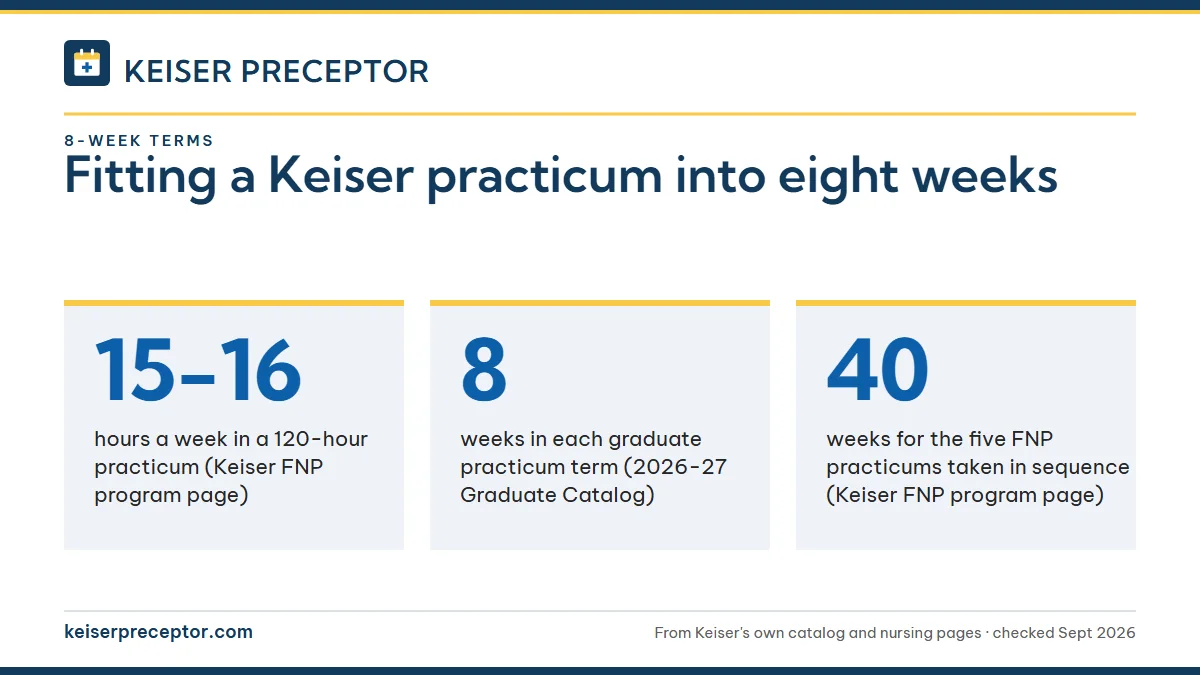
Every Keiser graduate practicum lives inside one 8-week term, so a 120-hour course works out to about 15 to 16 hours a week at the site, on top of 6 to 8 hours a week in the online course. Keiser recommends spreading the hours across all eight weeks, and the end of the term is a hard stop for the hours that belong to it.
Get your placement plan
Tell us your Keiser program and where you live. A placement advisor replies with the preceptor and site options that fit your Keiser course.
Weekly targets by course
Keiser's FNP page gives the rule of thumb: roughly 15 to 16 hours a week for a 120-hour practicum and about 8 for a 60-hour one. The same division works for every Keiser practicum. The right-hand column below is plain arithmetic, the course hours divided by eight weeks.
| Practicum | Course hours (source) | Even weekly share |
|---|---|---|
NUR604A, NUR605A (FNP) | 60 (catalog) | 7.5 |
NUR602A, NUR603A (FNP) | 120 (catalog) | 15 |
NUR691A (FNP) | 180 (catalog) or 150 (program page) | 22.5 or about 19 |
NUR612A, NUR613A (WHNP) | 130 (catalog) | about 16 |
NUR614A (WHNP) | 160 (catalog) | 20 |
NUR615A (WHNP) | 260 (catalog) | 32.5 |
NUR801A, NUR802A (DNP) | 120 (catalog, which says 15 hours a week) | 15 |
The final FNP term and the last WHNP clinical are the heavy ones. Plan them against the catalog figure, since the program page's lower number for NUR691A may not be the one your faculty apply; the clinical hours guide sets out that conflict.
Why Keiser wants the hours spread out
Keiser's FNP answers say it directly: "We highly recommend that you spread the clinical hours over the 8 week session." The calendar inside each term explains why. Your preceptor completes a midterm evaluation in week 4 and a final in week 8, and your academic advisor reviews direct care hours at the midpoint. A student with almost nothing banked by week 4 gives both reviews very little to work with.
Spreading also cushions you against the ordinary setbacks of any 8-week stretch: a sick day, a preceptor's vacation, a clinic closed for a holiday. With steady weeks behind you, one lost day is a small catch-up. With the hours crammed into the final three weeks, the same lost day can sink the course, because Keiser's older clinical manual is clear that a preceptor cannot be expected to keep precepting once the term is over.
Sample weekly patterns
Keiser sets the total and the advice to spread it; the shape of each week is agreed with your preceptor and recorded as the clinical days on your plan for clinical course completion. Patterns that meet the weekly targets:
- 60-hour practicum: one 8-hour clinic day each week, which yields 64 hours and a small cushion.
- 120-hour practicum: two 8-hour days a week (128 hours across the term), or one 10-hour day plus one 6-hour day.
- 180-hour practicum: three 8-hour days most weeks (up to 192 hours), or two 10-hour days plus a short third session.
- 260-hour WHNP clinical: about four 8-hour days every week with a few extra hours somewhere in the term, which calls for a preceptor running a near full-time clinic.
Remember the didactic partner. Keiser's FNP page estimates 6 to 8 hours a week in the online course alongside clinic time, so a 120-hour term is really a 21- to 24-hour weekly commitment before commuting.
Graduate term start dates for 2026 and 2027
Keiser's graduate calendar runs three 16-week semesters a year, Winter, Summer and Fall, each split into two 8-week terms that begin on a Monday. Each practicum fills exactly one of these terms, so plan your first clinic day in week 1 and your last one in week 8. Holidays inside a term still count as calendar weeks, which is one more reason to keep a spare half day in your pattern.
| Semester | First 8-week term | Second 8-week term |
|---|---|---|
| Winter 2026 | January 12 | March 9 |
| Summer 2026 | May 11 | July 6 |
| Fall 2026 | August 31 | October 26 |
| Winter 2027 | January 11 | March 8 |
| Summer 2027 | May 10 | July 5 |
| Fall 2027 | August 30 | October 25 |
Counting back about three months from your practicum's start date gives the point to begin the preceptor search. The three-month lead time guide turns that into a working timeline, and the graduate calendar covers the rest of the academic year.
When the term goes off plan
Lose a day or two and the cleanest fix is an extra half day spread over the following weeks, kept inside Keiser's limit of 16 consecutive clinical hours without restful sleep. Tell your preceptor and course faculty early, and update the clinical days on your plan so the schedule faculty hold matches the one you are working. A short note to faculty the same week reads far better at the midterm evaluation than a gap nobody mentioned.
A bigger loss, such as a preceptor leaving in week 5, needs course faculty involved at once. Falling short on clinical hours means repeating the whole practicum, hours and all, and a new preceptor still has to be approved before any replacement hours count. The behind on hours guide and when a site falls through walk through both situations in detail.
How we build a term that holds
Before we present a preceptor to a Keiser student, we confirm clinic days across all eight weeks of the target term, not only the first few. That schedule becomes the clinical days and dates on your plan for clinical course completion, so what faculty approve is a plan the preceptor has already agreed to.
For the heavy terms, the 180-hour Integration Practicum and the 260-hour WHNP clinical, we look for preceptors with full clinic weeks who can carry the load without squeezing it into the last month. If someone drops mid-term, we stay on call and start the replacement search the same day. Come to us about three months ahead and there is room to get every piece right. Tell us your term.
Questions Keiser students ask
Can I take two Keiser FNP practicums in the same 8-week term?
No. Each FNP practicum lists the earlier practicum pairs as prerequisites, so they run in a fixed order from NUR602A to NUR691A, and final grades for one pair must be posted before you enroll in the next. Graduate students carry one or two courses a term, and a practicum always pairs with its own didactic course.
Can I finish my Keiser practicum hours early?
Keiser's FNP guidance recommends spreading hours over the full 8-week session rather than finishing in a rush, and the preceptor's final evaluation falls in week 8. If your preceptor's schedule would complete the hours well before then, ask course faculty before agreeing to it, since evaluations and faculty contact still run to the end of the term.
Can I keep working full time during a Keiser practicum?
Plan the combined load first: about 15 to 16 clinic hours plus 6 to 8 hours of online coursework each week in a 120-hour term. A rotation at your own employer has to sit outside your normal working hours, and the 16-hour rule limits long catch-up days, so settle fixed clinic days with your employer before the term begins.
Is the Integration Practicum harder to schedule than the others?
It carries the most hours per week. At the catalog's 180 hours, NUR691A averages 22.5 hours a week over eight weeks, and at the program page's 150 it is still about 19. The same term includes the second on-campus FNP residency, a two-day weekend in Fort Lauderdale, so build the clinic schedule around it. See the residencies guide.
Related pages
Last checked 2026-09-25
We check these pages against Keiser's catalogs, graduate nursing manuals, licensure disclosures and program pages. Your course, the Clinical Coordinator and the 2026-27 Graduate Catalog have the final word.
Keiser asks you to find your own preceptor. Let us run that search.
Tell us your Keiser program, your next practicum and where you live. We find preceptors who fit the course and prepare the CV, license and site details your Preceptor/Mentor Information Form needs, about three months ahead.
- Preceptors matched to the course: adult and older-adult primary care for
NUR602AandNUR603A, pediatrics forNUR604A, women's health forNUR605A - CV, license, certification and site contact ready for Keiser's review and the affiliation agreement
- Across Florida, from Miami to Jacksonville, and in the other states where you are licensed
Start your placement plan
Your program, city and next practicum term is all we need to begin.