Your Keiser term starts soon and no preceptor has said yes.
A short runway is workable if you run every step at once instead of one after another. Keiser needs an approved preceptor and a signed affiliation agreement before any clinical hour counts, so speed comes from a fast yes plus a file that is ready the same day. Our placement desk runs rush searches built for exactly that.
Get your placement plan
Tell us your Keiser program and where you live. A placement advisor replies with the preceptor and site options that fit your Keiser course.
How short is too short at Keiser
Keiser's FNP page advises planning each clinical course about three months before it starts. Inside that window you are in rush territory, and inside four weeks every day counts. The reason is structural: each practicum is one 8-week term taken with its didactic course, so there is no long semester to absorb a slow start.
The graduate calendar in the 2026-27 catalog puts the next term starts at October 26, 2026, then January 11 and March 8, 2027. Find the Monday your practicum begins, count back, and be honest about how many weeks are left. Our Keiser graduate calendar guide lists every start date, and the three-month lead time guide shows the ideal timeline you are now compressing.
The chain that has to finish before hour one
Four pieces stand between a willing clinician and your first logged hour. None of them can be skipped, and each involves someone other than you, which is why a rush search has to feed them early.
- Keiser vets the preceptor. Their CV and credentials travel to Clinical Faculty or the Clinical Coordinator on Keiser's Preceptor/Mentor Information Form, and the Program Director gives the approval.
- The site signs an affiliation agreement, on Keiser's template or the agency's own, executed by Keiser and the agency before clinical work starts there.
- A faculty member looks the site over before your first day, by visit or virtually.
- Your course faculty get a written schedule showing when the practicum opens and closes and which days you attend.
A site that already holds a current affiliation agreement with Keiser may have the second item done. Ask the practice manager on the first call, then have the Clinical Coordinator confirm it is current.
Keiser puts preceptor approval and a signed affiliation agreement ahead of your first clinical hour, so a quick yes only helps once the paperwork moves just as quickly.
Run the rest in parallel
Students lose the most time by finishing one task before starting the next. While the search runs, clear everything that does not depend on the preceptor.
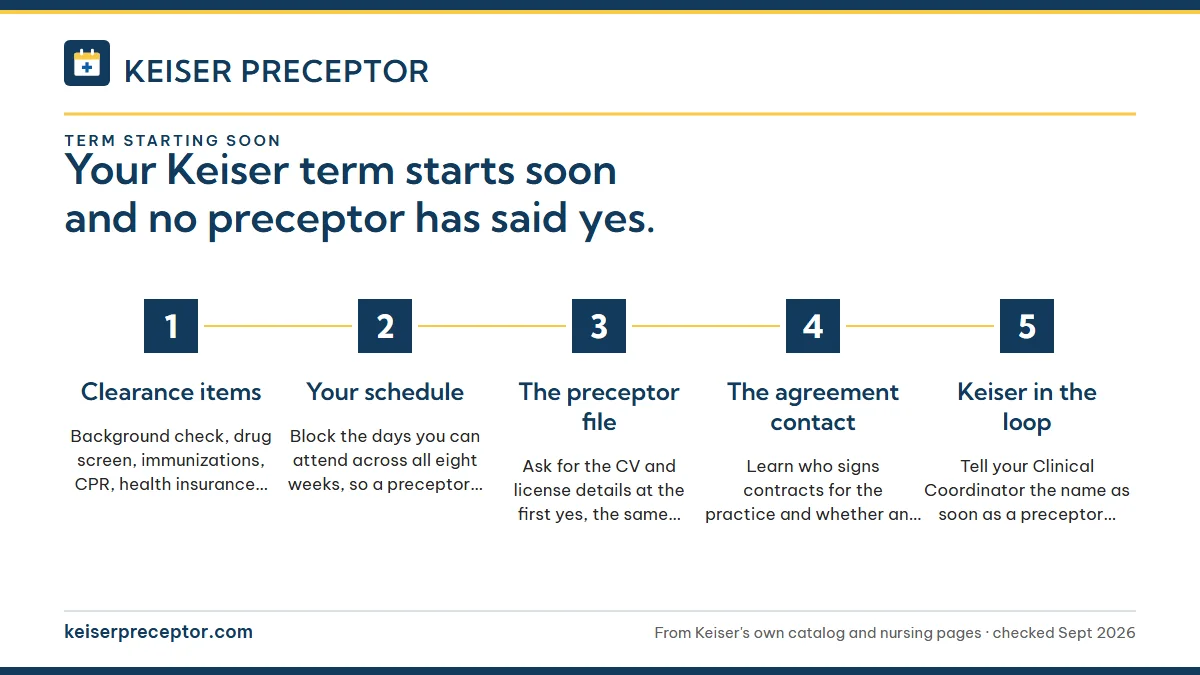
- Clearance itemsBackground check, drug screen, immunizations, CPR, health insurance proof and professional liability insurance can all be current before a name exists. Details are in the background check and drug screen guide.
- Your scheduleBlock the days you can attend across all eight weeks, so a preceptor sees a concrete plan instead of an open question.
- The preceptor fileAsk for the CV and license details at the first yes, the same conversation, not a week later.
- The agreement contactLearn who signs contracts for the practice and whether an agreement with Keiser already exists.
- Keiser in the loopTell your Clinical Coordinator the name as soon as a preceptor agrees, so review starts at once.
Where quick yeses tend to come from
The settings Keiser suggests for FNP students include retail and urgent care clinics, physician practices, fast track units and the primary care side of public health departments. Clinics with evening or weekend sessions make it easier to fit roughly 15 to 16 hours a week around a job, the weekly pace Keiser's FNP page describes for its practicums.
Your own employer can be a fast option when three Keiser conditions hold: the rotation is off your usual unit, your boss is not the one precepting, and the clinical time sits outside your paid shifts. The workplace clinical rules guide covers the details and the liability insurance waiver.
Match the practicum, too. A pediatric office suits NUR604A, a women's health practice suits NUR605A, and a busy family or adult primary care clinic fits NUR602A and NUR603A. Asking the right setting first saves the week a wrong-fit refusal costs.
How our rush search works
When the term is close, our placement desk works the search in parallel across many eligible clinicians near you, screening each for Keiser fit before you hear a name. That means the right credential, a practice where they actually see patients, and patients who match your course.
At the first yes we gather the preceptor's CV and credentials, pin down who handles contracts at the practice, and draft clinical days that spread your hours over all eight weeks. You hand Keiser a complete file on day one rather than chasing pieces while the calendar runs.
Keiser's faculty make the approval decision and set the pace of their own review. Our job is making sure nothing we send comes back for a missing item. Message us through the form at the bottom of this page or the contact page, with your term start date in the opening line.
Questions Keiser students ask
Can I start my Keiser practicum late and catch up the hours?
Keiser recommends spreading clinical hours across the full 8-week session, and its older graduate clinical manual says a preceptor cannot be assumed to extend past the term. A late start compresses everything into fewer weeks. Talk to course faculty before the term opens, and read our guide on being behind on clinical hours for the math.
Does a site that already works with Keiser move faster?
Often, yes. Every site needs a signed affiliation agreement with Keiser before clinical work starts, and a practice that already holds a current one may have that step behind it. Ask on the first call, then let the Clinical Coordinator confirm the agreement is active. The preceptor still needs Keiser's approval.
What should I send the placement desk to start a rush search?
Your Keiser program, the practicum course number, the term start date, where you live and how far you can drive, the states where you hold an RN license, the days you can attend, and every clinician you have already asked. With those, the search starts the day you write.
Is three months of lead time really necessary?
It is Keiser's own advice. The FNP page tells students to begin planning each clinical course roughly a quarter-year early, and the older clinical manual wants the preceptor's and site's contact information in hand no later than three months before clinicals. The approvals and the agreement explain why that much time helps.
What if my term has already started with no preceptor?
Contact your course faculty and Clinical Coordinator right away and ask what options exist for this term. Keiser's clinical manual says a practicum without its hours is retaken in full, so an honest early conversation matters. Our guide to delayed graduation explains how a lost term ripples forward.
Related pages
Last checked 2026-09-25
We check these pages against Keiser's catalogs, graduate nursing manuals, licensure disclosures and program pages. Your course, the Clinical Coordinator and the 2026-27 Graduate Catalog have the final word.
Keiser asks you to find your own preceptor. Let us run that search.
Tell us your Keiser program, your next practicum and where you live. We find preceptors who fit the course and prepare the CV, license and site details your Preceptor/Mentor Information Form needs, about three months ahead.
- Preceptors matched to the course: adult and older-adult primary care for
NUR602AandNUR603A, pediatrics forNUR604A, women's health forNUR605A - CV, license, certification and site contact ready for Keiser's review and the affiliation agreement
- Across Florida, from Miami to Jacksonville, and in the other states where you are licensed
Start your placement plan
Your program, city and next practicum term is all we need to begin.