Keiser's four WHNP clinical courses, one at a time
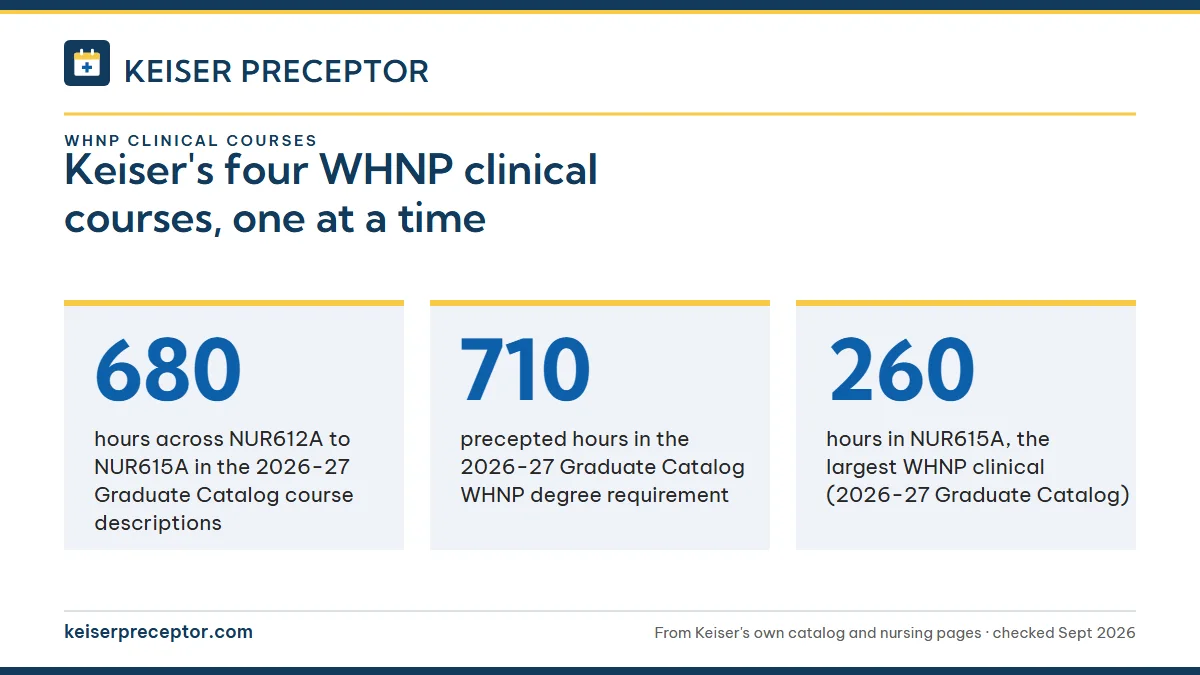
Keiser's Women's Health NP program puts all of its precepted hours into four clinical courses, NUR612A to NUR615A, each taken beside a didactic course in the same 8-week term. The course descriptions add up to 680 hours while the catalog's degree requirement says 710, and every pair needs an approved preceptor and site before you can register.
Get your placement plan
Tell us your Keiser program and where you live. A placement advisor replies with the preceptor and site options that fit your Keiser course.
Four clinicals, each tied to a didactic partner
The WHNP is a 51-credit online program, and its precepted work lives in the four courses that carry the letter A. Each runs alongside the didactic course with the same number, so NUR612A is taken with NUR612, NUR613A with NUR613, and so on. The 2026-27 Graduate Catalog prints these hours in its course descriptions.
| Clinical course | Catalog title | Credits (outline) | Clinical hours |
|---|---|---|---|
NUR612A | WHNP I: Primary Care in Adolescents and Adults Clinical | 1 | 130 |
NUR613A | WHNP II: Perinatal Care Clinical | 1 | 130 |
NUR614A | WHNP III: Women's Health Care Across the Lifespan Clinical | 2 (1 in the description) | 160 |
NUR615A | WHNP IV: Women's Health Synthesis Clinical | 2 (1 in the description) | 260 |
Two small mismatches sit in Keiser's own documents. The catalog outline gives NUR614A and NUR615A two credits each, while their descriptions and the program page say one, and the program page calls the second course Prenatal Care where the catalog prints Perinatal Care. Neither touches the hour figures, and your advisor can confirm the credit load that shows on your schedule.
680 or 710 hours: two numbers in one catalog
Keiser's WHNP hour total depends on which page of the catalog you open. The degree requirements ask graduates to complete 710 precepted clinical hours. The four course descriptions add up to 680 (130, 130, 160 and 260), and the 2023 graduate policy manual arrives at that same 680.
No public Keiser document explains the 30-hour gap. The 2026-27 Graduate Catalog is the governing text, and course faculty or the Clinical Coordinator are the people who can say which total your clinicals are measured against, so raise it before your first clinical term is on the calendar. Every Keiser program's figures, each with its source, sit side by side on the clinical hours page.
Line up preceptor time for the higher figure, 710, until course faculty confirm which total applies to you.
Cleared before you register, not after
The WHNP carries a gate that the FNP course descriptions lack. Each WHNP clinical pair's catalog entry puts approval of the preceptor and the site ahead of registration, and it requires the Clinical Coordinator to clear you before you take either half of that rotation, lecture or clinical. So the paperwork for NUR613A gets finished while you are still in an earlier term, never in its opening week.
Approval runs through the same pieces as other Keiser graduate clinicals: a Preceptor/Mentor Information Form carrying the preceptor's resume or CV plus license information, and a signed affiliation agreement with the site. Where the site comes from depends on your address. The catalog offers help obtaining a site in South Florida and expects you to choose one elsewhere, a split laid out on the South Florida placement page.
What each WHNP clinical asks of a preceptor and site
Keiser publishes no preceptor list written for the WHNP alone. The graduate-wide qualifications in its older clinical manual ask for at least a year of experience in the role, a current unencumbered license, authority to practice in an advanced practice role (or another health care license), state approval in the specialty and certification where it applies. Keiser's 2023 clinical sites policy also requires direct supervision at every moment. From there, each course title points to the practice that suits it.
NUR612A, primary care in adolescents and adults: gynecology and well-woman practices that see teenagers as well as adult women.NUR613A, perinatal care: obstetric and prenatal practices where pregnancy visits fill the schedule.NUR614A, women's health across the lifespan: practices that follow patients from adolescence through menopause and beyond.NUR615A, synthesis: a setting with enough volume and range to fill 260 hours of women's health care in one term.
Those are the settings we match to each course. Course faculty and the Clinical Coordinator decide whether a particular practice fits the course objectives.
Pacing: from about 16 hours a week to more than 30
WHNP courses run in 8-week terms, so the catalog hours turn into steep weekly loads. Simple division gives roughly 16 to 17 hours a week for NUR612A and NUR613A, 20 for NUR614A, and 32 or 33 for NUR615A, before any week lost to illness or a closed office. Keiser's graduate rules follow every one of those hours: telehealth capped at a quarter of direct patient care, encounters documented within 7 days, logs kept in Typhon. The rules on what counts spell out each one.
NUR615A is the clinical to plan first. A preceptor who can host you three or four days a week for eight straight weeks is far rarer than one who can take you twice a week, so the synthesis placement deserves attention long before the earlier clinicals finish.
Where the clinicals fall in the program
Clinical work comes late. The catalog says WHNP students complete clinical experiences toward the end of the program, and NUR612A waits on every MSN core course, from NUR501, NUR502, NUR520 and NUR540 through NUR650, NUR661, NUR671 and NUR680. After NUR615A comes NUR616, the review course for the NCC's WHNP-BC certification and the last course in the program. International clinical practice also earns a brief mention in the catalog's WHNP section; ask the Clinical Coordinator whether it could fit your plan.
Keiser builds an intensive campus weekend into NUR671, NUR612 and NUR614, and your attendance at each is graded. Two of those weekends fall inside clinical terms, so your preceptor calendar has to leave them open. The WHNP degree rules, a GPA of at least 3.0, a single C at most, three residencies and five years, sit on the grades and progression page.
Why WHNP students choose us for these four courses
We build every WHNP search around Keiser's order of operations. Your placement advisor looks for a preceptor and practice that fit the specific course, in person where you live, and plans the four clinicals as one sequence, so the heavy NUR615A term is covered from the start instead of scrambled for at the end.
Ahead of each registration, your placement advisor builds the packet the Clinical Coordinator looks at: a CV or resume for the preceptor, proof of license and board certification, who signs agreements for the practice, and a dated clinical schedule. It is all assembled roughly three months ahead, leaving clearance time to spare. Should a preceptor leave partway through the sequence, we remain on call and line up a replacement. Approval stays with Keiser's faculty, and our job is to hand them a file with nothing missing. Read how it works, then tell us your term through the form below.
Questions Keiser students ask
When should I start looking for a WHNP preceptor?
Keiser's lead time of about three months is written for FNP students, but the WHNP's registration gate makes early planning matter even more, because approval and clearance have to land before you can enroll in each clinical pair. The three-month lead time page shows how to count back from a term start.
Will Keiser faculty visit my WHNP clinical site?
Expect it. Keiser's older graduate clinical manual calls for at least one faculty site evaluation each semester, in person or virtual, plus at least one phone conference each term, and the 2023 policy says a faculty member or designee visits students at their placements. Let your preceptor know early; the site visits page covers what happens.
Which Keiser WHNP clinical has the most hours?
NUR615A, the Women's Health Synthesis Clinical, at 260 catalog hours, followed by NUR614A at 160. Both come late in the program. Fitting 260 hours into one 8-week term takes a preceptor who can host you several days every week, which is why that placement is worth securing before the others.
Can a physician precept a Keiser WHNP student?
Keiser names MDs and DOs as acceptable preceptors for FNP students but publishes no WHNP-specific list. Its graduate-wide criteria include licensed health care professionals with at least a year in the role, so a physician practicing women's health may qualify. The Program Director approves each preceptor, and the Clinical Coordinator clears the arrangement before you register.
What certification do Keiser WHNP graduates prepare for?
The program page names the NCC's WHNP-BC credential, and the final course, NUR616, is a certification review. Keep your clinical logs complete across all four clinicals; Typhon is where Keiser's graduate students track hours by age group and diagnosis, and faculty review those entries.
Related pages
Last checked 2026-09-25
We check these pages against Keiser's catalogs, graduate nursing manuals, licensure disclosures and program pages. Your course, the Clinical Coordinator and the 2026-27 Graduate Catalog have the final word.
Keiser asks you to find your own preceptor. Let us run that search.
Tell us your Keiser program, your next practicum and where you live. We find preceptors who fit the course and prepare the CV, license and site details your Preceptor/Mentor Information Form needs, about three months ahead.
- Preceptors matched to the course: adult and older-adult primary care for
NUR602AandNUR603A, pediatrics forNUR604A, women's health forNUR605A - CV, license, certification and site contact ready for Keiser's review and the affiliation agreement
- Across Florida, from Miami to Jacksonville, and in the other states where you are licensed
Start your placement plan
Your program, city and next practicum term is all we need to begin.