Keiser grades and progression through the clinical courses
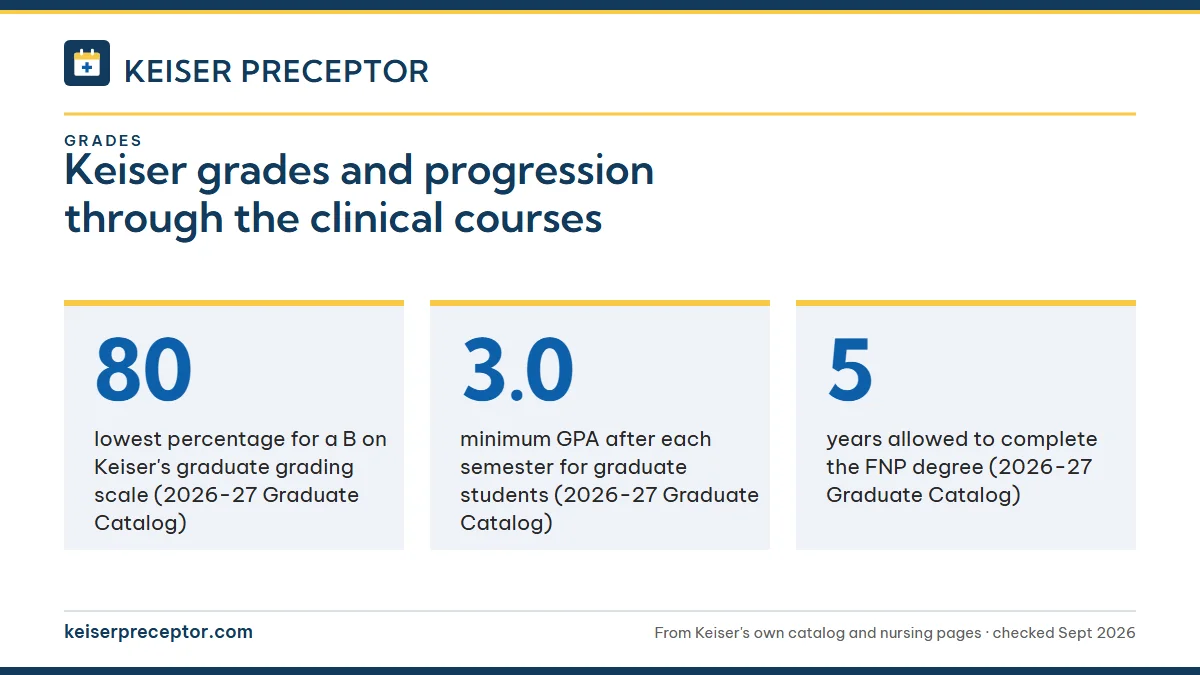
In Keiser's FNP, every practicum and its didactic partner needs an A or B, and the 2023 policy manual dismisses a student who earns two grades below B in those courses. Around that sit the program-wide rules: a 3.0 GPA after each semester, no more than one C at graduation, three attempts per course and five years to finish.
Get your placement plan
Tell us your Keiser program and where you live. A placement advisor replies with the preceptor and site options that fit your Keiser course.
Keiser's graduate grading scale
Keiser's graduate programs grade on four letters. The scale has no D, so anything below 70 is an F. A C still carries 2.0 grade points into your GPA, but in the FNP courses listed further down it forces a repeat.
| Grade | Percentage | Grade points |
|---|---|---|
| A | 90 to 100 | 4.0 |
| B | 80 to 89.99 | 3.0 |
| C | 70 to 79.99 | 2.0 |
| F | 69.99 or below | 0.0 |
For clinical courses, the line that matters is 80. A practicum grade rests on more than hours: the Clinical Evaluation Form your preceptor completes at midterm and at the end of the term carries minimum ratings that rise from 3 in the first three clinical terms to 5 in the fifth, and if a preceptor rates you poorly, it is the faculty member who rules on whether the course goals were met. The evaluations guide covers the form.
FNP courses that need an A or B
The 2026-27 Graduate Catalog sets a B floor on a defined group of FNP courses:
- The three specialty courses taken before clinicals:
NUR650,NUR661andNUR671 - Each didactic course and its practicum:
NUR602andNUR602A,NUR603andNUR603A,NUR604andNUR604A,NUR605andNUR605A,NUR691andNUR691A - The certification review course,
NUR698
Keiser's FNP page adds a timing rule on top of the grade rule. You enroll in the next clinical and theory pair only after the current pair is passed and its final grades are posted, so a grade still open at the end of a term holds up the next practicum as well as your transcript. The FNP practicum courses guide shows the pairs in order, and the first clinical course guide covers the gate before NUR602A.
Two grades below B, and the third C
Keiser's 2023 Graduate Nursing Program Policy and Procedure Manual turns the B floor into a progression rule. A C or F in one of the listed courses means repeating it, and then: "If a student earns two grades that are less than a grade of 'B' in any of the above courses, they will be academically dismissed." The same policy adds, "A student who obtains a third 'C' grade will be dismissed."
Read alongside the catalog, the rules stack. One grade below B in a specialty or clinical course is recoverable if the repeat goes well. A second one in those courses ends the program. Separately, the catalog's graduation requirements allow no more than one course with a C, and the manual dismisses on a third C anywhere. The manual's course list prints NUR692 where it means NUR691, a leftover worth knowing if you read it yourself.
A single C in an FNP practicum means a repeat, and it also uses up the only grade below B that the 2023 manual tolerates in those courses.
Repeating a course, and what happens to the hours
Keiser's catalog lets you repeat a graduate course with a final grade of C or lower, and the higher grade is the one that counts. No course may be attempted more than three times unless a program's handbook sets another limit, and a student who fails the first course in a program generally retakes it the following term.
For a practicum, a repeat means earning the clinical hours again. Keiser's older clinical manual says failing the clinical hours means the class is taken over in its entirety, hours included, and that the preceptor cannot be expected to continue past the term. Short of a failing grade, the 2023 manual gives a student found deficient at a site an action plan, which can include repeating the rotation. Either way, a repeat needs a preceptor for a new 8-week term, a fresh plan for clinical course completion and, if the site changes, a new agreement. The site falls through guide covers the mid-term case.
GPA, time limits and the FNP finish line
Satisfactory academic progress in the Graduate School means at least a 3.0 GPA after each semester. Falling below it starts a sequence of financial aid warning, probation and, if the shortfall continues, dismissal, so a weak didactic grade in a practicum term can cost more than the course itself.
The FNP degree has its own finish line: a cumulative 3.0, all FNP specialty credits taken at Keiser, the catalog's 540 clinical hours, both residencies, registration for the national board exam before the last course, and completion within five years. Keiser's FNP page defines part-time study as one course per 8 weeks and recommends finishing inside the five years. The clinical hours guide explains how the 540 compares with the other figures Keiser prints.
Grade rules in Keiser's other nursing programs
The B floor is spelled out most fully for the FNP. The other programs set their own lines:
| Program | Grade rule | Also required |
|---|---|---|
| MSN WHNP | No more than one C; no course-level B rule found in the catalog | 3.0 GPA, 710 hours, three residencies, 5 years |
| DNP | 3.0 GPA | Final 30 credits at Keiser, 1,000 practice hours, residency before ADP902, 5 years; 8 years from program start for the applied project phase |
| MSN (Nursing) | No more than two Cs; 3.0 GPA | Final 27 credits at Keiser, capstone, 5 years |
| Accelerated, FastTrack and Traditional BSN | B or higher in Nursing Core courses | Cumulative GPA of 3.0 or higher |
| RN to BSN | C or higher in every course | 45 clinical hours in NUR4636 |
| ASN | C of at least 76% in each nursing course; 70 to 75.99% earns CF, Insufficient to Proceed | Undergraduate repeat limits |
Undergraduate courses can generally be repeated up to two times, with a petition for a fourth attempt, and grade replacement excludes major courses in nursing. A stricter repeat policy in the Undergraduate Catalog is titled for Allied Health and does not name nursing, so ask your program which one governs your course.
Protecting your grade with the right placement
A practicum grade depends on hours you can only earn at a site that stays with you for all eight weeks. We plan each Keiser practicum so the preceptor's clinic days cover the full course hours with room to spare, and we stay on call to find a replacement if a preceptor drops, which keeps a lost site from turning into a lost course.
When a repeat is needed, we treat it as a fresh placement: a preceptor and site ready for the new term, with the CV or resume, license details and clinical dates prepared for the Preceptor/Mentor Information Form. Keiser's faculty decide on approval, and they receive a complete file from us the first time. Ask about your next term.
Questions Keiser students ask
Does failing a Keiser practicum mean losing my preceptor?
Not necessarily, but Keiser's manuals do not promise you can keep them. The older clinical manual says a preceptor cannot be expected to continue past the term, and a repeat is a whole new 8-week course. Ask your preceptor early whether they could take you again, and have course faculty confirm the arrangement before the new term.
Can I retake a Keiser graduate course to raise my GPA?
Yes, if the final grade was C or lower. The catalog lets you repeat it and counts the higher grade, within the three-attempt limit. For FNP clinical and specialty courses, ask your advisor whether the original C still counts toward the 2023 manual's two-grade dismissal rule, since that rule is worded around grades a student earns.
What happens if my Keiser graduate GPA drops below 3.0?
Graduate students need at least a 3.0 GPA after each semester to stay in satisfactory progress. Dropping below it starts Keiser's warning and probation steps for financial aid, and a continued shortfall can end in dismissal. The FNP also requires a cumulative 3.0 to graduate, so plan any retake and your course load to recover quickly.
Does the B rule apply to Keiser's WHNP clinical courses?
The catalog sets a 3.0 GPA and a limit of one C for WHNP graduation, but it does not spell out a course-level B requirement the way it does for the FNP. Confirm the minimum grade in each WHNP syllabus, and raise it with the Clinical Coordinator, who clears you before every WHNP clinical registration anyway.
Related pages
Last checked 2026-09-25
We check these pages against Keiser's catalogs, graduate nursing manuals, licensure disclosures and program pages. Your course, the Clinical Coordinator and the 2026-27 Graduate Catalog have the final word.
Keiser asks you to find your own preceptor. Let us run that search.
Tell us your Keiser program, your next practicum and where you live. We find preceptors who fit the course and prepare the CV, license and site details your Preceptor/Mentor Information Form needs, about three months ahead.
- Preceptors matched to the course: adult and older-adult primary care for
NUR602AandNUR603A, pediatrics forNUR604A, women's health forNUR605A - CV, license, certification and site contact ready for Keiser's review and the affiliation agreement
- Across Florida, from Miami to Jacksonville, and in the other states where you are licensed
Start your placement plan
Your program, city and next practicum term is all we need to begin.