NUR4636: the RN to BSN's 45-hour community clinical
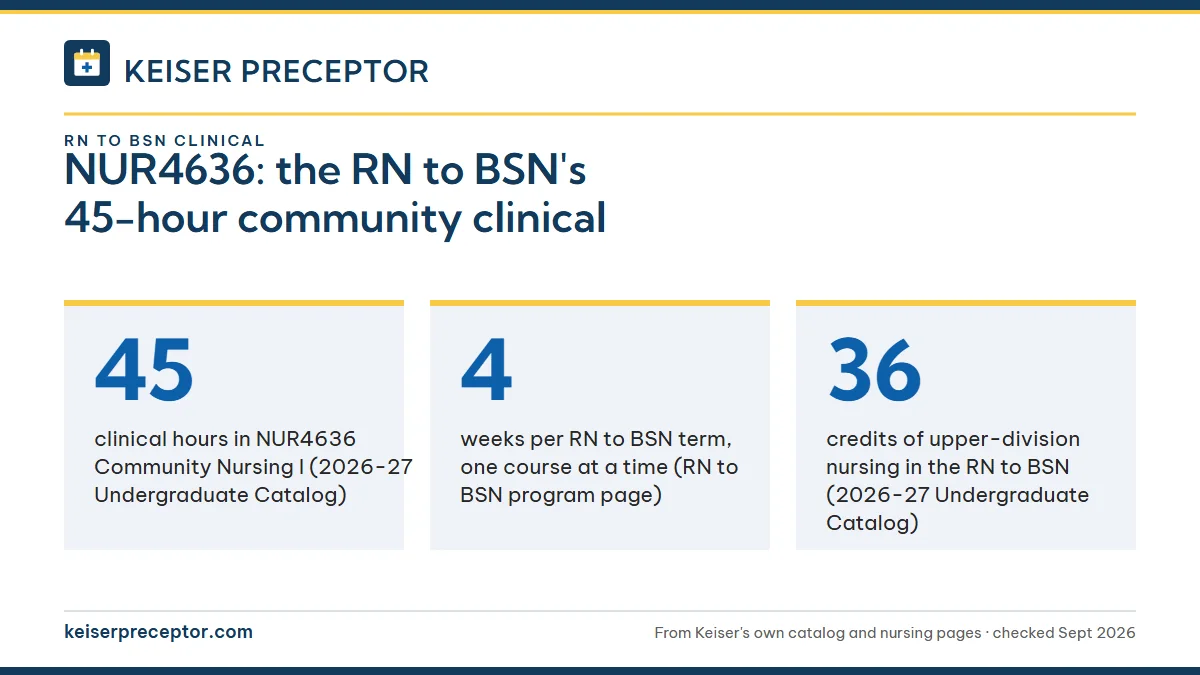
Keiser's RN to BSN has one clinical course with published hours, NUR4636 Community Nursing I, and it leaves both the setting and the preceptor to you. Its catalog entry calls for 45 clinical hours at a site of your choosing, subject to approval by the University Department Chair, all within a program built on one 4-week course at a time.
Get your placement plan
Tell us your Keiser program and where you live. A placement advisor replies with the preceptor and site options that fit your Keiser course.
What Keiser's catalog says about NUR4636
Two passages in Keiser's 2026-27 Undergraduate Catalog define the course. The program text reads: "NUR 4636 requires 45 clinical hours. Students are responsible for securing the appropriate preceptors for this clinical courses." The course description adds that the hours take place "in a clinical setting chosen by the student and approved by the University Department Chair," with a preceptor supervising.
That leaves three things for you to arrange before any hour counts: a community setting, a preceptor who works there, and enough lead time for the Department Chair to review the choice. The RN to BSN program page repeats the preceptor responsibility, so this is Keiser's current position for the course rather than a stray line. The approvals and roles page explains where the Department Chair sits among Keiser's clinical titles.
Where NUR4636 fits in the RN to BSN
The RN to BSN totals 120 credits, 36 of them upper-division nursing, and the program page describes 4-week terms taken one course at a time. NUR4636 is one of eleven nursing courses in the catalog outline, alongside courses such as NUR3081 Transition to Professional Nursing, NUR4166 Nursing Research and NUR4888 Nursing Leadership in Systems of Healthcare.
Keiser has not published the prerequisites for NUR4636 or its place in the sequence, so ask your advisor for your planned term as soon as you enroll. The outline lists the course at 4 credits and the description at 3; the 45 hours are the same in both. Every RN to BSN course needs a C or better to proceed, and the program's wider details are on the RN to BSN program page.
45 hours inside a 4-week term
If NUR4636 runs in a single 4-week term like the program's other courses, 45 hours comes to about 11 or 12 hours a week, on top of the online coursework and whatever shifts you work as an RN. That is two long days or three shorter visits every week of the term, with very little room to make up a missed day.
With terms this short, a late search has nowhere to hide. On Keiser's undergraduate calendar, a semester of 16 weeks breaks into 4-week Terms A, B, C and D; the fall 2026 set opens on the Mondays of August 31, September 28, October 26 and November 23. The graduate calendar page shows how those letters line up with the graduate terms.
Choosing a community setting the Department Chair will approve
Keiser's description leaves the setting open and names the University Department Chair as the approver. The course title, Community Nursing, points toward care for families and populations beyond the inpatient unit. Settings that suit a community nursing course include:
- County and state health department programs, such as immunization, maternal and child health or disease investigation
- Community health centers and clinics serving rural or underserved neighborhoods
- School health, home health and hospice services
- Community and public health nursing roles in nonprofit organizations
Preceptor rules for the course sit in the RN to BSN Clinical Course Manual, which Keiser cites in the catalog and on the program page but has not posted publicly. Keiser's published workplace rules, such as a different department and a preceptor who is not your supervisor, are written for FNP students; the workplace rules page explains them, and course faculty can say what applies to NUR4636.
Get the preceptor requirements from the RN to BSN Clinical Course Manual through course faculty before you ask anyone to precept you.
Community Nursing II and other catalog leftovers
A second community course, Community Nursing II, appears in the outline as NUR9999, a 4-credit placeholder number with no description and no printed hour count, so ask your advisor whether it carries a clinical component before you map out your final terms. If it does, plan that preceptor search the same way as the one for NUR4636, well before its 4-week term opens.
The course descriptions also include NUR4817 Nursing Roles Practicum, a 45-hour precepted course labeled for the RN to BSN in a setting the student chooses. It is missing from the current program outline, so unless your advisor puts it on your plan, NUR4636 is the clinical to prepare for.
Why RN to BSN students choose us for NUR4636
A 45-hour clinical sounds small, but a community preceptor with room in a 4-week window is hard to find around a working nurse's schedule. We search community and public health settings near you for a preceptor who fits NUR4636, and we confirm the clinical days before your term opens so the hours fit around your shifts.
Your placement advisor pulls together the setting and preceptor details for the Department Chair's review: the preceptor's resume and license, the site contact, and the days and dates you plan to attend. If a preceptor falls through, we stay on call and find another. The Department Chair approves the setting, and the details we send are complete from the start. For the full process, visit how it works; if your term is close, go to need a preceptor fast.
Questions Keiser students ask
Does Keiser find RN to BSN preceptors for NUR4636?
The catalog and the program page place that search with the student: students secure the appropriate preceptors, and the setting is one the student chooses and the University Department Chair approves. Keiser's part is the approval. The search itself is exactly what our placement desk takes on for RN to BSN students.
Can I do my NUR4636 hours where I work as an RN?
Keiser's public employer rules, which call for a different department, a preceptor who is not your supervisor and hours outside your shifts, are written for FNP students. Whatever applies to RN to BSN students lives in the course manual that Keiser keeps off its public site, so check with course faculty before you plan hours at your own employer.
Do RN to BSN students need a Florida RN license?
The catalog admits applicants with an associate degree, a diploma or an RN license in their state of residence, and asks for a current U.S. RN license. Students in an on-campus hybrid RN to BSN must hold a Florida RN license. If you are weighing the hybrid format from out of state, confirm the license question with admissions first.
What grade do I need in NUR4636?
Keiser's RN to BSN rule is a C or higher in every course to proceed, a lower bar than the B standard in the graduate NP programs. The 45 clinical hours are part of the course, so ask course faculty how the hours and the preceptor's input factor into your grade before the term begins.
How long does Keiser's RN to BSN take?
Keiser's web page advertises a finish in as little as a year, and the catalog agrees that most students take 12 months even as it lists the program at about 40. With 4-week terms and one course at a time, the clinical takes one short slot in that plan, so a late preceptor can hold up the courses behind it.
Related pages
Last checked 2026-09-25
We check these pages against Keiser's catalogs, graduate nursing manuals, licensure disclosures and program pages. Your course, the Clinical Coordinator and the 2026-27 Graduate Catalog have the final word.
Keiser asks you to find your own preceptor. Let us run that search.
Tell us your Keiser program, your next practicum and where you live. We find preceptors who fit the course and prepare the CV, license and site details your Preceptor/Mentor Information Form needs, about three months ahead.
- Preceptors matched to the course: adult and older-adult primary care for
NUR602AandNUR603A, pediatrics forNUR604A, women's health forNUR605A - CV, license, certification and site contact ready for Keiser's review and the affiliation agreement
- Across Florida, from Miami to Jacksonville, and in the other states where you are licensed
Start your placement plan
Your program, city and next practicum term is all we need to begin.