Keiser's Associate of Science in Nursing and its clinical courses
Keiser's Associate of Science in Nursing prepares you for RN licensure in about two years, with clinical experience built into most nursing courses at approved health care agencies. In NUR2817C Nursing Roles Practicum, clinical oversight may come from an approved RN preceptor in an affiliated facility. After licensure, the RN to BSN is where Keiser first asks you to secure a preceptor yourself.
Get your placement plan
Tell us your Keiser program and where you live. A placement advisor replies with the preceptor and site options that fit your Keiser course.
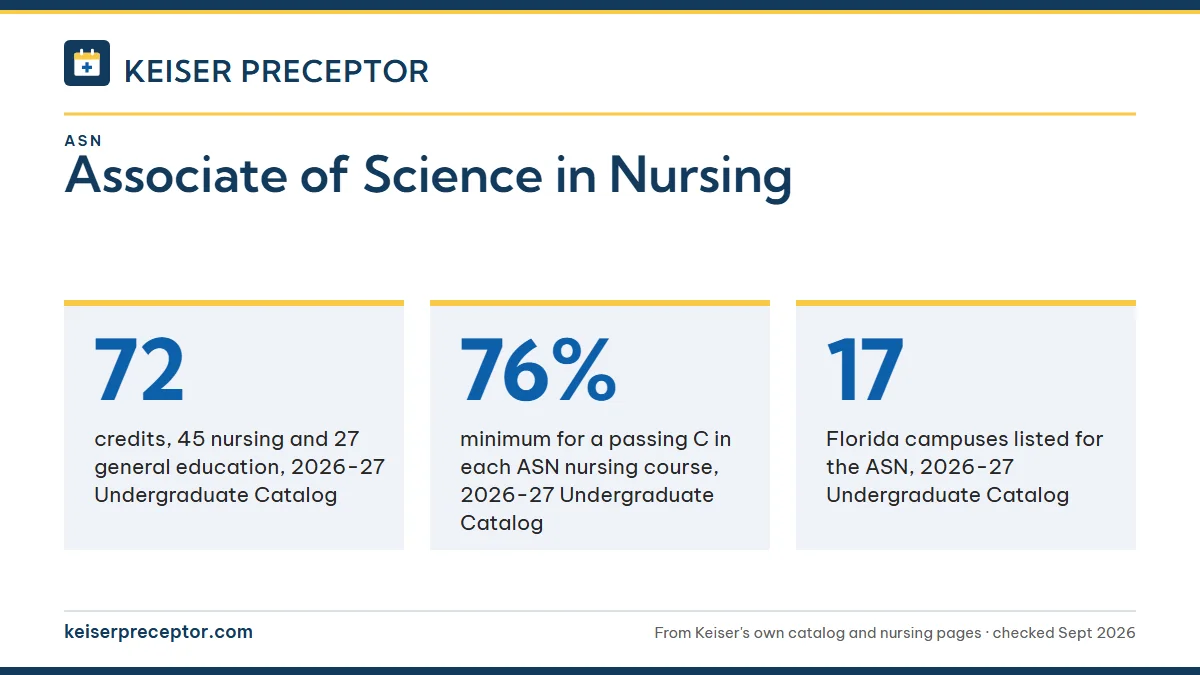
The ASN in brief
The catalog lists the program as "Nursing, AS". It is taught on campus, delivered in 4-week terms, and pre-licensure: you graduate prepared to seek your RN license rather than adding to one you already hold.
| Item | What Keiser publishes |
|---|---|
| Credits | 72: 45 nursing and 27 general education (the program page header says 42 nursing) |
| Length | About 24 months in the catalog; 25 months on the program page |
| Format | On campus, 4-week terms |
| Campuses | Clearwater, Daytona, Fort Lauderdale, Fort Myers, Jacksonville, Lakeland, Melbourne, Miami, Naples, New Port Richey, Ocala, Orlando, Port St. Lucie, Sarasota, Tallahassee, Tampa, West Palm Beach |
| Clinical sites | Approved health care agencies, arranged by the program |
| Passing grade | A C of at least 76% in each nursing course |
Keiser's professional licensure disclosure for the ASN and BSN, dated June 2024, reports that the programs meet educational requirements in all states. The licensure disclosures guide explains what those documents cover and how to read them.
Getting into the nursing courses
Admission and the move into nursing courses come with a checklist. The catalog lists:
- A background check at enrollment, repeated before the nursing courses if needed
- An interview and a Wonderlic SLE score of 23
- A B in Anatomy and Physiology I and II
- A C in Microbiology, Intermediate Algebra, Life Span Development and the general education courses
- A 3.0 GPA across the prerequisites
- A drug screen and immunizations
Because the background check can run twice, once at enrollment and again before nursing courses begin, anything that changes on your record in between can matter. The anatomy grades carry the highest bar on the list, so plan those courses with the most care.
Clinical courses, from Fundamentals to the Roles Practicum
Clinical work starts early. NUR1022C Fundamentals of Nursing, the first nursing course, already includes clinical experiences, and the courses after it continue at the approved health care agencies the program works with.
| Course | Credits | Catalog note |
|---|---|---|
| NUR1022C Fundamentals of Nursing | 8 | First nursing course; includes clinical experiences |
| NUR1211C Basic Adult Healthcare | 8 | Adult care |
| NUR2230C Advanced Adult Healthcare | 8 | Medical-surgical and mental health |
| NUR2421C Maternity Nursing Care | 4 | Maternity |
| NUR2310C Pediatric Nursing | 4 | Pediatrics |
| NUR2817C Nursing Roles Practicum | 6 | Faculty and/or an approved RN preceptor in an affiliated facility |
| NUR2989C Professional Nursing Readiness | 3 | Simulation; its description is printed under NUR2898C |
NUR1140C Nursing Pharmacology, a 4-credit course, is the nursing course without a clinical component. Keiser does not publish clinical hours for ASN courses, so each course schedule is where you see how the rotation days fall.
The Nursing Roles Practicum and its RN preceptor
NUR2817C, a 6-credit course, is where the ASN starts to look like the job. Its clinical oversight may come from faculty, from "an approved RN preceptor in an affiliated facility", or from both, so you may spend part of the practicum working alongside a practicing RN rather than in a faculty-led group.
Both conditions in that phrase matter. The preceptor has to be approved and the facility has to be affiliated with Keiser, so the practicum runs inside the program's own agreements. The catalog also still carries a description of NUR2811C Nursing Practicum, a 3-credit course whose clinical experience is proposed by the student and chosen together with faculty and an RN preceptor; the current ASN course list names NUR2817C instead.
If your campus invites you to suggest a setting or an RN preceptor for the Roles Practicum, that is where our placement desk helps. We find an RN preceptor in the kind of unit you want, near where you live, and prepare the license and contact details faculty need to weigh the proposal within Keiser's affiliated facilities.
Grades and the 76% line
Each ASN nursing course has to be passed with a C of at least 76%. A score from 70.0% to 75.99% earns a CF, which the catalog defines as "Insufficient to Proceed" even though it carries 2.0 grade points. Treat 76%, not 70%, as the pass mark from your first course.
Clinical sites have a say too. If a facility asks that a student leave, the catalog says the program will try to reassign that student elsewhere; once a second removal happens, reassignment stops and the course counts as failed.
Repeat rules add a layer. The general policy allows a course to be repeated up to two times, while a stricter major-course policy, titled for Allied Health, limits each major course to one repeat. It does not name nursing, so ask your campus which rule applies to ASN courses.
After the ASN: RN to BSN, then graduate study
Once you are licensed, Keiser's RN to BSN is the next step inside the university: online or hybrid, one 4-week course at a time, with your license counting for 42 credits of advanced placement. It changes one thing the ASN did for you. NUR4636 Community Nursing I needs 45 clinical hours with a preceptor whom you arrange yourself, at a site the University Department Chair signs off on; the NUR4636 guide covers it.
Past the BSN, the MSN FNP runs the student-led model at full size: five practicums totaling 540 precepted hours in the 2026-27 Graduate Catalog, with a year or more of RN practice with patients required before you apply.
Why ASN students plan ahead with us
Through the ASN, Keiser's approved agencies carry your rotations. Our desk is built for the moments when the search is yours: a Roles Practicum setting your campus asks you to propose, the RN to BSN's community clinical, and later the FNP. We find a preceptor close to where you live, confirm availability for your dates, and assemble what Keiser reviews, so the request is complete when it reaches faculty or the Department Chair.
Send your campus, expected graduation and next program through the form below, and we will work out the timing together.
Questions Keiser students ask
Does Keiser arrange clinical placements for ASN students?
Yes. The ASN program page describes clinical experiences at approved health care agencies, and the Nursing Roles Practicum uses faculty, an approved RN preceptor in an affiliated facility, or both. Your campus schedules the rotations. At Keiser, the student-led preceptor search starts later, in the RN to BSN's community nursing course.
How long does Keiser's ASN take?
About 24 months in the 2026-27 Undergraduate Catalog and 25 months on the program page, delivered in 4-week terms. The 72 credits split into 45 nursing and 27 general education in the catalog, while the program page header shows 42 nursing credits, so check your own degree plan with your campus.
What happens if I score 74% in a Keiser ASN nursing course?
That earns a CF, not a passing C. The catalog requires at least 76% in each nursing course, and scores from 70.0% to 75.99% are marked Insufficient to Proceed. You would need to pass the course at the required level before moving on, subject to Keiser's repeat rules, so talk with your instructor as soon as your average nears the line.
Is the Keiser ASN offered online?
No. The ASN is an on-campus program at 17 Florida campuses in the 2026-27 catalog, from Jacksonville and Tallahassee in the north to Miami and Naples in the south. Keiser's online nursing options begin after licensure, with the RN to BSN, and continue into the Graduate School's online master's and doctoral programs.
Can an ASN graduate go straight into Keiser's FNP program?
Not directly, because the FNP is a master's program. Its admission list starts with a completed BSN at a 3.0 cumulative GPA, then adds an active Florida RN license with no restrictions and a minimum of a year of recent hands-on patient care. Through Keiser's own programs, the path runs from the ASN to RN licensure, then the RN to BSN and clinical experience, and then the FNP.
Related pages
Last checked 2026-09-25
We check these pages against Keiser's catalogs, graduate nursing manuals, licensure disclosures and program pages. Your course, the Clinical Coordinator and the 2026-27 Graduate Catalog have the final word.
Keiser asks you to find your own preceptor. Let us run that search.
Tell us your Keiser program, your next practicum and where you live. We find preceptors who fit the course and prepare the CV, license and site details your Preceptor/Mentor Information Form needs, about three months ahead.
- Preceptors matched to the course: adult and older-adult primary care for
NUR602AandNUR603A, pediatrics forNUR604A, women's health forNUR605A - CV, license, certification and site contact ready for Keiser's review and the affiliation agreement
- Across Florida, from Miami to Jacksonville, and in the other states where you are licensed
Start your placement plan
Your program, city and next practicum term is all we need to begin.