NUR602A and NUR603A: two terms of adult primary care
Your first two Keiser FNP practicums keep you in adult and older-adult primary care for consecutive 8-week terms, 120 precepted hours apiece. On these two courses every Keiser source agrees about the hours, so the real work is the match: a preceptor Keiser will approve, at a practice with a steady adult caseload, lined up about three months before NUR602A begins.
Get your placement plan
Tell us your Keiser program and where you live. A placement advisor replies with the preceptor and site options that fit your Keiser course.
What the two adult courses cover
NUR602 Primary Health Care of the Family I is the adult and older-adult course, and NUR602A is its practicum. NUR603 Primary Health Care of the Family II and its practicum NUR603A follow in the next term, with the NUR602 pair as a prerequisite. Together they open the five-practicum FNP sequence.
| Practicum | Didactic partner | Practicum credits | Hours | Where the figure appears |
|---|---|---|---|---|
NUR602A | NUR602 Primary Health Care of the Family I (3 credits) | 2 | 120 | 2026-27 catalog and FNP program page |
NUR603A | NUR603 Primary Health Care of the Family II (3 credits) | 2 | 120 | 2026-27 catalog and FNP program page |
Keiser's older clinical manual treats the pair as one 240-hour adult block, and the age-group answer on the FNP page divides the same 240 between young and middle adults and older adults. Taken together, then, the two terms should reach adults of every age. Typhon sorts your hours by age group and diagnosis, so a caseload that skews young in NUR602A is worth balancing in NUR603A.
What has to be done before NUR602A opens
NUR602A is the first practicum, so it inherits every gate in the program. The core and specialty courses come first, with a B or better in NUR650, NUR661 and NUR671. Keiser's FNP page also lists medical clearance and immunizations, a clear background check, personal liability insurance, a contract between the site and Keiser, and Keiser's approval of the preceptor. The first clinical course guide covers that order in detail.
NUR603A has a lighter gate: the NUR602 pair must be finished, with final grades posted. Its preceptor still needs approval for the new term, and a site new to Keiser still needs a signed affiliation agreement before the first hour. Both adult terms are also your first ratings on the FNP Clinical Evaluation Form, where Keiser's older manual sets a minimum score of 3 for clinical terms one to three.
Settings with the right adult caseload
Keiser's FNP page suggests primary care in health departments, retail clinics, physician offices, urgent care and fast-track clinics. For the adult terms the strongest of these is a continuity practice, a family medicine or internal medicine office where the same patients come back for conditions such as hypertension, diabetes and lung disease, alongside acute visits.
Urgent care and retail clinics bring volume and acute complaints, but their patients rarely return. If one of them hosts NUR602A, a continuity practice for NUR603A gives your Typhon record the chronic care it would otherwise lack. For older adults, internal medicine and geriatric practices keep the schedule close to the patients NUR602 covers.
If you work in health care, your own employer can host you only on Keiser's terms: another department, a preceptor who is not your immediate supervisor, and hours outside your normal shifts. The workplace rules guide sets them out.
The preceptor Keiser will approve for adult terms
Keiser prefers a master's-prepared family nurse practitioner for every practicum, and a family NP in adult practice is the cleanest fit here. Adult nurse practitioners are among the other NPs Keiser accepts in limited numbers, and physicians holding an MD or DO, such as internists and family physicians, are acceptable preceptors. Physician assistants are absent from Keiser's list.
The personal rules travel with every term: a current license with no encumbrance, a year or more of experience, active practice at the site, direct supervision throughout, and no supervisory relationship with you at work. Anyone who covers for your preceptor must hold the same credentials.
One planning point is specific to these terms. Keiser does not print how many non-FNP nurse practitioners a student may use, and pediatrics and women's health are where a pediatric or women's health NP helps most. Ask course faculty before spending that allowance on an adult term. The preceptor requirements guide has the full list.
How to find an adult primary care preceptor
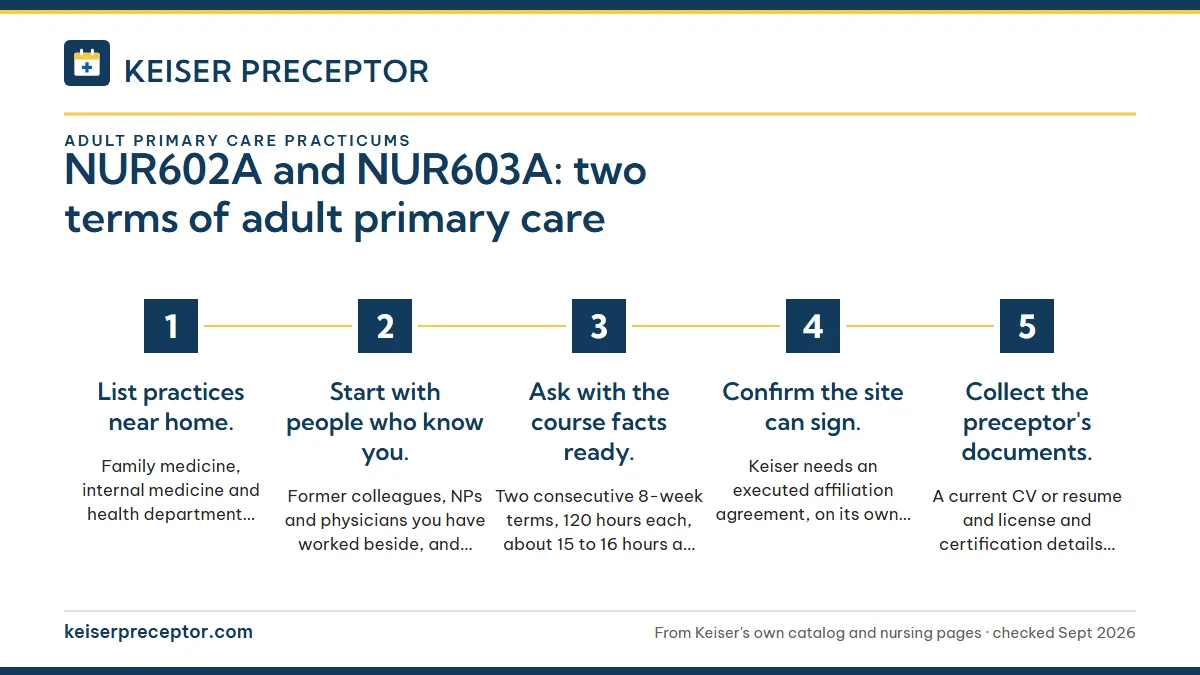
- List practices near home.Family medicine, internal medicine and health department clinics within a realistic drive, since Keiser's hours happen in person at an approved site.
- Start with people who know you.Former colleagues, NPs and physicians you have worked beside, and clinicians from your own care. A personal introduction gets your request in front of the person who decides.
- Ask with the course facts ready.Two consecutive 8-week terms, 120 hours each, about 15 to 16 hours a week, direct supervision, and preceptor evaluations at weeks 4 and 8.
- Confirm the site can sign.Keiser needs an executed affiliation agreement, on its own template or the agency's, before any hours count. Get the name of whoever signs for the practice.
- Collect the preceptor's documents.A current CV or resume and license and certification details go to the Clinical Faculty or Clinical Coordinator with the Preceptor/Mentor Information Form.
- Raise the second term early.If the practice suits both courses, mention
NUR603Ain the first conversation. Each term still gets its own dates and its own approval.
Pacing 120 hours inside eight weeks
Keiser's FNP page puts a 120-hour practicum at roughly 15 to 16 hours a week, plus 6 to 8 hours for the online course, and recommends spreading clinical hours across all eight weeks. Two 8-hour clinic days a week reach 128 hours by week eight, a small cushion against one cancelled day.
Several fixed points sit inside every adult term: the midterm evaluation at week 4, the final at week 8, a phone conference with clinical faculty each term, and a site visit, in person or virtual, at least once a semester. Log each encounter within 7 days, and keep telehealth under a quarter of your direct patient care hours. The 8-week pacing guide plans the term week by week, and the Typhon guide covers logging.
Why Keiser students start their adult terms with us
The adult terms set the pattern for the rest of the program, and we treat them that way. Your placement advisor searches in person where you live for an adult or family practice with a preceptor who meets Keiser's rules, and asks about NUR603A in the same conversation so both terms are settled early.
Then we build what the Clinical Coordinator will look for: the preceptor's curriculum vitae, license and board certification details, the practice contact who handles the agreement, and a calendar of your clinic days, ready about three months before NUR602A. If a preceptor withdraws, we stay on call and find a replacement. Keiser's faculty and Program Director approve every arrangement, and our job is a complete file on their desk. Tell us your term on the contact page or in the form below.
Questions Keiser students ask
Can the same preceptor supervise NUR602A and NUR603A?
Keiser's rules treat each practicum as its own approved arrangement with its own dates, so a preceptor who hosted NUR602A can be put forward again for NUR603A. Ask early rather than assume: Keiser's older clinical manual notes that a preceptor's commitment cannot be taken for granted past the term. Course faculty confirm the second approval.
Do urgent care hours count toward NUR602A?
They can. Urgent care and fast-track clinics appear on the Keiser FNP page's list of suggested settings. What matters is that the site holds an executed affiliation agreement, your preceptor is approved before you start, and the hours are direct patient care: assessing, diagnosing, treating or evaluating real patients under supervision.
Can a physician assistant precept a Keiser adult practicum?
Physician assistants are missing from the preceptors Keiser names, which are master's-prepared FNPs, a limited number of other NPs, and MDs and DOs. If a PA is your only lead, ask the Clinical Coordinator before anyone fills out paperwork. A supervising physician in the same practice is worth asking as well.
Can I complete NUR603A while working full time?
Keiser's clinical hours are unpaid, and at your own employer they must fall outside your normal working hours in another department. Plan two clinic days a week, or a mix of weekdays and weekends if the practice opens then, and settle the schedule with the preceptor before your plan for clinical course completion goes to faculty.
How early should I find my NUR602A preceptor?
Keiser asks FNP students to start planning clinical courses about three months before the course begins. For NUR602A that usually means searching while the specialty courses are still running, because a new site's affiliation agreement and the Program Director's approval both have to clear first. See the three-month lead time guide.
Related pages
Last checked 2026-09-25
We check these pages against Keiser's catalogs, graduate nursing manuals, licensure disclosures and program pages. Your course, the Clinical Coordinator and the 2026-27 Graduate Catalog have the final word.
Keiser asks you to find your own preceptor. Let us run that search.
Tell us your Keiser program, your next practicum and where you live. We find preceptors who fit the course and prepare the CV, license and site details your Preceptor/Mentor Information Form needs, about three months ahead.
- Preceptors matched to the course: adult and older-adult primary care for
NUR602AandNUR603A, pediatrics forNUR604A, women's health forNUR605A - CV, license, certification and site contact ready for Keiser's review and the affiliation agreement
- Across Florida, from Miami to Jacksonville, and in the other states where you are licensed
Start your placement plan
Your program, city and next practicum term is all we need to begin.