NUR604A: children, adolescents and a pediatric preceptor
NUR604A is the third Keiser FNP practicum and the only one built around children and adolescents: 60 precepted hours in the 2026-27 Graduate Catalog, taken with NUR604. The hours come to half an adult term, but the match is narrower, because you need a practice where young patients fill the schedule and a preceptor Keiser will approve.
Get your placement plan
Tell us your Keiser program and where you live. A placement advisor replies with the preceptor and site options that fit your Keiser course.
Where NUR604A falls in the FNP
NUR604 Primary Health Care of the Family III covers children and adolescents in 2 credits, and NUR604A is its 1-credit practicum. The pair follows both adult terms as the third of the five FNP practicums, and the adult pairs must be complete, with grades posted, before it opens.
One catalog quirk is worth knowing. The printed prerequisites for NUR604 still name NUR660 and NUR670, course numbers that no longer appear in the FNP curriculum. If that line causes confusion at registration, ask your advisor or course faculty; the current program outline shows the real order.
As with every FNP clinical course, NUR604A needs an A or B, and the practicum and NUR604 are graded as two separate courses. Your preceptor rates you on the FNP Clinical Evaluation Form at weeks 4 and 8, and Keiser's older manual keeps the minimum at 3 for this third clinical term.
Sixty hours or 120: the pediatric numbers
Keiser's documents give pediatrics two different weights, depending on which one you open.
| Keiser source | Pediatric hours | FNP total it belongs to |
|---|---|---|
| Graduate Catalog 2026-27, course description | 60 (NUR604A) | 540 |
| FNP program page, course hours | 60 | 510 |
| FNP program page, age-group answer | 120 | 630 implied |
| Older Graduate Nursing Programs Clinical Manual | 120 (NUR604/NUR604A) | 630 in the text |
The 120 figure turns up only in older material and in one answer on the program page that disagrees with that page's own course hours. The catalog governs, so plan on 60 unless course faculty tell you otherwise. The clinical hours guide tracks every Keiser total side by side. When you ask a preceptor, quote the catalog's 60 and mention that a spare day or two would help if a clinic session is cancelled. A clear, modest number is easier for a busy pediatric office to accept.
Practices where children fill the schedule
Keiser's list of suggested FNP settings includes health departments, retail clinics, physician offices and urgent care. For NUR604A, the physician office that works best is usually a pediatric practice, or a family practice where children make up a large share of the visits.
Settings worth approaching
- Pediatric offices with an NP or physician who can take one student for one term
- Family practices whose family NP carries a heavy pediatric panel
- Health department clinics that run well-child visits and immunizations
- School-based health centers, where the sponsoring clinic can sign the agreement
- Urgent care centers with steady pediatric volume, for acute visits
Aim for range. A term of only sick visits, or only well-child checks, leaves gaps in a Typhon record that sorts hours by age group and diagnosis. Infants, school-age children and teenagers are different patients, and a practice that sees all three serves this course best.
Who can precept NUR604A
A master's-prepared family nurse practitioner is Keiser's first preference here as everywhere, and an FNP who sees many children fits without drawing on the limited allowance for other NPs. Pediatric nurse practitioners are named among those other NPs, which makes this the natural term to use one. Pediatricians qualify through Keiser's rule that MDs and DOs are acceptable preceptors. A pediatric physician assistant does not appear among Keiser's preceptor types, so clear any such lead with the Clinical Coordinator first.
Whoever it is must be licensed without restriction, have at least a year in practice, work at the site itself and supervise you directly. Their CV or resume and license details travel with the Preceptor/Mentor Information Form to the Clinical Faculty or Clinical Coordinator, and the Program Director gives the approval.
Finding a pediatric preceptor, step by step
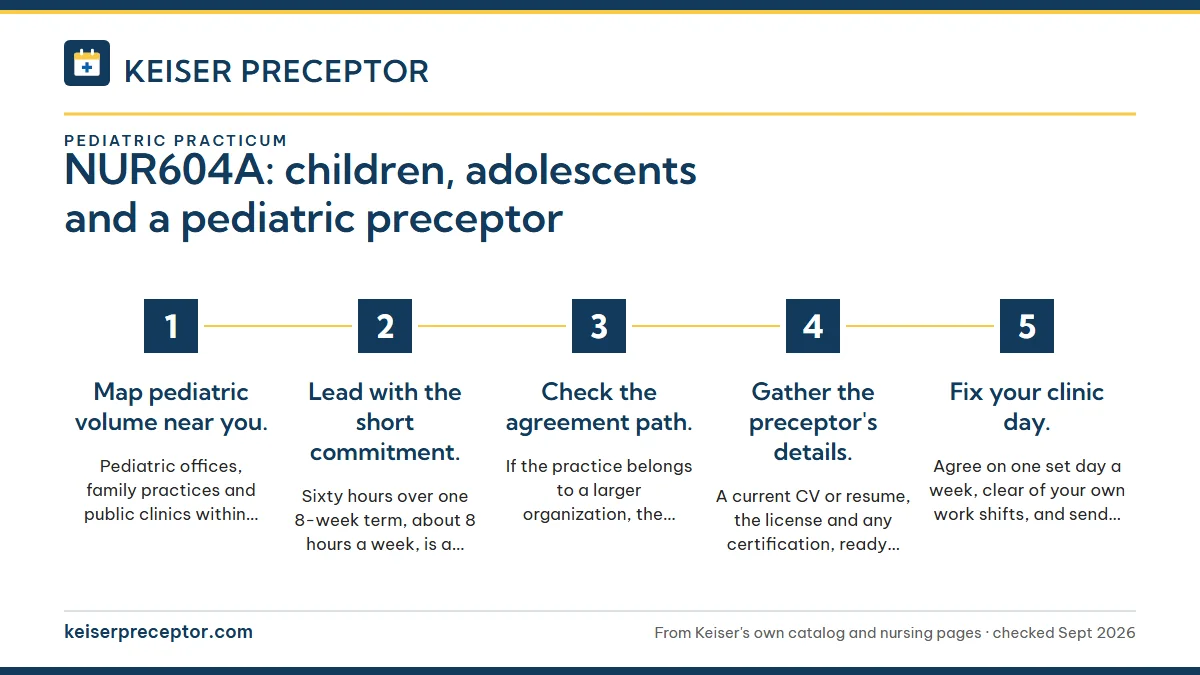
- Map pediatric volume near you.Pediatric offices, family practices and public clinics within reach, noting which ones see children every day rather than now and then.
- Lead with the short commitment.Sixty hours over one 8-week term, about 8 hours a week, is a lighter ask than an adult term, and it helps to say so in the first sentence.
- Check the agreement path.If the practice belongs to a larger organization, the affiliation agreement may go through a central office. Ask who signs, and whether they use their own agreement or Keiser's template.
- Gather the preceptor's details.A current CV or resume, the license and any certification, ready for the Preceptor/Mentor Information Form.
- Fix your clinic day.Agree on one set day a week, clear of your own work shifts, and send the dates to course faculty in your plan for clinical course completion.
- Start about three months out.Keiser's lead time applies to every practicum, even one with fewer hours, because approval and the agreement take the same time either way.
Sixty hours across eight weeks
Keiser's FNP page puts a 60-hour practicum at about 8 hours a week and asks students to spread hours through the term rather than packing them into a few long days. One clinic day a week for eight weeks reaches 64 hours, a slim margin, so agree a make-up day with the preceptor in advance.
The shorter course keeps the full set of checkpoints. Your preceptor completes the midterm evaluation at week 4, after roughly 30 hours together, and the final at week 8, and encounters go into Typhon within 7 days. If a week is lost to illness or a clinic closure, the 8-week pacing guide and the page on falling behind on hours show how to recover inside the term.
Why Keiser students bring us their pediatric term
We run the pediatric term as its own search, started early, not as an afterthought squeezed between the adult terms and women's health. Your placement advisor looks in person where you live for a pediatric or family practice with real volume in children and a preceptor who fits Keiser's list.
We then prepare the preceptor's resume or CV, proof of license and any specialty certification, the name of the person who signs the agreement for the practice, and your proposed clinic days, so the Preceptor/Mentor Information Form can go in about three months ahead of NUR604A. If the preceptor drops, we stay on call and look for a replacement. Keiser's faculty and Program Director decide; we make sure the file reaching them has nothing missing. Start on the contact page or in the form below.
Questions Keiser students ask
Can a pediatrician be my Keiser NUR604A preceptor?
Yes. Keiser's FNP page accepts MDs and DOs as preceptors, and a pediatrician fits that rule. The individual requirements still apply: a license in good standing, at least a year of experience and regular practice at the site. The Program Director approves the preceptor from the CV or resume sent with the Preceptor/Mentor Information Form.
Can NUR604A hours happen on a hospital pediatric unit?
NUR604 is a primary health care course, and every setting Keiser suggests for FNP clinicals is outpatient. An inpatient unit would need course faculty to agree before you build a plan around it, and the time would still have to meet Keiser's definition of direct patient care under a qualified preceptor.
Does my pediatric site need its own affiliation agreement?
Every site needs an executed affiliation agreement with Keiser before hours begin. If your adult practice also sees children and its agreement is still in force, that agreement may cover NUR604A too; Keiser reviews agreements at least once a year. A new pediatric office means a new agreement, which is why the search starts months ahead.
What if my pediatric preceptor cancels partway through the term?
Keiser's 2023 policy manual says an alternate site is coordinated by the Program Coordinator and the Clinical Coordinator with agency representatives, and the older clinical manual says a preceptor cannot be expected to extend past the term. Tell course faculty at once. Our placement desk searches for a replacement alongside you; see preceptor dropped out.
Related pages
Last checked 2026-09-25
We check these pages against Keiser's catalogs, graduate nursing manuals, licensure disclosures and program pages. Your course, the Clinical Coordinator and the 2026-27 Graduate Catalog have the final word.
Keiser asks you to find your own preceptor. Let us run that search.
Tell us your Keiser program, your next practicum and where you live. We find preceptors who fit the course and prepare the CV, license and site details your Preceptor/Mentor Information Form needs, about three months ahead.
- Preceptors matched to the course: adult and older-adult primary care for
NUR602AandNUR603A, pediatrics forNUR604A, women's health forNUR605A - CV, license, certification and site contact ready for Keiser's review and the affiliation agreement
- Across Florida, from Miami to Jacksonville, and in the other states where you are licensed
Start your placement plan
Your program, city and next practicum term is all we need to begin.