Keiser's nursing programs from Florida: licenses, campuses and clinical sites
Florida is the state Keiser's graduate nursing programs are built around. The Florida RN license they ask for is the one you already hold, the residencies are a drive away in Fort Lauderdale and West Palm Beach, and Keiser's November 2025 FNP disclosure lists Florida as meeting its requirements. What remains is the part Keiser leaves to FNP students everywhere: finding a preceptor and a site it will approve.
Get your placement plan
Tell us your Keiser program and where you live. A placement advisor replies with the preceptor and site options that fit your Keiser course.
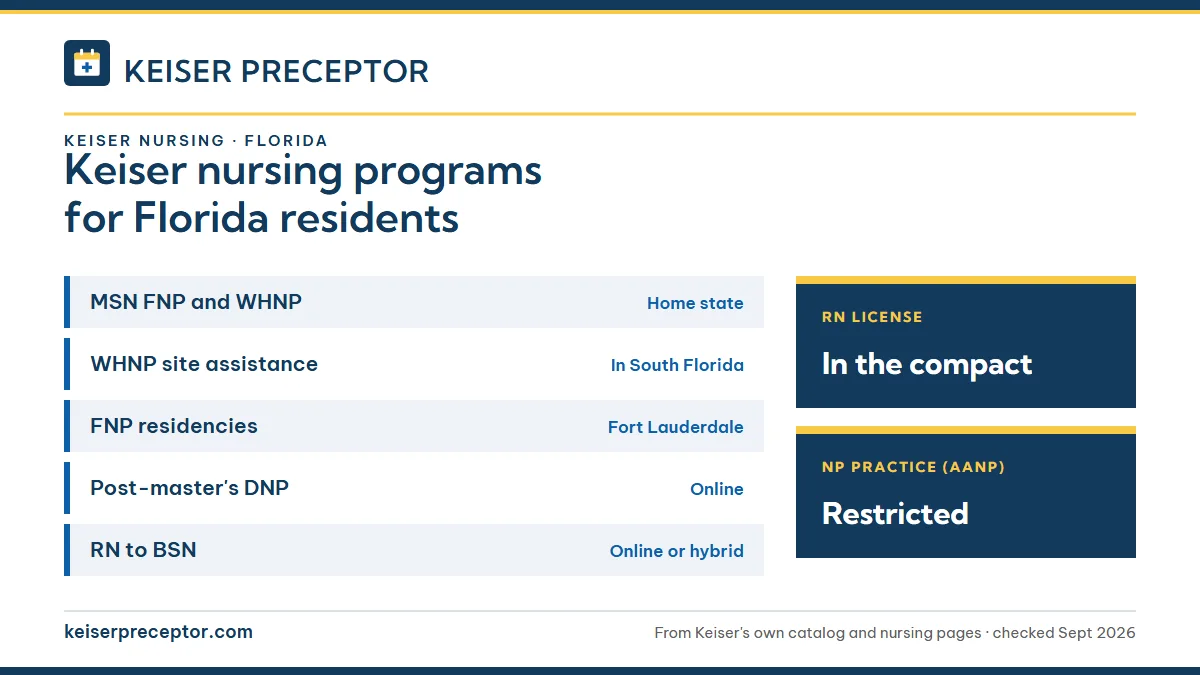
What each Keiser program means for a Florida resident
Keiser teaches its graduate nursing degrees online through the Graduate School and its entry-level programs on campuses around the state. For a nurse living in Florida, the clinical side of each program works out like this.
| Program | Open to Florida residents? | Where the clinical work happens |
|---|---|---|
| MSN Family Nurse Practitioner | Yes; an active, unrestricted Florida RN license is an admission requirement | Florida practices and preceptors you identify, approved by Keiser under a signed affiliation agreement; two residencies in Fort Lauderdale |
| MSN Women's Health NP | Yes, on the same license terms | Keiser's catalog offers help obtaining a site in South Florida; elsewhere you select it; three on-campus weekends |
| Post-master's DNP | Yes; asks for an RN license in your state of residence | Practice courses in organizational and community settings with a mentor; one doctoral residency at the Flagship campus |
| MSN (Nursing) | Yes; the catalog asks for a Florida RN license | No practicum course; the capstone project is set in your own practice setting |
| RN to BSN | Online, or hybrid at many campuses (the hybrid requires a Florida RN license) | 45 hours in NUR4636, in a setting you choose and the Department Chair approves, with a preceptor you secure |
| BSN tracks and ASN | Campus programs across Florida | Clinicals arranged by the program at partner facilities |
| Nurse Anesthesia (DNAP) | Naples campus, hybrid | Clinical affiliates arranged by the program |
Florida's standing on Keiser's two state lists is as clean as it gets: both the FNP and WHNP disclosures mark Florida as meeting requirements, and Florida is absent from the restriction list in the Graduate School FAQ. Admission remains Keiser's call, so confirm your program with the Graduate School before you apply.
Your licenses: the Florida board, the compact and the APRN license
The Florida Board of Nursing approves prelicensure RN and LPN programs and nothing above them. Section 464.019 of the Florida Statutes reaches only entry-level education, and the Board's education page says it is not authorized to conduct site visits. No Florida rule makes a graduate NP program register or seek approval before it places students in Florida clinics, so for Keiser's MSN and DNP students the gatekeepers are Keiser's own approvals and each site's affiliation agreement.
Florida joined the Nurse Licensure Compact, which took effect here on January 19, 2018, so a Florida multistate RN license travels to the other compact states. Its reach ends with RN and LPN licenses. Your future APRN license will be issued by Florida, and Florida has not adopted the separate APRN Compact. If you are relocating to Florida on another state's multistate license, the Board's 2024 notice gives nurses who move to a new compact state 60 days to apply for that state's license.
Because Keiser's admission requirement names an active, unrestricted Florida RN license, raise it with admissions early if your license came from another state. After graduation, the Board looks for national certification, a master's degree and evidence of malpractice insurance, or an exemption from it, before it issues an APRN license.
Florida NP practice: protocols by default, autonomy in primary care
AANP files Florida under restricted practice. Most Florida APRNs practice under a protocol agreed with a physician who supervises, kept on file where they practice, and Schedule II prescriptions are capped at a 7-day supply outside psychiatric care. Since 2020 a second route has existed: an APRN with 3,000 physician-supervised practice hours in the previous five years, plus graduate credit earned within the last five years in both pharmacology and differential diagnosis, can register as an autonomous APRN and practice primary care without a supervising physician.
Both models produce preceptors. A family NP working under protocol can host you, and so can an autonomous APRN in a primary care field such as family medicine, which lines up with the primary care focus of Keiser's FNP practicums. The Department of Health issued 2,729 autonomous registrations in fiscal year 2024-25 alone. The Florida practice and precepting guide explains how each model shapes the preceptor you work with.
Where Florida clinicals happen: four regions, many doors
By the Census Bureau's 2025 estimates, the southeast coast's Miami-Fort Lauderdale-West Palm Beach metro holds roughly 6.4 million residents, Tampa-St. Petersburg-Clearwater comes next with roughly 3.4 million, then Orlando-Kissimmee-Sanford near 3.0 million and Jacksonville near 1.8 million. The health systems below appear as examples of where Florida clinicians practice and how each handles NP students, not as Keiser partners.
- South Florida: Baptist Health South Florida and Broward Health run student rotations through Complio, and Cleveland Clinic Florida takes placement requests only from the school.
- Tampa Bay and the Gulf Coast: BayCare files NP students under its physician-sponsored process, so each needs an MD or DO sponsor credentialed there.
- Orlando and Central Florida: AdventHealth asks students to find a preceptor on its medical staff and file an APRN Student Application.
- North Florida: Mayo Clinic Florida hosts NP students from a short list of affiliated schools, and Baptist Health Care in Pensacola runs an online student application.
Region to region, the same three conditions recur: paper between Keiser and the system, frequently specific to one program; a clinician employed or privileged there; and onboarding on the system's platform. Private practices, urgent cares, retail clinics and health departments, the settings Keiser itself suggests, decide one site at a time. The statewide preceptor guide compares the systems side by side.
Keiser's Florida campuses and the residency weekends
Keiser's main campus is in Fort Lauderdale, and the Graduate School and Online Division work from a separate Fort Lauderdale address on West Commercial Boulevard. The Flagship campus, a 100-acre residential campus established in 2015, sits on North Military Trail in West Palm Beach.
Nursing is also taught on the west coast at New Port Richey, Clearwater, Tampa, Sarasota, Fort Myers and Naples; inland at Lakeland, Orlando and Ocala; in the north at Jacksonville and Tallahassee; and on the east coast at Daytona Beach, Melbourne, Port St. Lucie, West Palm Beach, Pembroke Pines and Miami. The 2026-27 Graduate Catalog lists graduate nursing as online at every one of them, so your local campus anchors ASN and BSN cohorts rather than NP coursework.
The on-campus requirements are where living in Florida pays off. The FNP calls for two Fort Lauderdale residencies: three days during advanced health assessment (NUR671) and two days in the final Integration Practicum (NUR691A). WHNP students attend three intensive weekends, in NUR671, NUR612 and NUR614. DNP students complete a doctoral residency at the Flagship campus before ADP902, two days in the catalog, though an older DNP web page said two to four. A residency fee applies and travel is yours to arrange, which for most Florida students means a drive rather than a flight. The FNP residency guide covers timing around your practicums.
WHNP students: South Florida help, your own search elsewhere
The women's health track is the one place Keiser's catalog offers placement help, and it draws the line by geography. If your clinicals will be in South Florida, the 2026-27 Graduate Catalog says Keiser will help you obtain a site. Anywhere else in the state, from Tampa to Tallahassee, you select a site that can supply the patients, activities and supervision each course needs.
The catalog leaves South Florida's edge undefined, so students in Port St. Lucie, Naples or Fort Myers should ask the Clinical Coordinator which side of the line they fall on. Every WHNP clinical course also needs its preceptor and site approved, plus the Clinical Coordinator's clearance, before you can register. The WHNP placement page sets out how Keiser's three descriptions of this help differ.
Florida's shortage numbers and the TEACH program
Florida has a large APRN workforce and still falls short on primary care. The Department of Health's annual report counted 50,378 in-state active APRN licenses in fiscal year 2024-25, a figure covering every APRN role rather than NPs alone. HRSA's summary as of June 30, 2026 lists 328 primary care shortage designations in Florida, covering about 7.3 million residents between them, and estimates that 1,501 more practitioners would be needed to remove them. Mental health adds 254 designations of its own.
We found no Florida tax credit for preceptors, and Keiser's preceptors are volunteers. The one state program tied to precepting is TEACH, created in 2024 and run by AHCA. The money goes to qualifying facilities, a list that starts with community health centers (FQHCs), rural clinics and community mental health centers, and it covers precepted hours for several student types, APRN students in primary care among them. Payments depend on appropriations and are limited to students of accredited Florida-based programs. Keiser is one of those, which gives its students standing that out-of-state online programs lack when a community health center weighs hosting an NP student.
Why Florida's Keiser students choose our placement desk
We work Florida the way Keiser's approval process works it. Your placement advisor combs your part of Florida for a preceptor whose patients fit the practicum on your calendar, checks each lead against Keiser's preceptor rules and the host system's own gates, and assembles what Keiser's Clinical Coordinator and its Preceptor/Mentor Information Form call for: the CV or resume, license and certification, the agreement contact and your clinical days across the 8-week term.
You have that package roughly three months before the course opens, and we remain on call through all eight weeks, starting the hunt for a replacement the day a preceptor steps away. Keiser's faculty and Program Director make the approval decision; our job is handing them a file that is complete and built to their rules from the start.
Questions Keiser students ask
Do Keiser FNP students in Florida get assigned a preceptor?
No. Keiser's FNP program page puts identifying the site and preceptor on the student, and living in Florida does not change that. Keiser's part is approval: the Program Director approves the preceptor, clinical faculty approve the arrangement, and an affiliation agreement between Keiser and the site is signed before clinical work starts. The women's health track in South Florida is the one exception, where the catalog promises help obtaining a site.
Does the Florida Board of Nursing approve my clinical site or preceptor?
No. The Board approves prelicensure RN and LPN programs, and Florida law sets no credential, ratio or hour rule for NP preceptors. Keiser is the one that approves: its faculty assess the site in person or remotely, the Program Director approves each preceptor individually, and the site's affiliation agreement is executed first.
Does TEACH funding go to my preceptor?
No. Florida's TEACH program pays qualifying sites, community health centers and rural clinics among them, for the hours they spend training students, and only when those students attend accredited programs based in Florida. The supervising clinician needs a Florida license and has to meet AHCA's standards. Individual preceptors are not paid through it, and Keiser's preceptors volunteer their time.
Is my future Florida APRN license covered by the Nurse Licensure Compact?
No. The compact Florida joined in 2018 covers RN and LPN licenses only. A Florida APRN license is issued by Florida for practice in Florida, and the state has not adopted the separate APRN Compact. If you might practice in another state after finishing at Keiser, plan on applying for that state's APRN license as well.
Is Keiser's online FNP taught at my local Florida campus?
Not in the classroom. Keiser's 2026-27 Graduate Catalog lists the MSN, FNP, WHNP and DNP as online at every Florida campus, with the Graduate School based in Fort Lauderdale; some Keiser web tiles say online or on campus, and the catalog governs. You come on campus for residencies, and your practicums take place at approved sites near home.
Related pages
Last checked 2026-09-25
We check these pages against Keiser's catalogs, graduate nursing manuals, licensure disclosures and program pages. Your course, the Clinical Coordinator and the 2026-27 Graduate Catalog have the final word.
Keiser asks you to find your own preceptor. Let us run that search.
Tell us your Keiser program, your next practicum and where you live. We find preceptors who fit the course and prepare the CV, license and site details your Preceptor/Mentor Information Form needs, about three months ahead.
- Preceptors matched to the course: adult and older-adult primary care for
NUR602AandNUR603A, pediatrics forNUR604A, women's health forNUR605A - CV, license, certification and site contact ready for Keiser's review and the affiliation agreement
- Across Florida, from Miami to Jacksonville, and in the other states where you are licensed
Start your placement plan
Your program, city and next practicum term is all we need to begin.