How Florida's APRN rules shape who precepts you
Florida law governs how your preceptor practices and says very little about precepting itself. An NP preceptor works either under a physician protocol or as a registered autonomous APRN in primary care, and the state sets no preceptor credential, ratio or hour rule for NP students, so Keiser's standards do that job.
Get your placement plan
Tell us your Keiser program and where you live. A placement advisor replies with the preceptor and site options that fit your Keiser course.
Protocol practice, Florida's default
Unless registered as autonomous, a Florida APRN works within an established protocol kept on site, per s. 464.012. In a group practice the protocol runs with at least one physician in the group, who keeps supervision for directing the specific course of medical treatment. AANP rates Florida's practice environment as restricted, and the Board of Nursing expects the protocol to be filed where the APRN practices.
Prescribing is capped too. Most Schedule II prescriptions stop at a 7-day supply, with psychiatric drugs written by psychiatric nurses as the exception, and psychiatric controlled substances for anyone under 18 are reserved to psychiatric nurses.
For you, protocol practice means your preceptor's decisions sit inside a physician framework, and yours sit inside your preceptor's: Keiser's practicum policy bars students from diagnosing, setting a treatment plan, treating or discharging without the preceptor's explicit approval or direct supervision.
The autonomous APRN pathway
Since 2020, section 464.0123 has let experienced APRNs register to practice without a supervising physician. As the 2025 statute reads, registration requires:
- An active, unencumbered Florida APRN license and a clean disciplinary record for five years.
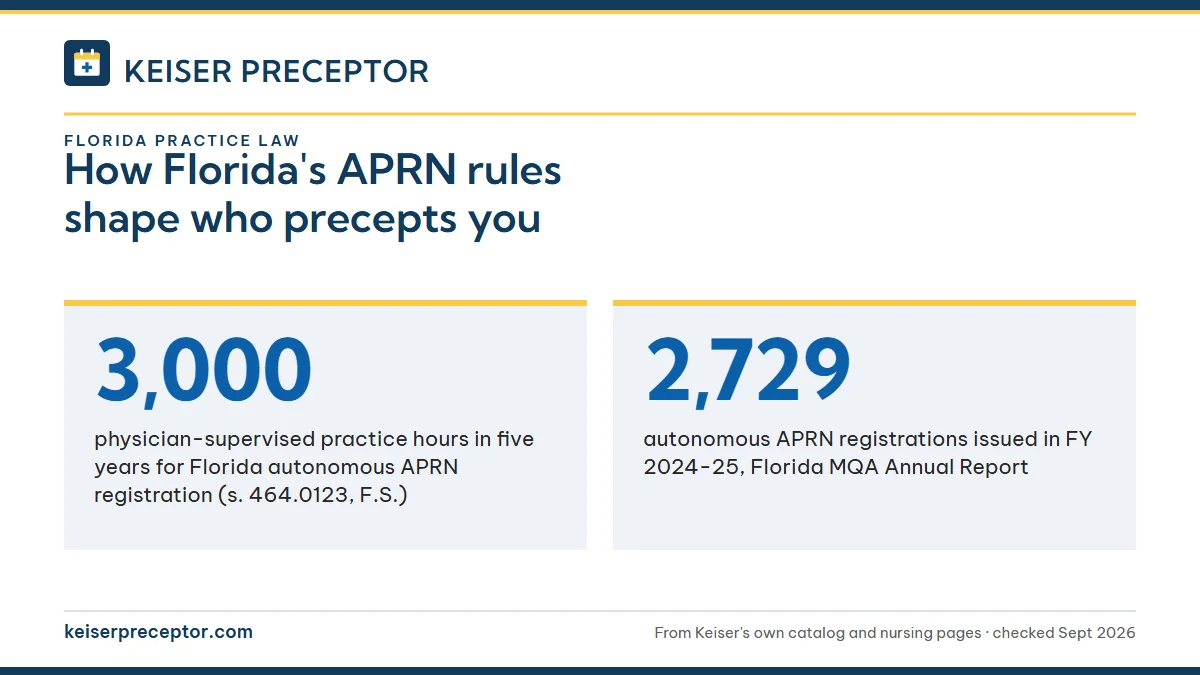
- 3,000 clinical practice hours in those five years, supervised by an MD or DO.
- Three graduate semester hours each in differential diagnosis and pharmacology, earned within the same window.
- Liability insurance at the statute's minimums.
- Primary care only (family medicine, general internal medicine and general pediatrics, as the Board's rule defines them), with certified nurse midwives also eligible and surgery limited to subcutaneous procedures.
- Renewal every two years with 10 extra continuing education hours.
Registration uses form DH-MQA 5050 under Rule 64B9-4.020. In fiscal year 2024-25 the Department of Health issued 2,729 of the 3,535 applications it received.
What the two models mean for your practicum
Keiser's FNP practicums center on primary care across the lifespan, and primary care is the whole of an autonomous APRN's scope. An autonomous family NP running a family medicine or general pediatrics practice matches Keiser's preferred preceptor, a master's-prepared FNP, and in a practice they own can make the hosting decision themselves.
Protocol practices are just as usable. A family NP under protocol qualifies under Keiser's rules, and because Keiser accepts MDs and DOs, the protocol physician can be a second possible preceptor in the same office. The statute also has a teaching clause: the 3,000 hours an APRN logs toward autonomous registration can include clinical instructional hours taught as faculty in a clinical setting for a graduate NP program. Whether volunteer precepting counts is a question for the Board of Nursing.
What Florida leaves to Keiser
Florida's nursing statute lets students of approved nursing schools practice as part of their education, with no clause written for APRN students. Nor does it set any statewide NP preceptor credential, ratio or hour minimum. The preceptor standards in s. 464.019 cover RN and LPN programs only.
Keiser's rules fill that space. Your preceptor needs a current, unencumbered license, at least twelve months in the role, a place on the site's staff and a commitment to direct supervision at all times, and cannot be your immediate supervisor. Keiser's clinical faculty orient new preceptors, assess sites in person or remotely and visit during the practicum. The preceptor requirements page has the complete list, and the statewide preceptor guide shows how Florida's health systems add rules of their own.
Licenses your preceptor holds
A Florida APRN license comes from Florida alone. The Nurse Licensure Compact, in force here since January 19, 2018, covers RN and LPN licenses, and Florida has not joined the separate APRN Compact. An NP precepting you in a Florida clinic therefore holds a Florida APRN license on top of a Florida or multistate RN license.
Behind that license sit the Board's requirements: national certification, a master's degree for NPs who graduated on or after October 1, 1998, and proof of malpractice coverage or an exemption. The preceptor's license and certification details travel with the Preceptor/Mentor Information Form so Keiser's Program Director can check them. Students' own license questions are on the Florida state page.
TEACH: Florida's facility reimbursement
Florida's precepting money goes to facilities, not to individual preceptors, and we found no Florida preceptor tax credit. Keiser's preceptors volunteer. The one statutory program tied to precepting is TEACH, s. 409.91256, created in 2024 and run by AHCA. Its payments reach rural clinics, community health centers (FQHCs), certified community behavioral health clinics and community mental health centers, covering hours spent training students, APRN students pursuing primary care among them.
TEACH comes with conditions. The preceptor must be a Florida-licensed practitioner who meets AHCA's standards and training, funding depends on appropriations, and only students in accredited programs based in Florida count. That last line is where Keiser's Florida base matters, since students of out-of-state online programs fall outside it. The program is set to end on July 1, 2034.
LINE, and the bills that stalled
The LINE Fund, created in 2022, is a state match for nursing programs that partner with health care employers, and its statute lists recruiting clinical preceptors among the permitted uses. Its eligibility measures are prelicensure ones, and Keiser appears, marked ICUF, on the Department of Education's LINE lists for 2024-25 and 2025-26.
Two bills aimed at nursing education died in the Senate's Fiscal Policy committee: SB 526 in 2025, which would have had the Florida Center for Nursing develop graduate nursing preceptorship standards, and SB 254, a 2026 nursing education programs bill. In Congress, H.R. 392, the PRECEPT Nurses Act, is still only a proposal.
Why Keiser students rely on us for Florida precepting
Florida's rules leave the preceptor search to you and the approval to Keiser, and our service fills the ground between. Our placement desk finds Florida NPs, autonomous or under protocol, and physicians whose practices fit your practicum, checks their licenses and experience against Keiser's standards, and builds the Preceptor/Mentor Information Form package with the agreement contact and your clinical days. It is ready about three months before the course, and we stay reachable all term to replace a preceptor who drops.
Questions Keiser students ask
Can an autonomous APRN precept a Keiser FNP student?
Yes, when they meet Keiser's standards: an unencumbered current license, twelve months or more in the role, practice at your site and direct supervision throughout. Autonomous registration limits practice to primary care, which suits Keiser's FNP practicums. Keiser prefers master's-prepared family nurse practitioners, and its Program Director approves each preceptor from the CV and license details submitted.
Does Florida require preceptor training for NPs?
No Florida rule sets training, credentials or ratios for NP preceptors. Keiser's older clinical manual says its clinical faculty orient new preceptors to the role, and preceptors receive Keiser's Preceptor/Mentor Agreement with the course objectives and evaluation criteria. The same manual points them to NONPF's preceptor manual and a mentoring text.
Is there a Florida tax credit for precepting NP students?
We found none in Florida law. Two bills touching nursing education and graduate precepting died in committee in 2025 and 2026, and the federal PRECEPT Nurses Act is still a bill. Florida's TEACH program reimburses qualifying facilities rather than individual preceptors, and Keiser describes its preceptors as volunteers.
Can my Florida preceptor use a compact license?
Only for the RN part. The Nurse Licensure Compact covers RN and LPN licenses and Florida has not joined the APRN Compact, which means an NP precepting you here needs a Florida APRN license. Their RN license can be Florida-issued or multistate. Keiser looks for unrestricted licensure when it reviews the preceptor.
Does my preceptor's protocol limit what I can do as a student?
Your own limits come from Keiser: no diagnosis, treatment plan, treatment or discharge without your preceptor's explicit approval or direct supervision. The protocol shapes your preceptor's authority, including the 7-day Schedule II cap, so the plans you help build stay inside what that protocol allows.
Related pages
Last checked 2026-09-25
We check these pages against Keiser's catalogs, graduate nursing manuals, licensure disclosures and program pages. Your course, the Clinical Coordinator and the 2026-27 Graduate Catalog have the final word.
Keiser asks you to find your own preceptor. Let us run that search.
Tell us your Keiser program, your next practicum and where you live. We find preceptors who fit the course and prepare the CV, license and site details your Preceptor/Mentor Information Form needs, about three months ahead.
- Preceptors matched to the course: adult and older-adult primary care for
NUR602AandNUR603A, pediatrics forNUR604A, women's health forNUR605A - CV, license, certification and site contact ready for Keiser's review and the affiliation agreement
- Across Florida, from Miami to Jacksonville, and in the other states where you are licensed
Start your placement plan
Your program, city and next practicum term is all we need to begin.