West Virginia nurses in Keiser's online FNP
West Virginia reads "meets" on Keiser's November 2025 FNP licensure disclosure, and the Graduate School FAQ attaches no restriction to it. The state's RN Board oversees schools that prepare nurses for a first license and hands graduate programs over to WVHEPC, the state higher-ed commission, whose nursing office asks for approval only from non-SARA schools or from those clustering ten-plus students in one facility. Keiser is a SARA member, so the head count is the one thing to confirm with Keiser.
Get your placement plan
Tell us your Keiser program and where you live. A placement advisor replies with the preceptor and site options that fit your Keiser course.
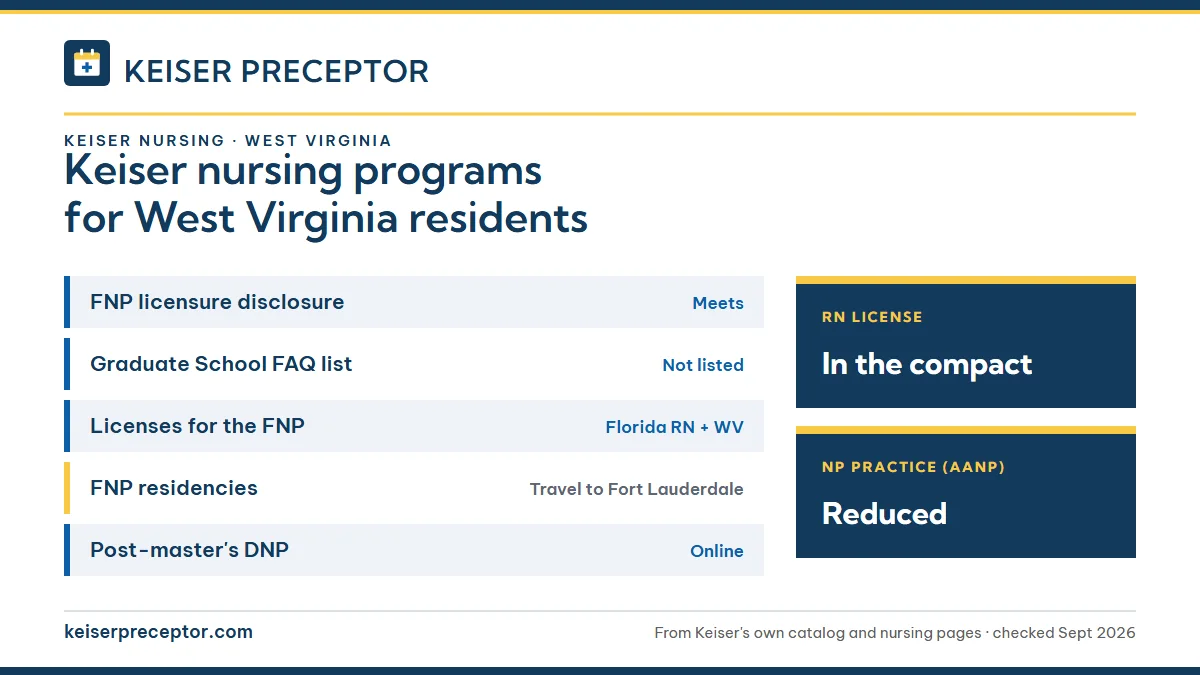
Two agencies, and which one reaches an online FNP
The West Virginia Board of Registered Nurses keeps its program oversight to pre-licensure education. A school from another state that prepares students for a first license files the Board's prelicensure approval application before using any facility in the state. Schools offering advanced degrees get different directions from the Board: take clinical placement questions to WVHEPC and to the school's national nursing accreditor.
WVHEPC's nursing office (Nursing Education and Workforce Development) answers those questions in its clinical rotation guide. A graduate or APRN program from elsewhere needs WVHEPC's approval under just two conditions: its college is not an NC-SARA participant, or it clusters ten-plus students in one facility. Keiser belongs to SARA, per its own licensure pages, so ask the Graduate School whether that head count could ever touch your site.
The RN Board's out-of-state approval application is for pre-licensure schools. Keiser's graduate programs answer to the WVHEPC guide instead.
Keiser's programs from a West Virginia address
| Program | From West Virginia? | Where the clinical work happens |
|---|---|---|
| MSN FNP | Meets requirements per the November 2025 disclosure; confirm with the Graduate School | West Virginia sites you secure and Keiser approves; two Fort Lauderdale residencies |
| MSN WHNP | The WHNP disclosure lists West Virginia as meeting requirements | Women's health sites you choose; three weekends on campus |
| Post-master's DNP | Expects an RN license from your state of residence; confers no license | Practice hours with mentors; one two-day residency at the Flagship campus |
| RN to BSN (online) | Expects an RN license from your state of residence | NUR4636, a 45-hour community clinical at a setting you pick |
| BSN tracks and ASN | Florida campus programs | Florida sites set up by the program |
Keiser's two state lists disagree in places, and neither promises a seat. The licensure disclosures guide sets them side by side.
Licenses and reduced practice in West Virginia
The WVHEPC guide ties your student license to where you live. Students who call West Virginia their primary home do clinicals on a West Virginia RN license, while those based in another state use a multistate license, which works here because West Virginia joined the compact in 2018. Keiser layers its own terms on top: a current Florida RN license, licensure for whichever state hosts clinicals, and a letter showing West Virginia accepts the rotations and would license you as an NP. The Florida RN license guide walks through Keiser's side.
AANP places West Virginia in reduced practice: through an NP's first three years, prescriptive authority depends on a collaborative arrangement with a physician, and any Schedule II narcotic is limited to three days' worth. The APRN Compact is not law in West Virginia. Since Keiser counts MDs and DOs, not only NPs, as acceptable FNP preceptors, a collaborating physician is a fair person to approach.
Settings from Morgantown to Huntington
Census-defined metro areas reaching into West Virginia, per 2025 estimates, include Morgantown, Charleston, Hagerstown-Martinsburg and Huntington-Ashland. Examples of systems include Vandalia Health (its members take in Davis Health, Mon Health and CAMC), WVU Medicine and Marshall Health Network, and the Department of Health's Bureau for Public Health leads public health. Each is a setting to consider, never an existing Keiser site; Keiser approves every preceptor and signs an agreement with the site first. No state preceptor incentive turned up in research, and Keiser's preceptors volunteer.
Borders matter here. Huntington-Ashland spills into Kentucky and Ohio, both "meets" on Keiser's disclosure, though a site over there brings that state's license and rules into play. Hagerstown-Martinsburg spills into Maryland, which Keiser's FAQ restricts, and Pennsylvania, just north of Morgantown, is "does not meet" on the FNP disclosure.
Residency trips and the eight-week term
The FNP's two in-person residencies are in Fort Lauderdale. The first runs three days inside Advanced Assessment; the second takes a Saturday and Sunday during the last practicum. Travel and lodging are on you. Every practicum occupies a single eight-week term, and Keiser asks you to begin planning each one about three months before it opens.
Why West Virginia students choose us
We are the thorough, Keiser-focused way to land a West Virginia preceptor. We hunt down the clinician and practice that match your exact practicum, in person and close to home, anywhere from Charleston to the Maryland line, and build the file Keiser's Clinical Coordinator reviews: CV, license and certification, site agreement contact and clinical dates, ready about three months early. If someone drops out, we find a replacement. Send the form below.
Questions Keiser students ask
Is RN Board approval part of the picture for Keiser students in West Virginia?
No. The RN Board's program oversight covers pre-licensure schools, and it steers graduate programs to WVHEPC. Under WVHEPC's guide, a graduate program from elsewhere needs approval only if its college is outside SARA or it clusters ten-plus students in one facility. Keiser is a SARA member; ask the Graduate School about the head count.
Which license covers my FNP clinicals in West Virginia?
WVHEPC's guide says it depends on your home: a West Virginia RN license for residents, a multistate compact license for students living in other states. Keiser's admission terms add an active Florida RN license and a license for your clinical state, so confirm your exact set with the Graduate School.
Could I train across the river in Ohio or Kentucky?
Both states meet requirements on Keiser's FNP disclosure and are absent from the FAQ restriction list, so a site there is not ruled out. Keiser still wants you licensed for whichever state hosts your clinicals, and that state's own rules come with it. Clear the idea with Keiser before approaching a preceptor.
How does reduced practice affect my search in West Virginia?
Mostly it shapes your first years as an NP, when prescribing runs through a physician collaboration agreement. For clinicals, it means NPs and physicians already practice side by side, and since Keiser approves MD and DO preceptors too, you have more clinicians to approach.
Related pages
Last checked 2026-09-25
We check these pages against Keiser's catalogs, graduate nursing manuals, licensure disclosures and program pages. Your course, the Clinical Coordinator and the 2026-27 Graduate Catalog have the final word.
Keiser asks you to find your own preceptor. Let us run that search.
Tell us your Keiser program, your next practicum and where you live. We find preceptors who fit the course and prepare the CV, license and site details your Preceptor/Mentor Information Form needs, about three months ahead.
- Preceptors matched to the course: adult and older-adult primary care for
NUR602AandNUR603A, pediatrics forNUR604A, women's health forNUR605A - CV, license, certification and site contact ready for Keiser's review and the affiliation agreement
- Across Florida, from Miami to Jacksonville, and in the other states where you are licensed
Start your placement plan
Your program, city and next practicum term is all we need to begin.