Studying with Keiser from Kentucky: licenses, board rules and your practicum
Kentucky is on the open side of Keiser's November 2025 FNP disclosure, and Kentucky's nursing board asks nothing of schools from elsewhere before their students train in the state. The planning comes down to two RN licenses, a preceptor you find and Keiser approves, and two trips to Fort Lauderdale.
Get your placement plan
Tell us your Keiser program and where you live. A placement advisor replies with the preceptor and site options that fit your Keiser course.
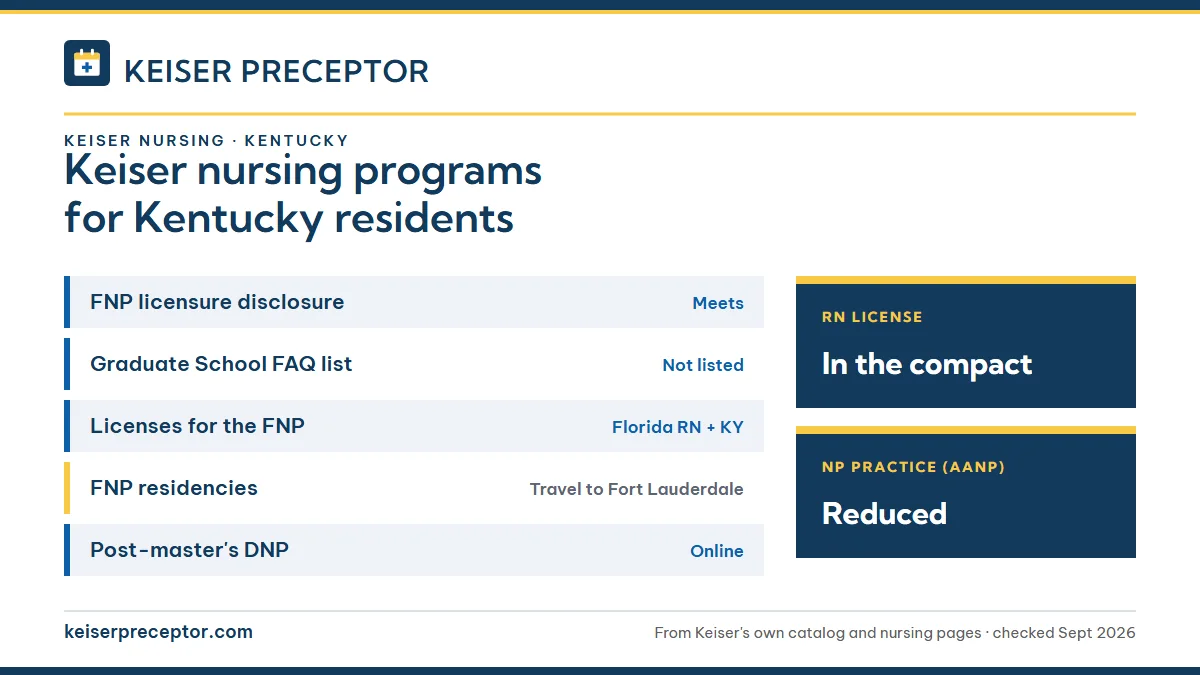
Keiser's programs, seen from Kentucky
Each Keiser program treats a Kentucky address a little differently. Here are the standing and the clinical setting for the four a Kentucky nurse is most likely to weigh.
| Program | From Kentucky? | Where the clinical happens |
|---|---|---|
| MSN FNP (online) | Meets, per the November 2025 FNP disclosure; not on the Graduate School FAQ restriction list | Kentucky sites you secure and Keiser approves; residencies in Fort Lauderdale |
| MSN WHNP (online) | Meets on the WHNP disclosure too | A women's health site you select; three campus weekends |
| Post-master's DNP | RN license in your state of residence; leads to no license | Mentored practice hours; a Flagship campus residency |
| RN to BSN (online) | RN license where you live | NUR4636 community hours in a setting the Department Chair approves |
Both Keiser lists leave Kentucky open, which is not true of every neighbor: Tennessee sits on the disclosure's does-not-meet list. Admission is still Keiser's call, so confirm eligibility with the Graduate School before you apply. The out-of-state student guide compares the two lists in full.
What the Kentucky Board of Nursing asks of an out-of-state program
Nothing up front. The KBN says it does not approve nursing programs based outside Kentucky, and those programs need no KBN sign-off even if a clinical placement is all they do in the state. Its approval work covers prelicensure programs that originate in Kentucky; its jurisdiction reaches graduate programs that lead to licensure, such as an FNP, but not RN to BSN programs.
The board's attention goes to who supervises you. Nursing faculty who oversee online APRN students at Kentucky clinical sites, or who precept them there, need active, unencumbered Kentucky licensure at both the RN and APRN level; faculty whose home is in another compact state can manage with the APRN license alone. Kentucky law (KRS 314.101) also exempts nurses licensed elsewhere who rotate through a Kentucky clinical site, provided their school takes part in SARA. Keiser is a SARA member, and its own admission rule still asks for a license where you train.
On licensing across borders, Kentucky put the Nurse Licensure Compact into effect in January 2018, which means a multistate license held by a Kentucky resident also works in other compact states.
Reduced practice and the Kentucky preceptor pool
AANP counts Kentucky among its reduced-practice states. Prescribing NPs keep written agreements with a physician for both controlled and non-controlled prescriptions, barring a board exemption, and new licensees face limits on practice setting in their first year. Where NPs and physicians share agreements, a single practice can offer two kinds of preceptor: Keiser prefers a master's-prepared FNP and also accepts MDs and DOs, as the preceptor requirements guide explains.
Kentucky's population gathers in a few metro areas: Louisville (about 1.1 million people on the Kentucky side), Lexington-Fayette, the Kentucky slice of greater Cincinnati and Bowling Green. Large systems range from UK HealthCare, tied to the University of Kentucky, to St. Elizabeth Healthcare, Norton Healthcare, the Baptist Health system and UofL Health. Read those names as a map of possibilities, not sites holding a Keiser agreement; every site signs its own affiliation agreement with Keiser before your hours count.
Your steps from a Kentucky address
- Hold both licenses.Keiser wants an active, unrestricted Florida RN license alongside the license that covers your Kentucky site. The Florida license guide explains why.
- Get Kentucky's answer in writing.Out-of-state applicants give Keiser written verification that their home state permits the rotations and NP licensure after graduation. Keiser also warns that hours logged outside Florida may not qualify for licensure in some states, so ask the KBN about hours from a Florida program.
- Start the search early.FNP students find their own preceptors, and Keiser asks for plans about three months before a practicum begins.
- Budget for Fort Lauderdale.The FNP brings you to campus twice: three days during
NUR671, the advanced assessment course, and two during the final Integration Practicum, with travel and lodging on you.
Why Kentucky students hand us the search
We are specialists in Keiser's clinical process, and we take on the part Keiser assigns to you: finding a Kentucky preceptor and site that fit your practicum course, in person and near home. We gather what the Preceptor/Mentor Information Form and the Clinical Coordinator's review call for, from the preceptor's CV and license to the site contact and your clinical dates, so the packet is ready about three months ahead.
Approval belongs to Keiser's faculty, and the file in front of them is whole on its first pass. Should a preceptor back out mid-plan, a replacement search starts at once. The steps are laid out under how it works, and the request form below starts yours.
Questions Keiser students ask
Does the Kentucky Board of Nursing have to approve Keiser before I start clinicals?
No approval step applies. In the KBN's published position, a program headquartered in another state requires no approval from it, even when a clinical placement is its only activity in Kentucky. Its rules focus instead on the people supervising you, who must carry Kentucky licenses when they oversee online APRN students at Kentucky sites.
Does a Kentucky nurse preceptor need a Kentucky APRN license?
Under KBN guidance, nursing faculty who oversee or precept online APRN students at a Kentucky clinical site need active, unencumbered Kentucky RN and APRN licenses, and faculty living in another compact state need only the APRN one. Keiser separately requires every preceptor to hold an active unencumbered license and have at least a year of experience.
Can I use my Kentucky multistate license for Keiser's FNP?
Your Kentucky license covers the clinical-state half of Keiser's rule. For the other half, Keiser's catalog names an active, unrestricted Florida RN license, so ask the Graduate School's admissions team how it treats a multistate license before you apply for anything new.
How many trips to Florida does Keiser's FNP need from Kentucky?
Two. The first residency runs three days, Friday to Sunday, in the advanced assessment course, and the second runs two days, Saturday and Sunday, during the final Integration Practicum. Both are in person in Fort Lauderdale, at your own travel cost. The residency guide covers planning around them.
Related pages
Last checked 2026-09-25
We check these pages against Keiser's catalogs, graduate nursing manuals, licensure disclosures and program pages. Your course, the Clinical Coordinator and the 2026-27 Graduate Catalog have the final word.
Keiser asks you to find your own preceptor. Let us run that search.
Tell us your Keiser program, your next practicum and where you live. We find preceptors who fit the course and prepare the CV, license and site details your Preceptor/Mentor Information Form needs, about three months ahead.
- Preceptors matched to the course: adult and older-adult primary care for
NUR602AandNUR603A, pediatrics forNUR604A, women's health forNUR605A - CV, license, certification and site contact ready for Keiser's review and the affiliation agreement
- Across Florida, from Miami to Jacksonville, and in the other states where you are licensed
Start your placement plan
Your program, city and next practicum term is all we need to begin.