Keiser's FNP for Ohio nurses: licenses, law and preceptors
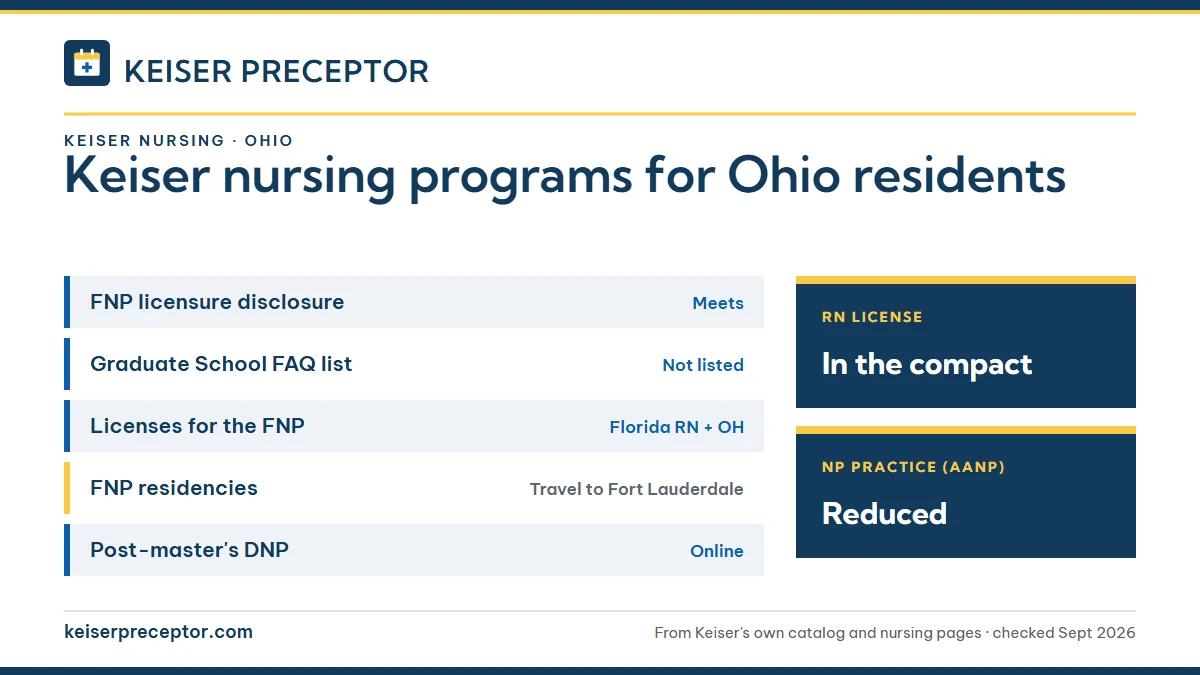
Ohio is open ground for Keiser's FNP: the licensure disclosure updated in November 2025 lists it under 'meets', and nothing in the Graduate School FAQ restricts Ohio residents. Ohio's Board expects nothing on file from a school outside the state. What it does have is a statutory exemption for APRN students, and its wording shapes which preceptor you should look for first.
Get your placement plan
Tell us your Keiser program and where you live. A placement advisor replies with the preceptor and site options that fit your Keiser course.
Keiser programs through an Ohio lens
Keiser's lists guide rather than admit; the Graduate School has the final word on eligibility.
| Keiser program | From Ohio? | Where the clinical hours go |
|---|---|---|
| MSN FNP | Meets on the disclosure; not on the FAQ list | Ohio practices you secure; Keiser approves the preceptor and signs a site agreement first |
| MSN WHNP | Meets on the WHNP disclosure | A women's health site you choose, cleared before registration |
| Post-master's DNP | Confirm with Keiser; RN license where you live | Organizational and community settings with mentors |
| RN to BSN (online) | Confirm with Keiser; RN license where you live | NUR4636, a 45-hour community clinical |
No Board filing, one supervision condition
Nothing in the Ohio Revised Code asks a nursing school from another state to apply to, or even inform, the Ohio Board before its students train here. Section 4723.32 works the other way, exempting the students themselves from licensure during training. Division (A) covers pre-licensure students in programs approved by a board belonging to NCSBN. Division (F) covers APRN students whose program readies them for a recognized national certification exam or grants a qualifying graduate degree, provided they train under the program's authority with an APRN supervising them as faculty, teaching assistant or preceptor.
One layer went unexamined in the research: whether Ohio's higher-education department must authorize Keiser. Put that to the Graduate School. Keiser, for its part, cautions in a 2023 policy that some boards may not credit hours earned outside Florida, so make sure Ohio's does; the out-of-state guide describes the step.
Choosing a preceptor with Ohio's wording in mind
Keiser's own rules are broad: a master's-prepared FNP is preferred, a limited number of adult, pediatric, psychiatric and women's health NPs are allowed, and MDs and DOs are acceptable too. Ohio's exemption, though, names an APRN as the person supervising the student.
So in Ohio, lead with NP preceptors. When the best offer comes from a physician, check with Keiser how that fits the state's wording before anyone signs. The preceptor requirements page lists everything else Keiser checks, from license status to a year of experience.
Your licenses, and NP practice after graduation
For Ohio residents, Keiser's NP admission rests on two licenses, the Florida RN license it requires of everyone, active and unrestricted, and an RN license good in Ohio. You also send written proof that Ohio permits the clinical training and would grant you NP licensure afterward. The Florida license page goes further.
Ohio's compact membership took effect on the first day of 2023, and the Board keeps count of nurses practicing in Ohio under licenses from other compact states. No APRN Compact law exists here. Ohio lands in AANP's reduced-practice category: NPs sign a standard care arrangement that lasts their whole career, the other party being a collaborating physician or podiatrist, and Schedule II prescribing is restricted in some settings.
Four metros, several borders
Ohio spreads its population across more large metro areas than most states, which widens the search.
| Metro area | Ohio population |
|---|---|
| Columbus | about 2.24 million |
| Cleveland | about 2.17 million |
| Cincinnati (Ohio part) | about 1.76 million |
| Dayton-Kettering-Beavercreek | about 827,000 |
Cleveland Clinic and University Hospitals both operate in Cleveland. Bon Secours Mercy Health is the Cincinnati-based name, while Columbus has OhioHealth and Ohio State's Wexner Medical Center. These tell you where practices concentrate, not where Keiser holds agreements. The research found no Ohio preceptor incentive.
The Cincinnati metro reaches into Kentucky and Indiana, so a site across the river brings a second clinical state into your licensing, even though neither requires program approval for graduate students. To the east, Keiser's disclosure puts Pennsylvania in its 'does not meet' column. Ohio-side practices keep things simplest.
The Fort Lauderdale weekends
The FNP's two residencies happen in person in Fort Lauderdale: a Friday-to-Sunday stay during Advanced Assessment and a Saturday-Sunday stay in the final Integration Practicum. WHNP students go three times. A one-time residency fee appears in the catalog, and you book your own travel. The residency guide explains how to keep hours on pace around them.
Why Ohio students choose us
Ohio has plenty of NPs, and finding the right one for a specific Keiser course, on your days, about three months out, is exactly the work we do. We search Columbus, Cleveland, Cincinnati, Dayton and the smaller markets with Ohio's APRN wording in mind, build the preceptor's side of the Preceptor/Mentor Information Form, from CV to board certification, and pin down the site and agreement contact. Keiser's faculty approve; they receive a complete packet. When a preceptor pulls out partway, the replacement search is ours too.
Questions Keiser students ask
Does Ohio require Keiser to register before my FNP clinicals?
No. Ohio's Board takes no application or notice from programs based elsewhere; state law simply exempts APRN students from licensure while they train under their program with an APRN supervising. Whether Ohio's higher-education department must separately authorize Keiser went unchecked in research, so ask the Graduate School.
Can a physician precept my Keiser clinicals in Ohio?
Keiser accepts MDs and DOs, but Ohio's student exemption describes an APRN as the supervisor. An NP preceptor matches both, so start there. If a physician is your best option, ask Keiser how that fits Ohio law before you submit the Preceptor/Mentor Information Form.
Is Ohio on either of Keiser's restriction lists?
Neither names Ohio as a problem. The FNP disclosure shows Ohio as 'meets', and Ohio is missing from the FAQ's list of restricted states for graduate nursing. Because the lists contradict each other elsewhere, a direct word from the Graduate School is still the safest check.
I live near Cincinnati. Can my clinicals be in northern Kentucky?
Keiser's disclosure lists Kentucky as meeting requirements, and Kentucky asks no approval of outside programs. You would still need a license covering Kentucky, and Keiser's Clinical Coordinator would clear the site. Staying on the Ohio side keeps one state in play.
Related pages
Last checked 2026-09-25
We check these pages against Keiser's catalogs, graduate nursing manuals, licensure disclosures and program pages. Your course, the Clinical Coordinator and the 2026-27 Graduate Catalog have the final word.
Keiser asks you to find your own preceptor. Let us run that search.
Tell us your Keiser program, your next practicum and where you live. We find preceptors who fit the course and prepare the CV, license and site details your Preceptor/Mentor Information Form needs, about three months ahead.
- Preceptors matched to the course: adult and older-adult primary care for
NUR602AandNUR603A, pediatrics forNUR604A, women's health forNUR605A - CV, license, certification and site contact ready for Keiser's review and the affiliation agreement
- Across Florida, from Miami to Jacksonville, and in the other states where you are licensed
Start your placement plan
Your program, city and next practicum term is all we need to begin.