Keiser from Minnesota: the NP route, the DNP and the RN to BSN
Keiser flags Minnesota twice. Its November 2025 FNP disclosure says the FNP falls short of Minnesota's educational requirements for licensure, the WHNP disclosure agrees, and the Graduate School FAQ restricts Minnesota for the MSN, FNP and DNP. That leaves two Keiser programs worth a conversation: the DNP for nurses who already hold a master's, and the RN to BSN taught online.
Get your placement plan
Tell us your Keiser program and where you live. A placement advisor replies with the preceptor and site options that fit your Keiser course.
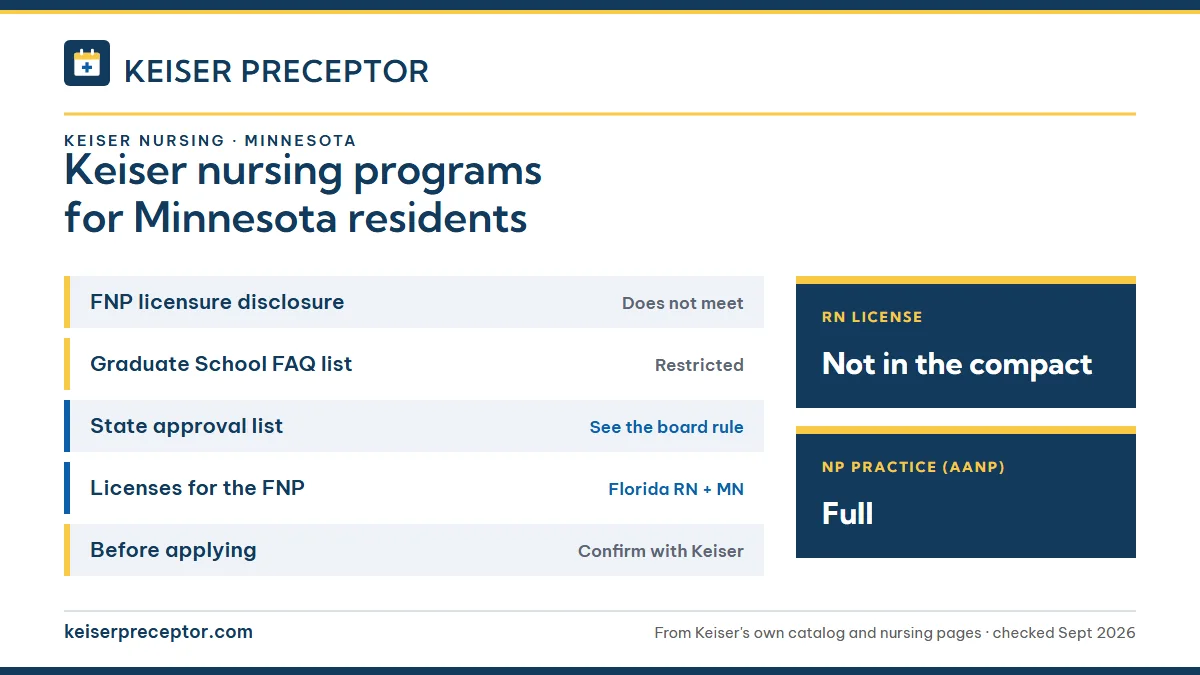
Minnesota at a glance, program by program
Each row summarizes Keiser's published documents as of September 2026, not an admission decision.
| Program | Open from Minnesota? | Where the clinical work happens |
|---|---|---|
| MSN Family Nurse Practitioner | Unlikely: "does not meet" on the disclosure, restricted on the FAQ | Practicums in the licensed state you name, with two Fort Lauderdale residencies |
| MSN Women's Health NP | Unlikely: its disclosure also says "does not meet" | Four clinical courses and three on-campus residency weekends |
| Post-master's DNP | Confirm: no disclosure, though the FAQ heading includes the DNP | Organizational and community practice courses with a mentor, and the Flagship campus residency |
| RN to BSN (online) | Confirm: absent from both lists | NUR4636, 45 clinical hours with a preceptor you secure |
Two Keiser lists, one verdict
Here Keiser's disclosure and FAQ actually agree, which is unusual. It sits in the disclosure's thirteen-state "does not meet" group for both NP programs and in the FAQ's list of MSN, FNP and DNP restrictions. The disclosures guide compares every state on both lists.
Even without the lists, Keiser's entry rules shape the question. FNP and WHNP students carry an unrestricted Florida RN license and a second license for the clinical state, and applicants living outside Florida must show, in writing, that their home state lets them rotate there and become licensed NPs afterward. Given Minnesota's double listing, raise it with Keiser before collecting that letter. The Florida RN license guide walks through the rule.
Minnesota's board rules for students from other states
Minnesota runs no separate approval track for schools based elsewhere. Its Board of Nursing approves programs held in Minnesota, and the rule interpreting the student exemption (Minn. R. 6305.0300) accepts a U.S. or Canadian program carrying approval from its home state or province. The condition lands on the teaching side: the person supervising the student needs Minnesota RN licensure and a current registration.
Statute adds a second carve-out. A nurse licensed in another state who comes to Minnesota as a student in a structured program, a graduate degree for instance, may practice within it without a Minnesota license (Minn. Stat. 148.271). Keiser still wants a license where the clinicals run, and Minnesota never joined the Nurse Licensure Compact and had no joining bill in play, so in practice a Minnesota license is the one to hold.
Individual sites may go further. Mayo Clinic sets its own terms for NP students: its program needs an affiliation agreement signed with the school; the student needs Minnesota licensure that is unencumbered and currently registered, plus clearance through a background study run by Minnesota's Department of Human Services; and faculty of record must hold RN or APRN licensure in the rotation's state.
Practice law, training funds and health systems
AANP lists Minnesota as full practice, though a new NP first puts in at least 2,080 hours of collaborative practice alongside a physician or APRN. No APRN Compact law has passed.
MERC, the state health department's fund for Medical Education and Research Costs, partly repays training sites for accredited clinical education, NP, CNS, CRNA and nurse-midwife students included. The money goes to sites, not to preceptors, and it counts only when the school and the site are both in Minnesota, so students of out-of-state programs fall outside it.
The state's large systems include Mayo Clinic, HealthPartners, M Health Fairview, Essentia Health and Allina Health. The big population centers are the Twin Cities metro of Minneapolis-St. Paul-Bloomington, then Rochester, Duluth and St. Cloud. They show the terrain only; none is named here as a Keiser partner.
What a Minnesota nurse can still raise with Keiser
The DNP leads to no license, has no disclosure, and wants an RN license from where you live. The FAQ lists the DNP beside the MSN and FNP, though, so ask the Graduate School whether Minnesota's entry covers the doctorate.
Keiser's RN to BSN is online and missing from both lists. Its one clinical, NUR4636, runs 45 hours in a community setting you choose, subject to the Department Chair's approval; confirm your eligibility with Keiser first.
Next door, Iowa reads "meets" and stays off the FAQ list, North Dakota reads "meets" yet sits on it, and South Dakota reads "does not meet." Keiser goes by your home state, so these matter chiefly if you relocate. The Iowa and North Dakota guides cover both.
Why Minnesota nurses call us first
When Keiser confirms which program is open to you, our placement desk runs the preceptor search around your address and your Keiser course. We gather what Keiser's reviewers read, from the preceptor's resume and credentials to who signs for the site and your clinical calendar, so the Clinical Coordinator sees a complete file on the first pass. The form below gets it started.
Questions Keiser students ask
Can I do Keiser's online FNP from Minnesota?
Keiser's documents point against it. The November 2025 FNP disclosure says the program does not meet Minnesota's educational requirements, and the Graduate School FAQ restricts Minnesota for the MSN, FNP and DNP. If a move is in your plans, the Graduate School can tell you whether a different route opens.
Does Minnesota make my school get board approval before clinicals?
No separate approval step surfaced in research. Minnesota accepts a program approved by its own state for the student exemption, but the instructor supervising you needs a Minnesota RN license with current registration, and large sites such as Mayo Clinic add their own conditions.
Does a compact license work in Minnesota?
It is not, and no compact bill was pending when this guide was researched. A multistate license issued elsewhere gives no privilege to work in Minnesota, so precepted hours there call for a Minnesota RN license, which also matches Keiser's clinical-state rule.
Do Minnesota preceptors receive state incentives?
Minnesota's MERC program helps fund training sites rather than paying preceptors, and it counts only teaching programs located in Minnesota. Students from programs based in other states therefore sit outside it. Research found no other state incentive for preceptors.
Related pages
Last checked 2026-09-25
We check these pages against Keiser's catalogs, graduate nursing manuals, licensure disclosures and program pages. Your course, the Clinical Coordinator and the 2026-27 Graduate Catalog have the final word.
Keiser asks you to find your own preceptor. Let us run that search.
Tell us your Keiser program, your next practicum and where you live. We find preceptors who fit the course and prepare the CV, license and site details your Preceptor/Mentor Information Form needs, about three months ahead.
- Preceptors matched to the course: adult and older-adult primary care for
NUR602AandNUR603A, pediatrics forNUR604A, women's health forNUR605A - CV, license, certification and site contact ready for Keiser's review and the affiliation agreement
- Across Florida, from Miami to Jacksonville, and in the other states where you are licensed
Start your placement plan
Your program, city and next practicum term is all we need to begin.