Wisconsin nurses weighing a Keiser degree
On paper, Wisconsin looks open: Keiser's November 2025 FNP licensure disclosure counts it among the states where the program meets educational requirements, and the Graduate School FAQ restriction list leaves it off. The catch is Wisconsin's own rule. Nursing schools from other states need the Wisconsin Board of Nursing's approval before their students train here, and Keiser's name was absent from the DSPS roster of approved outside schools, last revised in early August 2026.
Get your placement plan
Tell us your Keiser program and where you live. A placement advisor replies with the preceptor and site options that fit your Keiser course.
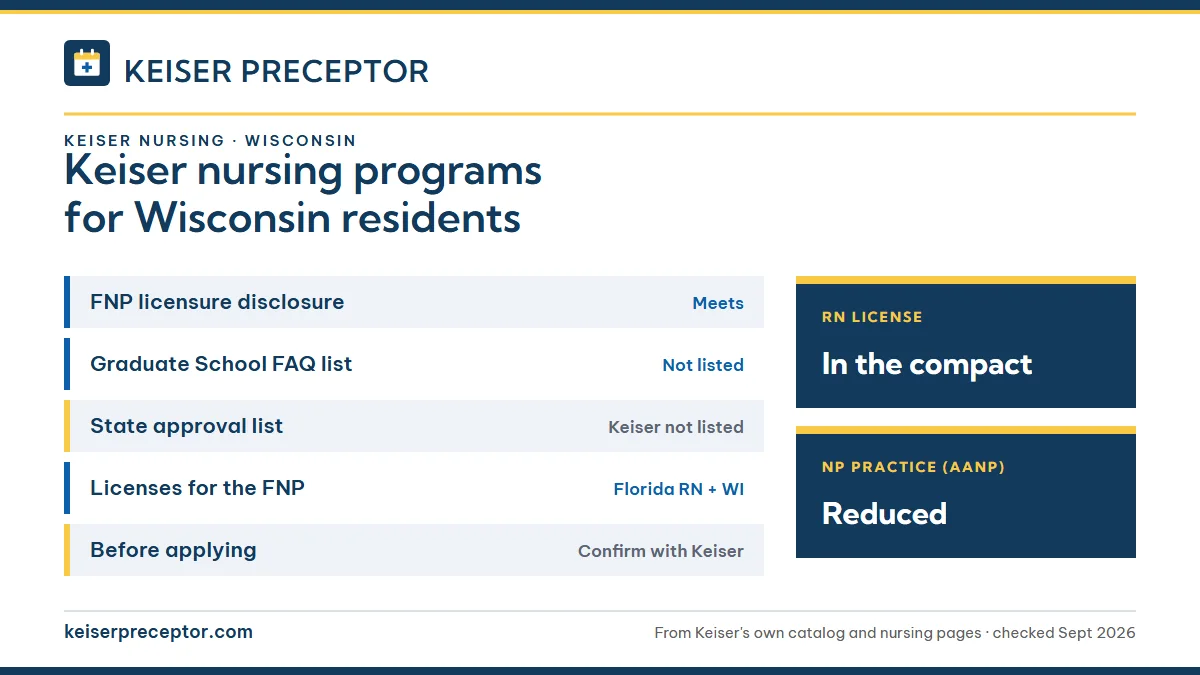
Keiser says meets; Wisconsin says approve first
Keiser's two lists agree on Wisconsin: neither names it as a problem. The difficulty sits with the Department of Safety and Professional Services, where the Board of Nursing vets schools headquartered elsewhere before they may place students. When that roster was checked on September 25, 2026, Keiser was not on it.
That gap matters more than either Keiser document for a student planning Wisconsin clinicals. Keiser's own FNP terms still apply on top: online coursework with two Fort Lauderdale residencies, an active Florida RN license plus a Wisconsin license or privilege, and a preceptor you find, approved by Keiser under an affiliation agreement. Compare Keiser's lists on our licensure disclosures page, then ask the Graduate School how it handles Wisconsin placements.
Each program against Wisconsin's approval rule
| Program | Keiser's lists | Wisconsin approval issue |
|---|---|---|
| MSN FNP | Disclosure: meets. FAQ: not listed | Graduate programs need Board approval; Keiser not on the roster |
| MSN WHNP | Disclosure: meets | Same approval question as the FNP |
| Post-master's DNP | No disclosure; not on the FAQ list | The rule reaches graduate-level programs; ask Keiser |
| RN to BSN, online | Graduate lists do not apply | Post-licensure bachelor's programs are covered; ask Keiser |
In every row the practical question is the same: can Keiser place you in a Wisconsin clinical setting? Because Wisconsin's rule reaches post-licensure and graduate programs alike, even Keiser's online RN to BSN and its post-master's DNP, which each ask for an RN license from your home state, need that answer. Confirm with Keiser before you enroll, and see the out-of-state FNP guide for the written home-state verification Keiser asks of applicants outside Florida.
How Wisconsin's approval rule works
The requirement traces to section N 1.06 of Wisconsin's administrative code, put into practice through DSPS form 3067-OEE (the April 2026 revision). Its reach is wide: practical nursing and RN education at the associate, bachelor's and graduate level, with post-licensure bachelor's degrees named expressly. An approved school stays approved by filing a self-evaluation report on a companion form, 3069OEE.
Wisconsin also regulates who stands beside a student. Whoever teaches or precepts clinical work inside Wisconsin must be licensed by Wisconsin or practice here on a recognized privilege. NCSBN dates Wisconsin's Nurse Licensure Compact implementation to January 2018, so for RNs a multistate license can supply that privilege.
A Wisconsin preceptor's yes, and even Keiser's approval of that preceptor, would not replace the Board's approval of the school.
Wisconsin's new APRN license
The state's new APRN statute, 2025 Wisconsin Act 17, began on the first day of September 2026. DSPS now licenses APRNs by role, and there are four: NP, CRNA, CNS and CNM. Existing APNP holders were moved over to the APRN credential. Independent practice, meaning no collaborating physician, needs its own application and a Board yes.
AANP's Wisconsin profile still shows reduced practice, anchored in physician collaboration, while flagging the Modernization Act's September 2026 start. Wisconsin has not enacted the APRN Compact, and research found no state preceptor incentive.
Milwaukee, Madison, Green Bay and Appleton
Wisconsin's large systems include UW Health, Froedtert ThedaCare Health, Ascension Wisconsin, Aspirus Health, and Advocate Health's Aurora Health Care. Milwaukee-Waukesha is the largest metro, then Madison, Green Bay and Appleton. The Wisconsin Department of Health Services leads public health. These are examples of settings where NP students train, not places with Keiser agreements.
Why Wisconsin nurses choose us
Once Keiser confirms that it can place you in Wisconsin, we run the search from Milwaukee to Green Bay: a preceptor matched to your practicum, a site ready for Keiser's affiliation agreement, and every item the Preceptor/Mentor Information Form asks for, assembled about three months before the term. If plans change mid-course, we find the replacement. See how our process works.
Questions Keiser students ask
Is Keiser approved by the Wisconsin Board of Nursing?
Keiser's name was missing from the DSPS roster of approved outside nursing schools (the August 3, 2026 revision) when it was checked on September 25, 2026. Wisconsin demands that approval of schools from other states at the associate, bachelor's and graduate levels, so ask Keiser's Graduate School how it handles Wisconsin clinicals.
Why does Keiser's disclosure say Wisconsin meets if the state wants approval?
The disclosure addresses whether Keiser's FNP curriculum lines up with Wisconsin's educational requirements for licensure. Wisconsin's approval rule is a separate question about whether an out-of-state school may place students in the state. A program can satisfy the first and still need the second.
Must my Wisconsin preceptor be licensed in Wisconsin?
Wisconsin looks for a Wisconsin license, or a recognized privilege to practice in the state, from anyone who precepts or teaches a clinical there. On top of that, Keiser wants its preceptors to hold an active, unencumbered license and at least twelve months of experience; see our preceptor requirements page.
What does Wisconsin's 2026 APRN law change for nurse practitioners?
Since Act 17 began in September 2026, DSPS licenses APRNs by role, NPs included, and has moved former APNP holders onto the APRN credential. Practicing without a collaborating physician is possible through a separate application that the Board must approve.
Related pages
Last checked 2026-09-25
We check these pages against Keiser's catalogs, graduate nursing manuals, licensure disclosures and program pages. Your course, the Clinical Coordinator and the 2026-27 Graduate Catalog have the final word.
Keiser asks you to find your own preceptor. Let us run that search.
Tell us your Keiser program, your next practicum and where you live. We find preceptors who fit the course and prepare the CV, license and site details your Preceptor/Mentor Information Form needs, about three months ahead.
- Preceptors matched to the course: adult and older-adult primary care for
NUR602AandNUR603A, pediatrics forNUR604A, women's health forNUR605A - CV, license, certification and site contact ready for Keiser's review and the affiliation agreement
- Across Florida, from Miami to Jacksonville, and in the other states where you are licensed
Start your placement plan
Your program, city and next practicum term is all we need to begin.