Montana, Keiser's online FNP, and where your clinicals can run
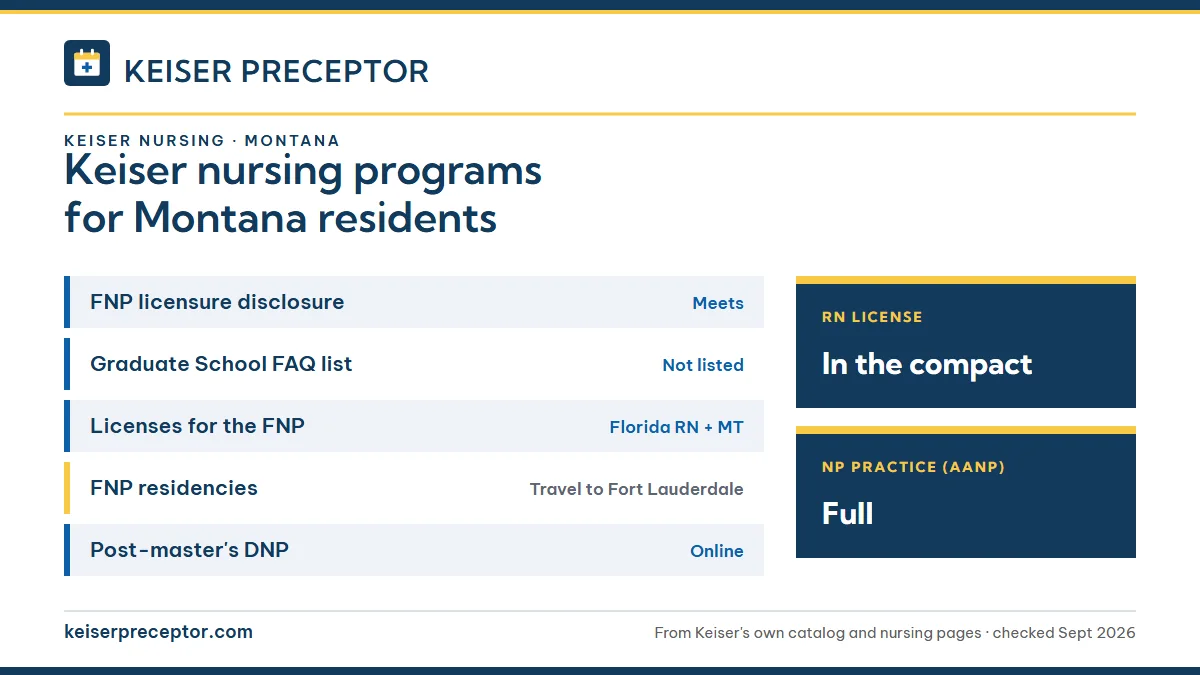
Both of Keiser's state lists leave Montana open: the FNP disclosure of November 2025 rates it as meeting requirements, and it is missing from the Graduate School's list of restricted states. Montana's board sets no approval step for graduate clinicals, so the planning centers on licensing, a preceptor search across long distances, and two trips to Fort Lauderdale.
Get your placement plan
Tell us your Keiser program and where you live. A placement advisor replies with the preceptor and site options that fit your Keiser course.
Keiser programs from a Montana address
Four Keiser programs are within reach of a Montana nurse. Their standing and clinical arrangements differ as follows.
| Keiser program | From Montana? | Clinical location |
|---|---|---|
| MSN FNP, online | Meets on the November 2025 FNP disclosure; off the Graduate School FAQ list | Montana sites you secure, approved and contracted by Keiser; two residencies in Fort Lauderdale |
| MSN WHNP, online | Meets on the WHNP disclosure | Women's health sites you select; three on-campus weekends |
| DNP, post-master's | Needs an RN license in your state of residence; leads to no license | Practice hours with a mentor and a Keiser faculty mentor; one Flagship residency |
| RN to BSN, online | Needs an RN license where you live | NUR4636: 45 hours in a community setting you choose |
Keiser alone decides admission, so confirm eligibility with its Graduate School before applying. Montana's neighbors are another story: Idaho and North Dakota both appear among the FAQ's restricted states, South Dakota is a does-not-meet state on the disclosure, and only Wyoming is open on both, as the Wyoming guide explains.
What the Montana board says about graduate clinicals
Montana regulates visiting schools through ARM 24.159.608, but that rule concerns prelicensure education: a school from another state preparing students for a first license needs a green light from the board, or from its executive director, before putting a student in a Montana clinical setting. Graduate study is a different matter. Per the board's published FAQ, an NP program or an RN to BSN program from elsewhere may run Montana clinicals with no approval at all.
The FAQ does attach a string. Students in those clinicals care for Montana patients, so the school must satisfy itself that each student's license is active and good for Montana. Compact membership helps here: Montana began operating under the compact in January 2018, and the board's RN licensing page confirms that a nurse working on another compact state's multistate privilege can skip the Montana license. For out-of-state instructors, a Montana license is required only of those delivering hands-on patient care, not of faculty whose role is advising the student and preceptor.
On top of Montana's rules sit Keiser's: an active, unrestricted Florida RN license plus your clinical-state license, a written statement that Montana will let you train there and later license you as an NP, and Keiser's warning that some state boards may reject hours logged outside Florida. The Florida license guide covers the first item.
Full practice in a state of long drives
Montana sits in AANP's full-practice group: NPs there are regulated by the nursing board alone and need no physician agreement. An independent FNP clinic therefore makes a promising site, since a master's-prepared FNP is the preceptor Keiser ranks first. Keiser's usual conditions still apply: the license must be active and unencumbered, the preceptor needs at least twelve months in practice, and they must work at that clinic.
Distance is the real constraint. Keiser itself warns on its FNP page that the preceptor hunt runs longer in some places than others, and Montana's metros are small. Keiser's faculty visit each site once a semester, either in person or virtually, which suits a clinic far from any city; the site visits guide explains the format.
Billings, Bozeman, Missoula, Helena: where a practicum could run
Billings leads the state's metros with just under 194,000 residents, Bozeman and Missoula sit near 129,000 each, and Helena follows. Hospital systems include Benefis Health System; Billings Clinic, which now operates together with Logan Health; St. Vincent Regional Hospital in Billings, part of Intermountain Health; and Providence Montana, whose Missoula hospital is Providence St. Patrick. They sketch where a practicum could happen and carry no Keiser agreement; any site would sign one with Keiser before your hours begin.
Keiser's Graduate School FAQ also points students toward smaller settings: public health departments offering primary care, walk-in clinics inside retail stores, doctors' offices, urgent care centers and fast-track units. In a rural state, those deserve as much attention as the hospital systems.
Why Montana students choose us
Across Montana's distances, a thorough search makes the difference, and thoroughness is what we deliver for Keiser students. We look for an FNP or other qualified preceptor within driving range of home whose practice fits your practicum course, then prepare what the Preceptor/Mentor Information Form asks about that preceptor (resume, licensure, board certification) along with the site contact and your schedule, all settled roughly three months ahead of the term. The decision stays with Keiser's faculty and Program Director, who work from a complete file, and if a preceptor bows out, we find the successor.
Questions Keiser students ask
Does Montana require board approval for Keiser's FNP clinicals?
Not for a graduate program. The board's FAQ exempts NP and RN to BSN programs from its approval process, which is written for out-of-state prelicensure schools. What it does expect is that the school checks your license: it must be active and good for Montana, because Montana patients are in your care.
Does my Keiser clinical faculty member need a Montana license?
Only one who treats patients directly. The board's FAQ ties the licensing duty for out-of-state faculty to hands-on care, so faculty whose role is advising you and your preceptor fall outside it. Keiser's faculty site visits happen once a semester, on site or virtually.
How often will I travel to Florida from Montana?
Two times for the FNP. The first visit runs Friday through Sunday and belongs to NUR671, the advanced assessment course; the second covers one weekend inside the closing Integration Practicum. Attendance in Fort Lauderdale is in person, the cost of getting there and staying is yours, and the second trip lands in your heaviest clinical term. See the residency guide.
Could I do clinicals in Idaho or the Dakotas?
Check with Keiser before planning it. Idaho and North Dakota both appear among the Graduate School FAQ's restricted states, and South Dakota is on the FNP disclosure's does-not-meet list. Wyoming is open on both lists but expects post-licensure programs to send its board written notice ahead of any clinicals.
Related pages
Last checked 2026-09-25
We check these pages against Keiser's catalogs, graduate nursing manuals, licensure disclosures and program pages. Your course, the Clinical Coordinator and the 2026-27 Graduate Catalog have the final word.
Keiser asks you to find your own preceptor. Let us run that search.
Tell us your Keiser program, your next practicum and where you live. We find preceptors who fit the course and prepare the CV, license and site details your Preceptor/Mentor Information Form needs, about three months ahead.
- Preceptors matched to the course: adult and older-adult primary care for
NUR602AandNUR603A, pediatrics forNUR604A, women's health forNUR605A - CV, license, certification and site contact ready for Keiser's review and the affiliation agreement
- Across Florida, from Miami to Jacksonville, and in the other states where you are licensed
Start your placement plan
Your program, city and next practicum term is all we need to begin.