Keiser's Traditional BSN: eight semesters and five Care Management courses
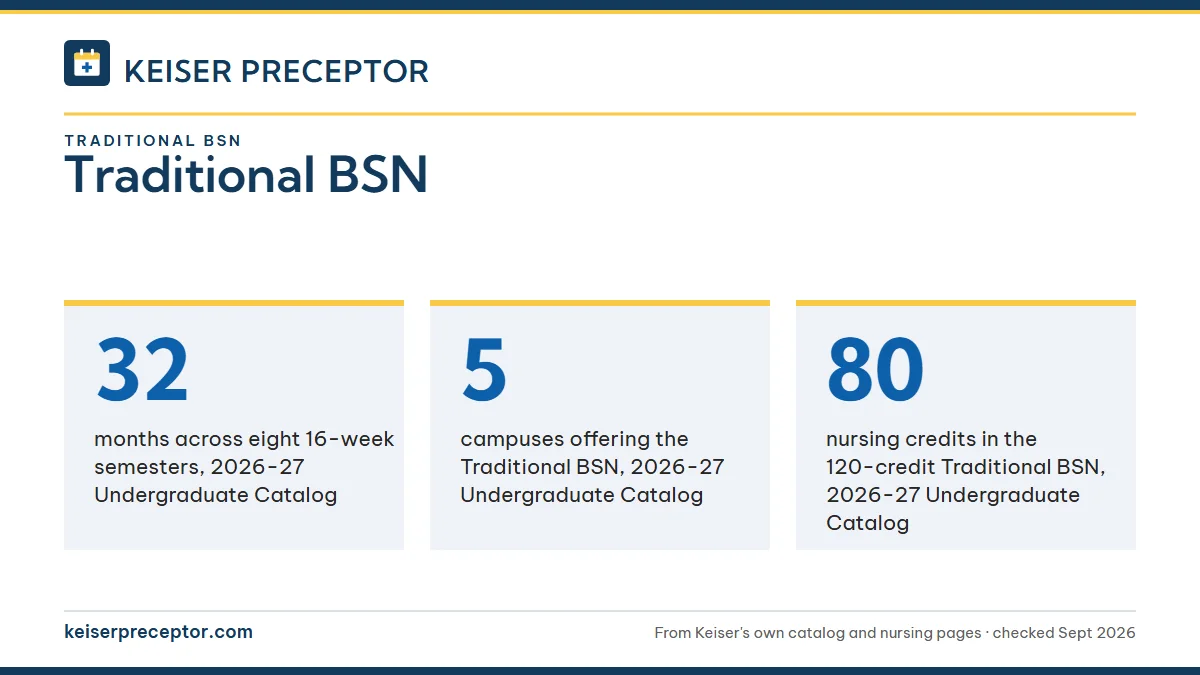
Keiser's Traditional BSN is the route into nursing for students starting from high school, running about 32 months across eight 16-week semesters at five Florida campuses. Clinical rotations are built into five Care Management courses that the program arranges, including a fourth course set in ICU, emergency or trauma care that the accelerated tracks do not list.
Get your placement plan
Tell us your Keiser program and where you live. A placement advisor replies with the preceptor and site options that fit your Keiser course.
Who the Traditional BSN suits
This is the program for a student who wants a bachelor's in nursing as a first degree. Admission weighs your high school GPA, which needs to be 3.0, together with college-level prerequisites, so it suits applicants who have not yet built up a large block of college credit.
It moves at a steadier pace than Keiser's other BSN routes, and that time shows in the clinical sequence: five Care Management courses rather than four. Students holding a prior bachelor's should compare the Accelerated BSN, and those with 60 or more recent credits the FastTrack BSN.
Admission checklist
The Undergraduate Catalog and the program page set out the same requirements:
- A high school GPA of 3.0
- Science prerequisite grades of B or higher
- A 3.0 GPA across general education and prerequisite courses
- Wonderlic SLE: a minimum score of 23
- A drug screen, background check and admissions interview
The 120 credits divide into 40 of general education and 80 of nursing, the largest nursing share among Keiser's three BSN routes. Inside the nursing core, every course calls for a B or better before the next one opens, and a cumulative GPA of 3.0 or higher keeps you in good standing.
Eight semesters, on a calendar set by your campus
The catalog spreads the program over eight 16-week semesters, about 32 months in all. Some campuses run those semesters in Fall and Spring only and others year round, so the same program can finish at different points in the year depending on where you enroll. Ask your campus which pattern it follows before you plan work, housing or summers.
The Traditional BSN is offered at five campuses in the 2026-27 catalog: the Flagship campus in West Palm Beach, Fort Myers, Pembroke Pines, Port St. Lucie and Sarasota. That is a much shorter list than the 13 locations for Keiser's accelerated tracks, so check the campus first if the Traditional pace is what you want.
The program page's summary also shows 4-week terms and one class at a time, while the catalog speaks in 16-week semesters. Your campus schedule is what reconciles the two.
Care Management I to V: how the clinicals are arranged
Clinical rotations are part of the program, and Keiser arranges them within each Care Management course. You attend the settings your campus schedules, and the sequence widens as you go, from a first clinical course after admission to the BSN program through to critical care.
| Course | Credits | What the catalog says |
|---|---|---|
| NUR2032C Care Management I | 8 | First course described in a clinical setting; requires admission to the BSN program |
| NUR3219C Care Management II | 9 | Clinical setting |
| NUR3411C Care Management III | 8 | Children, families, mothers and newborns |
| NUR3767C Care Management IV | 7 in the outline, 8 in the description | ICU, emergency or trauma; Traditional BSN only |
| NUR4764C Care Management V | 8 in the outline, 9 in the description | Traditional BSN only |
Care Management I is listed as the fourth nursing course in the Traditional outline, though the catalog does not describe that order as a required sequence. Keiser publishes no clinical hour figures for any of these courses.
Comparing the BSN tracks by length alone misses a real difference: only the Traditional BSN lists Care Management IV and V, while the ABSN and FastTrack carry Advanced Care Management in their place.
Questions to put to your campus before you enroll
Several details that shape daily life in the Traditional BSN are not in Keiser's public documents. Your campus nursing office can answer them, and the answers are worth having before you commit to a location.
- Does this campus run the nursing semesters Fall and Spring only, or year round?
- In which semester does Care Management I usually start for a new student here?
- How many clinical hours does each Care Management course carry, and on which days do rotations fall?
- Which facilities host rotations for this campus, and how far apart are they?
- How do the program page's 4-week terms fit with the catalog's 16-week semesters?
Write the answers down and compare campuses side by side; with only five locations offering this program, the choice of campus decides much of your schedule for nearly three years.
Using 32 months to plan the next step
A longer program gives you room to plan. If you already expect to become a nurse practitioner, Keiser's route is the MSN FNP, and it expects a current, unrestricted Florida RN license plus a full year or more of recent patient care before it will admit you.
The FNP turns the BSN's clinical model around. Instead of rotations set up by the program, FNP students bring Keiser a preceptor and site for each of five 8-week practicums, and Keiser approves every one, with a signed affiliation agreement required before the first hour. The clinical placement process guide walks through that path, and the first clinical course guide shows when the first FNP practicum can begin.
Your BSN years are a good time to learn which settings suit you. Rotations from pediatrics and maternity through critical care give you a feel for where you want to practice, and that knowledge shapes the preceptor search you run later.
Where our placement desk fits
Traditional BSN rotations come through the program, and that is how they are meant to run. Our service begins where Keiser hands the search to the student: the FNP's practicums, the DNP's clinical practice courses, or a precepted placement your campus invites you to suggest. Whichever it is, we find a preceptor near where you live who suits the Keiser course, prepare the resume, license and site contact Keiser reviews, and have the file ready about three months ahead.
If graduation is a year or two away and graduate study is on your list, contact us to set out a timeline that starts your first search at the right moment.
Questions Keiser students ask
Is Keiser's Traditional BSN offered year round?
It depends on the campus. The 2026-27 Undergraduate Catalog says the Traditional BSN runs either Fall and Spring only or year round, by campus, across eight 16-week semesters and about 32 months. Eight semesters take longer on the calendar when summers are off, so confirm your campus's pattern and expected graduation date during admission.
Do Traditional BSN students find their own clinical placements?
No. The Care Management rotations are part of the program, and Keiser arranges them. Finding your own preceptor enters Keiser's model later, most fully in the MSN FNP, where the student proposes every site and clinician, Keiser approves each one, and a signed affiliation agreement has to be in place before hours begin.
What is Care Management IV in Keiser's BSN?
NUR3767C Care Management IV is a Traditional BSN clinical course centered on ICU, emergency or trauma care. The catalog outline gives it 7 credits and its course description 8, one of several credit mismatches in the pre-licensure listings. The Accelerated and FastTrack tracks follow a different path through Advanced Care Management.
What grades do Traditional BSN students need?
Nursing core courses each need at least a B, and your overall GPA has to sit at 3.0 or above for you to continue, per the 2026-27 Undergraduate Catalog. Science prerequisites also need a B before admission. Keiser's undergraduate repeat rules vary by course type, so ask your campus how repeating a nursing core course would affect your semester plan.
Can I go from Keiser's Traditional BSN straight into the FNP?
Not straight away. Before the MSN FNP will consider you, you need the finished BSN with a 3.0 GPA overall, an unrestricted Florida RN license that is currently active, a year or more spent recently in direct patient care, a clear Level 2 background check and an interview. The sequence runs from the BSN to RN licensure, then a year or more of practice, then the FNP application.
Related pages
Last checked 2026-09-25
We check these pages against Keiser's catalogs, graduate nursing manuals, licensure disclosures and program pages. Your course, the Clinical Coordinator and the 2026-27 Graduate Catalog have the final word.
Keiser asks you to find your own preceptor. Let us run that search.
Tell us your Keiser program, your next practicum and where you live. We find preceptors who fit the course and prepare the CV, license and site details your Preceptor/Mentor Information Form needs, about three months ahead.
- Preceptors matched to the course: adult and older-adult primary care for
NUR602AandNUR603A, pediatrics forNUR604A, women's health forNUR605A - CV, license, certification and site contact ready for Keiser's review and the affiliation agreement
- Across Florida, from Miami to Jacksonville, and in the other states where you are licensed
Start your placement plan
Your program, city and next practicum term is all we need to begin.