Keiser's Accelerated BSN for students who already hold a degree
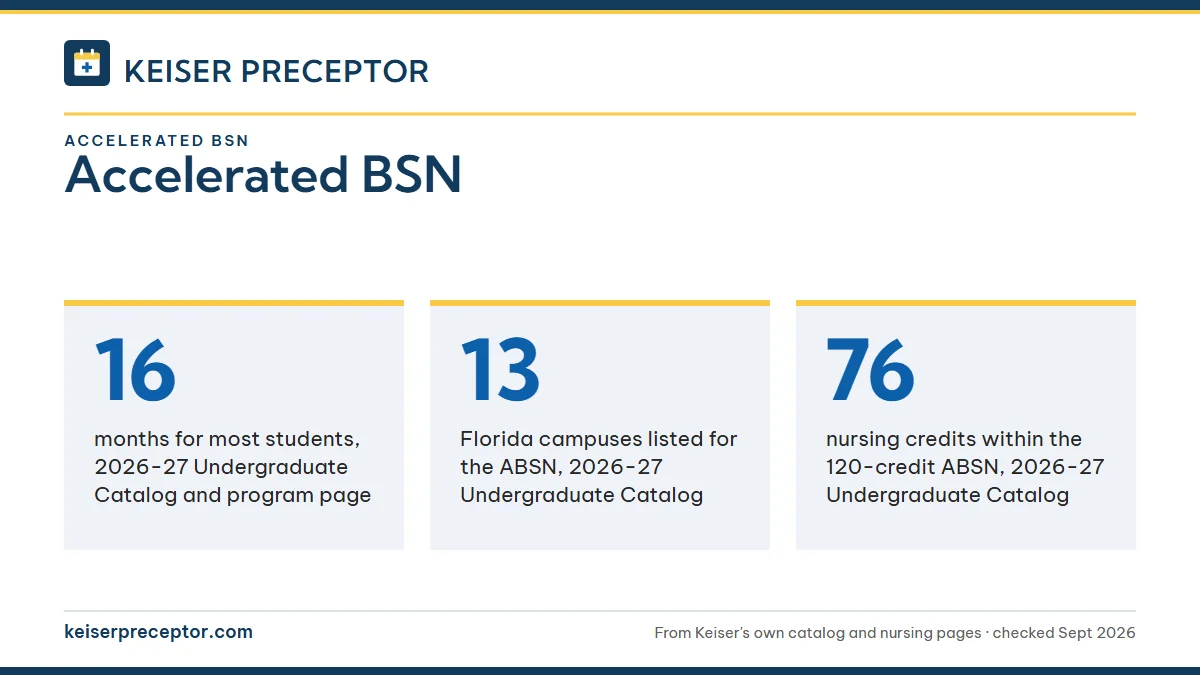
Keiser's Accelerated BSN turns a bachelor's or graduate degree in another field into a nursing degree, and most students finish in about 16 months. Your clinical rotations are arranged for you through a dedicated placement team, so the preceptor search that defines Keiser's FNP program is still years away. This guide covers who qualifies, the schedule, the campuses, the clinical courses and where outside placement help fits.
Get your placement plan
Tell us your Keiser program and where you live. A placement advisor replies with the preceptor and site options that fit your Keiser course.
Who the ABSN is built for
The ABSN is Keiser's second-degree route into registered nursing. You qualify with a bachelor's or graduate degree outside nursing and a GPA of 3.0, measured overall or across your last 60 credits. It is a pre-licensure program, meaning it prepares you for RN licensure rather than building on a license you already hold.
Your earlier degree is what lets the program move quickly. In the 2026-27 Undergraduate Catalog, the 120 credits break into 22 prerequisite credits, a 22-credit block and 76 credits of nursing, and both the catalog and the program page say most students finish in 16 months. The catalog also prints an overall length of about 40 months, so ask admissions how your transcript maps onto both figures.
If you have college credit but no finished bachelor's, the FastTrack BSN is the closer match. Starting from high school, look at the Traditional BSN.
Admission requirements
Keiser's ABSN list is short but strict, and two of its items have to be finished before you are accepted.
- A non-nursing bachelor's or graduate degree with a 3.0 GPA, overall or in your last 60 credits
DEP2004andSTA2023completed with a C or better before acceptance- A B or better in Anatomy and Physiology I and II, General Chemistry with lab, and Microbiology before nursing courses begin
- A Wonderlic SLE score of 23, taken on site at a Keiser campus
- A background check, a drug screen and an interview
Those science grades set the tone for what follows. Inside the program, each nursing core course needs a B or better to proceed and your cumulative GPA has to stay at 3.0 or higher, so the discipline that earned the prerequisites is the discipline the nursing sequence expects.
The background check and drug screen come at the admission stage. The undergraduate fee list also carries a TOPS Clinical background charge for pre-licensure students, and Keiser's public documents do not name the vendor behind TOPS, so ask your campus how and when to complete it.
The schedule, described two ways
Keiser describes the ABSN's rhythm twice. The catalog places the nursing core in four 16-week semesters after prerequisites, on a year-round schedule. The program page shows 4-week terms taken one class at a time. How an 8- to 13-credit Care Management course sits inside a 4-week term is not explained publicly, so the schedule your campus issues is the one to plan around.
A year-round schedule means the nursing core keeps going through the summer semester. Plan work hours, family commitments and travel for a continuous pace from the first nursing course to the last.
The program page also mentions two campus residencies that build hands-on clinical skills. The catalog does not list them, so ask your campus when they fall and how they connect to your courses.
How ABSN clinicals are arranged
Keiser arranges the ABSN's clinical rotations. The program page is direct about it: "A dedicated clinical placement services team assists students with finding and securing clinical placements." Your part is to meet each course's clinical schedule rather than to approach sites yourself.
| Course | Credits | Catalog note |
|---|---|---|
| NUR2032C Care Management I | 8 | First course described in a clinical setting; requires admission to the BSN program |
| NUR3219C Care Management II | 9 | Clinical setting |
| NUR3411C Care Management III | 8 | Children, families, mothers and newborns |
| NUR4717C Advanced Care Management | 11 in the outline, 13 in the description | ABSN and FastTrack only |
Keiser does not publish clinical hour totals for these courses. Care Management I is the fifth nursing course in the ABSN outline, although the catalog stops short of calling the outline a required order.
The arrangement carries responsibilities on your side too. Should a clinical site ask for a student to be withdrawn, the catalog says the program will attempt to place that student at a different site; a second removal ends reassignment and the course is recorded as failed. Conduct on rotation protects your place in the sequence as much as your grades do.
The 180-hour precepted practicum in the catalog
One course in the catalog deserves attention. The course descriptions include NUR4950C Professional Role Development and Transition to Practice, labeled for the ABSN, with "a supervised practicum of 180 hours" under a preceptor and faculty direction. It does not appear in the current ABSN outline.
If your campus schedules it or another precepted capstone, ask early how the preceptor is chosen and whether students can suggest a unit or specialty. A final precepted experience in the area you hope to work in is one of the few points in a program-arranged sequence where your own preference can shape the placement.
Where our placement desk fits for ABSN students
Keiser's placement services team is the right channel for your ABSN rotations. Our work fits around it at two moments. The first is any precepted capstone where your campus invites you to propose a setting or preceptor: we find a willing RN preceptor near you in the specialty you are aiming for and prepare the license and contact details faculty will want, so your proposal arrives complete.
The second comes after you are licensed and working. Keiser's MSN FNP admits nurses with a BSN, an active Florida RN license and at least a year of recent patient care, and from then on the search for every preceptor across five practicums belongs to the student. The finding your own preceptor guide explains that model, and how it works shows what we take on for FNP students, from the first search to a replacement if a preceptor drops.
Questions Keiser students ask
Does Keiser place Accelerated BSN students in clinicals?
Yes. The ABSN program page describes a dedicated clinical placement services team that helps students find and secure clinical placements, and the Care Management courses run in the clinical settings the program arranges. Your campus nursing office is the place to ask about specific sites, clinical days and how rotations are assigned.
How long is Keiser's Accelerated BSN?
Most students finish in about 16 months, according to both the 2026-27 Undergraduate Catalog and the program page. The catalog also lists an overall length of about 40 months and describes the nursing core as four 16-week semesters on a year-round schedule after prerequisites. Your prior coursework decides how much of the prerequisite stage you still need.
What Wonderlic score does the Keiser ABSN require?
A Wonderlic SLE score of 23, taken on site at a Keiser campus. Admission also calls for a 3.0 GPA on your earlier degree, DEP2004 and STA2023 at C or better before acceptance, science prerequisites at B or better before nursing courses, a background check, a drug screen and an interview.
Which Keiser campuses offer the Accelerated BSN?
The 2026-27 catalog and the program page list 13: Fort Lauderdale, Fort Myers, Lakeland, Melbourne, Miami, Naples, Orlando, Pembroke Pines, Port St. Lucie, Sarasota, Tallahassee, Tampa and West Palm Beach. The ABSN is taught on campus, so choose a location you can reach for classes, residencies and clinical days.
Do ABSN students need a preceptor?
Not for the Care Management rotations, which the program arranges. The catalog does describe NUR4950C, a 180-hour supervised practicum under a preceptor, although it is not in the current ABSN outline. Ask your campus whether a precepted capstone is part of your plan and how its preceptor is chosen.
What can I study at Keiser after the Accelerated BSN?
The BSN qualifies you to apply to Keiser's Graduate School once you hold an RN license. The generalist MSN involves no practicum, while the MSN FNP asks for an active Florida RN license and a year or more of recent patient care, then has students locate their own preceptors for five practicums, each approved by Keiser.
Related pages
Last checked 2026-09-25
We check these pages against Keiser's catalogs, graduate nursing manuals, licensure disclosures and program pages. Your course, the Clinical Coordinator and the 2026-27 Graduate Catalog have the final word.
Keiser asks you to find your own preceptor. Let us run that search.
Tell us your Keiser program, your next practicum and where you live. We find preceptors who fit the course and prepare the CV, license and site details your Preceptor/Mentor Information Form needs, about three months ahead.
- Preceptors matched to the course: adult and older-adult primary care for
NUR602AandNUR603A, pediatrics forNUR604A, women's health forNUR605A - CV, license, certification and site contact ready for Keiser's review and the affiliation agreement
- Across Florida, from Miami to Jacksonville, and in the other states where you are licensed
Start your placement plan
Your program, city and next practicum term is all we need to begin.