Immunizations and health requirements for Keiser clinicals
Before your first Keiser practicum, a health care provider documents your health on Keiser's own assessment form, and your file shows TB testing, a set list of immunizations, current CPR and active health insurance. For a working nurse most of it already exists somewhere; the deadlines and the yearly renewals are where Keiser students slip.
Get your placement plan
Tell us your Keiser program and where you live. A placement advisor replies with the preceptor and site options that fit your Keiser course.
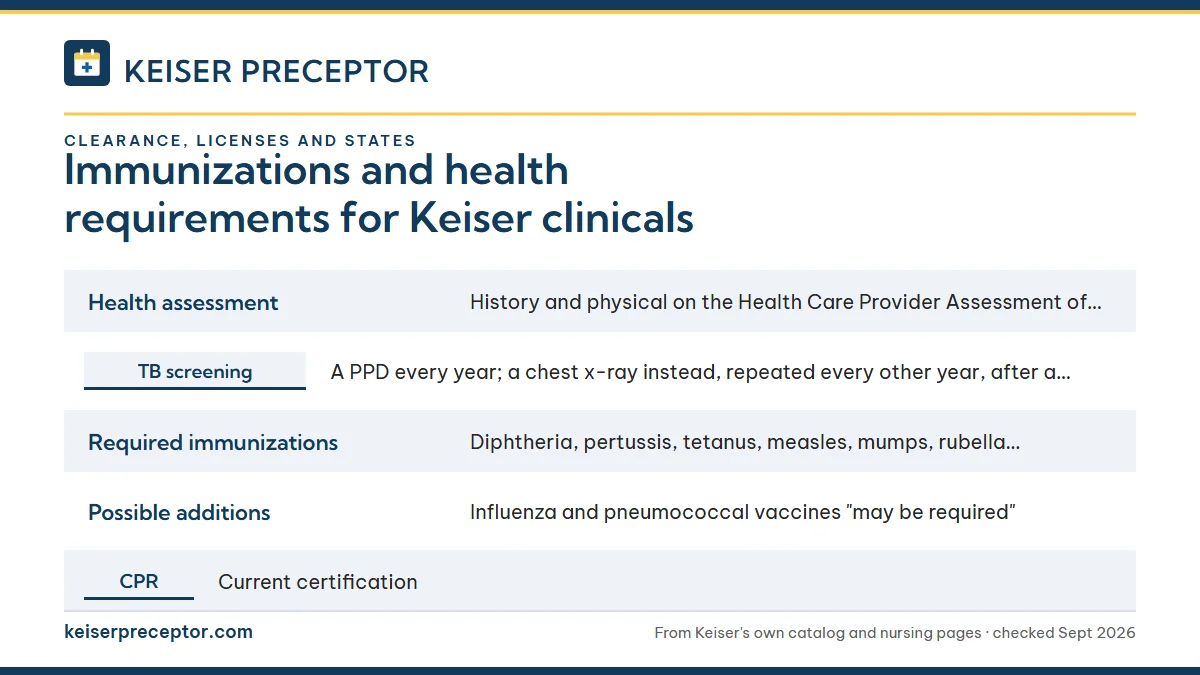
Keiser's health file at a glance
Keiser spreads its health rules across two documents. The 2023 Graduate Nursing Program Policy and Procedure Manual holds the Student Health and Wellness policy, and the older Graduate Nursing Programs Clinical Manual adds CPR. The FNP program page then sums it up as medical clearance and immunizations, due before the first practicum.
| Item | What Keiser asks | Where it is written |
|---|---|---|
| Health assessment | History and physical on the Health Care Provider Assessment of Student's Health Status, completed 4-6 weeks before the first Nursing Core Course | 2023 policy manual |
| TB screening | A PPD every year; a chest x-ray instead, repeated every other year, after a positive result or BCG | 2023 policy manual |
| Required immunizations | Diphtheria, pertussis, tetanus, measles, mumps, rubella, varicella, polio and hepatitis B, with a signed declination accepted for hepatitis B | 2023 policy manual |
| Possible additions | Influenza and pneumococcal vaccines "may be required" | 2023 policy manual |
| CPR | Current certification | Clinical Manual |
| Health insurance | Active medical coverage for the length of the clinical program | 2023 policy manual |
The health assessment form and its deadline
Keiser names the form precisely: the Health Care Provider Assessment of Student's Health Status. A health care provider completes a history and physical on it, and the policy manual sets the timing at four to six weeks before your first Nursing Core Course. That is earlier than many students expect, since the form is due well before any clinical hour is logged.
The form itself is not posted publicly. Keiser's policy manual says its forms live on the Keiser University Academic Portal, so you download the current version there once you are enrolled, or ask your Clinical Coordinator where it sits. Book the provider visit with the deadline in view: a visit that falls inside the four-to-six-week window leaves no margin if the provider's office is slow to return paperwork.
Keep a copy of the completed form. The FNP program page lists medical clearance among the conditions for starting a practicum, and a site's onboarding may ask to see proof of the same health status Keiser reviewed.
TB testing runs on a yearly clock
Keiser requires a PPD every year. If you have had a positive result before, or received the BCG vaccine, a chest x-ray takes the place of the skin test and is repeated every other year rather than annually.
The yearly cycle is what trips up FNP students. The Graduate Catalog describes the program as about 28 months long, and the program page says 21 to 24, so either way your practicums span more than one TB cycle. A PPD done at admission can lapse before NUR605A or NUR691A, and a lapsed test can hold up a clinical day even with every other approval in place.
Mark the renewal date on the same calendar that holds your term starts, and renew before a practicum rather than during it. The FNP practicum course guide shows how the five practicums line up across the program, which tells you roughly when each renewal will fall.
A PPD that expires mid-term can pause your clinical hours. Renew it before the practicum starts, not after a site flags it.
Immunizations, the declination, and the "may be required" vaccines
Keiser's required list covers diphtheria, pertussis, tetanus, measles, mumps, rubella, varicella, polio and hepatitis B. For hepatitis B, the policy accepts a signed declination in place of the vaccine series. Gather dated records for each item before your first practicum approaches; records scattered across old employers take time to collect.
Influenza and pneumococcal vaccines sit in a separate category: Keiser's policy says they "may be required." That wording leaves room for a requirement to be added, so ask the Clinical Coordinator and your site whether either applies during your practicum dates. A practicum that runs through flu season is the obvious case to check.
Your file follows you from site to site. Each of the five FNP practicums can bring a new practice, and each site's onboarding may ask to see the same immunization records, so keep a clean, complete set you can send without starting over.
CPR and health insurance
Keiser's graduate Clinical Manual requires current CPR certification. Check the expiry date against your last practicum, not your first, since a card that lapses before NUR691A finishes creates a gap at the worst moment. Keiser's public documents do not name a particular course provider for graduate students, so ask your Clinical Coordinator if you are unsure your card qualifies.
Health insurance is a separate requirement. Keiser's policy says students "must provide evidence of active medical health insurance coverage throughout clinical programs," which means the coverage has to stay in force from the first practicum to the last, not only on the day you submit proof.
Medical coverage is also distinct from the professional liability insurance Keiser asks graduate students to carry. Both belong in your clearance file, and the liability insurance page explains that second policy and its employer waiver.
Where health sits in your clinical timeline
Health clearance is one track among several that have to finish before your first clinical hour. The others are the screening checks on the background check page, the affiliation agreement, the Preceptor/Mentor Information Form and Keiser's approval of your preceptor. The first clinical course guide lists what must be complete before NUR602A, and the placement process overview shows how the tracks run side by side.
Keiser's campus programs handle health requirements through their own admission steps. The Undergraduate Catalog lists a drug screen and immunizations before ASN students move into the nursing courses, and the pre-licensure BSN programs arrange their clinicals for students. If you are in one of those programs, follow your campus instructions.
For graduate students, the practical rule is simple: build the health file once, completely, and then keep it current for every practicum after.
How we keep your health file in step with your placement
While we secure a preceptor and site near where you live, we also ask that site what health documentation it expects from you. That way the site's onboarding and Keiser's own list are on one checklist, next to your preceptor's CV, license and certification details and the agreement contact for the Clinical Coordinator's review.
We also look at dates. If your PPD, CPR card or insurance will lapse inside the practicum we are lining up, you hear about it while there is still time to renew. And if a site's list runs longer than Keiser's, you learn that before the term opens, not on your first morning there. Keiser's clinical faculty still make the approval call, and your file reaches them already whole. Start with the form below.
Questions Keiser students ask
What is Keiser's Health Care Provider Assessment of Student's Health Status?
It is the form Keiser uses to record a student's history and physical. A health care provider completes it, and Keiser's 2023 graduate policy manual says it is due four to six weeks before the first Nursing Core Course. The current version is posted on the Keiser University Academic Portal rather than the public website.
How often do Keiser nursing students need a TB test?
Every year. Keiser's policy calls for an annual PPD. Students who have tested positive before, or who received BCG, provide a chest x-ray instead, and that x-ray is repeated every other year. Plan renewals around your practicums so a lapsed test never interrupts clinical hours.
Can I decline the hepatitis B vaccine for Keiser clinicals?
Keiser's policy lists hepatitis B among the required immunizations and accepts a signed declination for it. A clinical site may have its own view, so if you plan to sign the declination, ask the site during onboarding whether it accepts one before your first day there.
Is a flu shot required for Keiser clinicals?
Keiser's policy says influenza and pneumococcal vaccines may be required, rather than listing them as always required. Whether one applies depends on your program's current instructions and your site, so ask the Clinical Coordinator and the site, especially if your practicum runs through the fall and winter.
Does Keiser require nursing students to have health insurance?
Yes. Keiser's graduate policy manual says students must show evidence of active medical health insurance throughout their clinical programs. That is separate from the professional liability insurance Keiser also asks for, so your clearance file needs proof of both, kept current across every practicum.
Related pages
Last checked 2026-09-25
We check these pages against Keiser's catalogs, graduate nursing manuals, licensure disclosures and program pages. Your course, the Clinical Coordinator and the 2026-27 Graduate Catalog have the final word.
Keiser asks you to find your own preceptor. Let us run that search.
Tell us your Keiser program, your next practicum and where you live. We find preceptors who fit the course and prepare the CV, license and site details your Preceptor/Mentor Information Form needs, about three months ahead.
- Preceptors matched to the course: adult and older-adult primary care for
NUR602AandNUR603A, pediatrics forNUR604A, women's health forNUR605A - CV, license, certification and site contact ready for Keiser's review and the affiliation agreement
- Across Florida, from Miami to Jacksonville, and in the other states where you are licensed
Start your placement plan
Your program, city and next practicum term is all we need to begin.